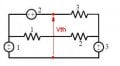
I have no way of telling if this is right or wrong because you are using currents, namely i_1 and i_2, that you have not defined. So I know neither what branch they are for or what direction they are defined in. Yes, I could reverse engineer your work, but I should haven't to. Yes, I could take a really good guess, but engineering is not about guessing.
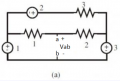
You need to annotate your diagrams so that all of your terms are defined. Noticed when I asked if you could find Vab I didn't make you guess what I meant. I not only labeled Nodes 'a' and 'b', but I explicitly indicated both the location and the polarity of Vab on the diagram.
Also, you need to track your units properly. Saying
Va = 3 - i_1·2
is meaningless because 'Va' is a voltage while '3' is just a number and 'i_1·2' is a current. How this should be expressed is
Va = 3V - i_1·2Ω
Now you have a voltage on the left being equal to the sum of two voltages on the right.
That's true, but I supposed it was not necessary to open a program and indicate the current and the direction of it. Believe me that I know how to do that, I just mentioned the results.
In other words, it's not worth your time to properly communicate your thoughts to those that you are asking help from and, instead, reasonable to expect them to figure out what you meant.
Consider that I believed it was worth my time to open a program and indicate the voltage and its direction in order to communicate effectively my thoughts to you -- and I'm not the one asking for help.
Believe me that I know how to do that, I just mentioned the results.
In text, you can get the Ω symbol by holding down the Alt key and entering 2-3-4 on the numeric keypad. As near as I can tell, it does need to be on an actual numeric keypad to work. You can also get it by hitting the 'S' button on the tool bar at the top of the edit window and then clicking on the symbol you want. You should also use either the * for multiplication or the · (Alt-250) and not the period (as that gets confused too easily with the decimal point). You can also use parens to make things clear.
With that in mind, your equations are (mostly to make them more readable for me):
Your first equation is wrong. Let's ask a sanity check question. Since i1 is flowing the same direction in both the 1Ω and the 2Ω resistor, does it make sense that the term for one of them would be positive while the term for the other would be negative?
This highlights the importance of having the diagram because I could immediately look at the diagram and look at your equations and know where you've made your mistake. Without the diagram, I might be able to tell that you made a mistake, but I don't know where since I have no idea which one is right and which one is wrong.
Hopefully you are seeing the value to checking your work as you go. Without doing that little check, you condemn yourself to spending lots of time obtaining an answer that is guaranteed to be wrong.
As a good check, if you add these two equations together you get
1V + 2V - i0(3Ω) - 3V = 0
which should be the loop equation going around the outside periphery of the circuit. Is it? If it is, then you have a good change (but no guarantee) that your loop equations are correct (and not that it would have caught the error you made). If it isn't, then you do have a guarantee that you have something wrong. Get in the habit of doing these kinds of checks as a matter of habit and routine.
Can you solve for i0 and i1 ?
Can you, having the values for i0 and i1, find Vab?
Vab=Va-Vb=1V+2/3V = 5/3V
Something is wrong. i0 cannot be 0, but I don't care. I just need to know how to solve the exercise. Please, tell me that. I have made 2 courses of solving circuits, I just need to know how to solve this exercise that I have never seen before. Thanks
But you already solved it ? And why you think that i 0 cannot be equal to 0A ?
Notice that the voltage across 3 ohm resistor is equal to two battery on the left - one battery on the right.
So voltage is equal to (1V +2V) - 3V = 0V. So if there is no voltage across this 3 ohm resistor, the current also is 0A.
I would ask why you think that i0 can't be 0, but there's no point since you don't care. But since you don't care about getting the answer correct, that makes things easy. Just randomly pick an answer and use it. After all, it's almost certainly wrong, but you don't care.
I just need to know how to solve the exercise. Please, tell me that. I have made 2 courses of solving circuits, I just need to know how to solve this exercise that I have never seen before. Thanks
And after you are shown how to solve this exercise, what then? What will you do the next time you've see an exercise that you've never seen before? Expect someone to show you how to solve that? Newsflash: engineering is all about solving problems that you've never seen before and if there were someone available to show you how to solve it, then that person would be getting paid to solve it instead of you. The ability to solve problems that you've never seen before is the primary value that an engineer brings to the table and that people are willing to pay them for.
Maybe you understand me in a wrong way. I'm a spanish speaker and maybe I cannot say what I'm trying to say in english.
Of course I want to have the correct answer, but I will do the calculus in my book. I think that i0 cannot be equal to 0 because I have there a source and a resistor so the current cannot be 0.
I need to know how to go from one circuit to another one. All the calculus to reach that can be done in my book by myself, but I don't know what is the name of the theory or the steps that I have to follow to arrive to the correct answer.
I hope you can understand me in a correct way Thanks!!
The name of the theory is Thevenin and Norton equivalent circuits, which you said that you know.
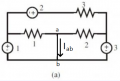
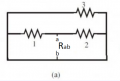
I am trying to walk you through the process of finding the Norton equivalent circuit but it is like pulling teeth. Find the two things asked for in Post #18 (Iab and Rab) and we will almost be there.

 Facebook
 Google
 GitHub
 Linkedin