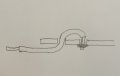
Frayed hookup wire issue

Thread Starter

mxabeles

Joined Apr 25, 2009
295
Dear AAC community,
I've been soldering for nearly two decades now but I've come across an issue that seems so elementary it's a bit embarrassing. Wondering if anyone has confronted this during their soldering.

Using 22AWG stranded wire, I make connections to my perfboard. Underside of perfboard, my solder joints (knock on wood) are clean, not cold. The problem lies atop the circuit board. Either I'm stripping wire clumsily or not applying solder far enough down to wire insulation but the wires can get so frayed directly between insulation and top of circuit board that they detached if pulled moderately hard.
First solution I can think of is getting automatic stripper. I'm using basic manual stripper.

...Anyone else run into this?
Best,
-M
 

Tonyr1084

Joined Sep 24, 2015
9,744
Haven't run into that personally. My "thinking" is that your perf board may be plated on both sides but not be plated through. If that's the case you may have to apply a bit of solder on top of the board as well.

Give me a few min's and I'll bang out a couple pictures.
 

dl324

Joined Mar 30, 2015
18,238
First solution I can think of is getting automatic stripper. I'm using basic manual stripper.

...Anyone else run into this?
Never. A different wire stripper is unlikely to help unless you're cutting through some strands while removing insulation.

Have you tried twisting and tinning the wire before inserting into the hole? Is there any opportunity for using some sort of strain relief? I'd make sure solder covered as much of the exposed wire. For hobby applications, I don't think a small amount of solder wicking under the insulation would be much of a problem.

Pictures would help.
 

Thread Starter

mxabeles

Joined Apr 25, 2009
295
Thanks for your reply! Yes, I twist and tin as a rule every time. Maybe the hookup wire is cheap? I do order from Jameco, not Amazon. Hmmmm....
 

Tonyr1084

Joined Sep 24, 2015
9,744
Perf boards come in different varieties. Some are just absolutely blank perf boards with no pads at all. Others have copper on just the bottom. Still others are clad both top and bottom but not plated through, while the best are plated through. IF your perf board is not plated through then there's virtually no way to get solder on both sides without soldering both sides manually. With plated through holes when you apply solder it flows throughout the joint. Perhaps this is something like what you're experiencing.

IMAGE REMOVED BECAUSE IT WAS INCORRECT! SEE POST #9

As for your wires breaking when you pull on them, examine your stripped wires for broken strands. If you're nicking strands or breaking them off during the stripping operation then you're weakening your wire. After all, 22 gauge wire is not all that strong. It's been many decades since I've done a pull strength test on wires but I think stranded copper wire doesn't have a whole lot of strength.
 
Last edited:

Tonyr1084

Joined Sep 24, 2015
9,744
Have you tried twisting and tinning the wire before inserting into the hole? Is there any opportunity for using some sort of strain relief? I'd make sure solder covered as much of the exposed wire. For hobby applications, I don't think a small amount of solder wicking under the insulation would be much of a problem.
Excellent suggestion. But your reply came before I posted.

[edit] looking at my drawing I've marked the first hole (left) as being a bare through hole. OOPS! My mistake. That's a single sided pad. A "Bare" through hole has no copper whatsoever.
 

Thread Starter

mxabeles

Joined Apr 25, 2009
295
"Haven't run into that personally. My "thinking" is that your perf board may be plated on both sides but not be plated through. If that's the case you may have to apply a bit of solder on top of the board as well."
Very interesting! The perfboards I bought actually annoy me because the holes are plated (not sure if thats correct term) on top and bottom. You are suggesting I should tin top of hole on board as well as underside? Makes sense . . . Perfboards are tricky, the cheap ones I had another issue where the actual copper on holes underneath would tear off ha.
 

Thread Starter

mxabeles

Joined Apr 25, 2009
295
I'm going to research through plated perf board. I do require using breadboard layout perfboard as it really cuts down on my need to use jumper cables with ICs. If anyone has any links to good through plated, breadboard layout perfboards I'm all for it.
For what it's worth, below is perfboard I'm currently using. Aforementioned issues aside, they are very durable and pads never crack off.
https://www.adafruit.com/product/1606
 

Tonyr1084

Joined Sep 24, 2015
9,744
"Haven't run into that personally. My "thinking" is that your perf board may be plated on both sides but not be plated through. If that's the case you may have to apply a bit of solder on top of the board as well."
Very interesting! The perfboards I bought actually annoy me because the holes are plated (not sure if thats correct term) on top and bottom. You are suggesting I should tin top of hole on board as well as underside? Makes sense . . . Perfboards are tricky, the cheap ones I had another issue where the actual copper on holes underneath would tear off ha.
There's an easier way to quote someone. You can click the "Quote" button bottom right side or you can highlight the section you want to highlight then click the quote that appears at the end of your highlighted section.

Yes, perf boards can be cheaply made. The ones I like the least are the ones that are clad only on the bottom. AND those pads are typically very weak. As for tinning the top pad, do that after you've installed your wire. Be sure to leave one wire diameter length between the insulation and the top clad hole. Not more than two wire diameters, as that has been the norm standard since I first started in electronics inspection. Can I give you a drawing for that? If so just highlight the "Can I give you a drawing" and click Quote. Then in your response click "Insert Quote" (bottom left).
 

Tonyr1084

Joined Sep 24, 2015
9,744
I don't think a small amount of solder wicking under the insulation would be much of a problem.
Wicking, since DL mentioned it, is when solder travels up the wire strands under the insulation. It can become a problem when the wire becomes stiff due to the presence of solder under the insulation. Bending the wire after wicking can crack some of the strands and weaken the joint. As DL said, it shouldn't be much of a problem. Best practice is to have the wires in the orientation expected when they're soldered. That way even if there is a small amount of wicking you're not likely going to be bending the wire. But I still think you may be nicking or cutting strands during your stripping operation.

As for "Different" stripping methods, one way has been to use hot tweezer strippers. It burns or melts through the insulation without nicking any of the wires. It's more expensive and I'll find a link so you can see what I'm talking about.
 

dl324

Joined Mar 30, 2015
18,238
For what it's worth, below is perfboard I'm currently using.
Adafruit says the holes are plated through. When you solder, solder should wick to the top side of the PTH. If you're tinning the wire you might not be getting the pad and wire hot enough, or you're not applying enough solder.

Pictures would help.
 

Tonyr1084

Joined Sep 24, 2015
9,744
Screenshot 2024-09-03 at 9.27.36 AM.png
Yes, the ones you've linked to ARE plated through (or as the blurb says "Thru-Plated"). And the gold plating can be a plus. But I've also seen concerns with gold plating as gold can make the solder brittle. It's called "Gold Imbrittlement". I would prefer a perf board that has been pre-tinned. But even there comes another problem: Tinned with Tin/Lead is easiest to solder but more and more the electronics community is moving away from Tin/Lead (TL) solder and going with Silver Solder (SS). It's better for the environment. Me? I still use a lot of TL, but I also have SS.
 
Last edited:

Ian0

Joined Aug 7, 2020
13,103
Dear AAC community,
I've been soldering for nearly two decades now but I've come across an issue that seems so elementary it's a bit embarrassing. Wondering if anyone has confronted this during their soldering.

Using 22AWG stranded wire, I make connections to my perfboard. Underside of perfboard, my solder joints (knock on wood) are clean, not cold. The problem lies atop the circuit board. Either I'm stripping wire clumsily or not applying solder far enough down to wire insulation but the wires can get so frayed directly between insulation and top of circuit board that they detached if pulled moderately hard.
First solution I can think of is getting automatic stripper. I'm using basic manual stripper.

...Anyone else run into this?
Best,
-M

It's a problem of the metallurgy and it is probably unavoidable.
At a certain point on the wire just above where the soldered area appears to end, an alloy of copper and lead is formed which is very brittle. The wire will easily break at that point if it is repeatedly flexed.
That is why all the safety standards require the wire to be mechanically fixed to the circuit board to which it is soldered (usually by a cable tie) if there is likely to be a hazardous situation should the wire become detached. The Part 1B in Metallurgy of my Electrical Sciences degree was a long time before lead-free solder was invented, so I don't know if the same situation occurs when there is no lead.
 

eetech00

Joined Jun 8, 2013
4,704
Dear AAC community,
I've been soldering for nearly two decades now but I've come across an issue that seems so elementary it's a bit embarrassing. Wondering if anyone has confronted this during their soldering.

Using 22AWG stranded wire, I make connections to my perfboard. Underside of perfboard, my solder joints (knock on wood) are clean, not cold. The problem lies atop the circuit board. Either I'm stripping wire clumsily or not applying solder far enough down to wire insulation but the wires can get so frayed directly between insulation and top of circuit board that they detached if pulled moderately hard.
First solution I can think of is getting automatic stripper. I'm using basic manual stripper.

...Anyone else run into this?
Best,
-M

Stranded wire shouldn't be used for jumpers on perf board. Always use solid conductor wire.
Stranded wire should only be used (if at all) for off-board connections where flexibility is needed, or for attaching lugs/connectors, otherwise, it should be avoided.

Soldering stranded wire to an unused thru hole pad works best if the wire is solder tinned first, then, guided thru the hole and soldered.
When removing and re-soldering stranded wire, first remove the wire by removing the old solder from the pad using a solder wick, or my favorite tool, a solder sucker. When done correctly, the wire will come right out, or maybe with a gentle tug on the wire. Once the wire is removed, remove the remaining solder from the wire hole until a clean thru hole can be seen using a light source. Trim and tin the stranded wire before soldering into the pad.

Always use a low wattage (~40W) soldering iron.....this is key to soldering, not only on perf board, but PCB's as well.

This is easy to do once you've done it a few times...
 

sparky 1

Joined Nov 3, 2018
1,218
Working on circuits with close tolerance less than 1% is an art. I am sorry but yes you knicked the wires.
always better to let the pcb handle high tolerance issues. Frayed multistranded 22 gauge wire does not just fray by itself.
Most circuits will never need every last measely ohm mΩ never the less I tin the end of multistranded wire with a %silver solder.
Today a microscope is a necessity, shrink tubing and nylon wire support that plugs and unplugs are also an advantage.
I get some plastic connectors at car parts. Getting rid of cheap electronic connectors and stepping up is satisfying. Frayed wires
and 0.1 pins is what maker sites demonstrate how to hack an arduino to control vital industrial equipment. Where is the problem ?
 
Last edited:
Top