Flywheeling diode for inductive load with high side MOSFET

Thread Starter

jgrv

Joined Mar 2, 2018
36
Hi,

I need some help deciding if I need a flywheeling diode or not for my design.

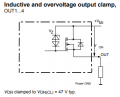
I will be using the high side driver ITS716. Infineon says I don't need a flywheel diode for inductive load, and refers to the image attached. Page 9 in datasheet.
High_side_driver_inductive.PNG

But what I don't understand is, how will the inductive load (24V solenoid, 0.4A, in my case) de-energize when the MOSFET is turned off?

How I see it is that when the MOSFET is turned off, there will be an open loop, and no way for the solenoid to de-energize. Do I need to add a diode in parallell to the load, or is it OK without?

Thanks.
 

crutschow

Joined Mar 14, 2008
38,518
You can add a diode in parallel with the solenoid coil (anode to ground) to suppress the transient..
 
Last edited:

Thread Starter

jgrv

Joined Mar 2, 2018
36
Thanks.

The cheaper solutions seems to be to just use a regular diode instead of adding a zener diode. I don't need fast de-energizing, and space is not a problem.

But for this solution I see many example circuits with a resistor in series with the flywheel diode. Is this really needed when fast de-energizing is not needed?
 

Danko

Joined Nov 22, 2017
2,169
1. In many cases resistor dissipates tens watt.
2. Resistor value depends on inductance, resistance and current of coil.
It is impossible to use fixed value resistor for different applications.
Circuit with zener diode is universal, compact and much cheaper. Ideally match with integrated circuit, but not only :).
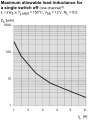
EDIT: For ITS716: DATASHEET
upload_2018-12-4_1-54-8.png
 
Last edited:

crutschow

Joined Mar 14, 2008
38,518
I see many example circuits with a resistor in series with the flywheel diode. Is this really needed when fast de-energizing is not needed?
No.
The resistor speeds up the dissipation of the inductive energy, which reduces the time for the current to decay to zero.
This does increase the inductive kickback voltage, which equals the inductor current times the resistor value.
 

ebp

Joined Feb 8, 2018
2,332
The zener and diode between the gate and the drain of the FET will keep the FET partially enhanced (partially turned on) if the source of the FET is pulled sufficiently negative with respect to the gate.

An inductor "tries" to keep the current through it constant in amplitude and direction. If the FET were abruptly turned off, the inductor would keep the current flowing in the same direction. To do this, the polarity would have be reversed - the end connected to circuit ground becomes positive with respect to the end connected to the FET (think about how a free-wheeling diode would conduct if it were across the inductor or look at how the inverting (non-isolated flyback) switch mode power supply works). The source of the FET would therefore be pulled negative. Because of the zener and the diode the gate is clamped at some maximum voltage negative with respect to the positive supply rail. If the source is pulled sufficiently negative, the gate to source voltage will increase to the point where the FET is enhanced, providing a path for current to continue to flow in the same direction in the inductor, allowing the stored energy to be discharged. Until the energy is dissipated, an equilibrium is maintained where the FET essentially acts as a somewhat crude regulator of the voltage at its source. The energy is dissipated as heat in the FET and in consequence there is a a specification for the maximum inductance (really the energy stored in the inductance). If you have a load with higher inductance, then it is necessary to use additional means to dissipate some of the energy.

Were it not for this circuit, the intrinsic body diode of the FET would avalanche. This can sometimes be used to advantage with discrete FETs but both the current and energy involved must fall within the FETs rating. With very small FETs, as on an IC, the energy handling would likely be too small for "most" inductive loads.
 

Thread Starter

jgrv

Joined Mar 2, 2018
36
Ok, so if I get this correctly:

Once the FET turns off, the polarity of the solenoid switches. So the voltage on the Source of the FET will instantly become -24V (assuming 24V is used to drive the solenoid) and no flywheeling diode parallell to solenoid is used, and the end of the solenoid connected to 0V plane will stay 0V? If a flywheeling diode is used, will the voltage on the source be the negative of the flywhelling diode's forward voltage drop? Because diode voltage drop is always "constant"?
 

Danko

Joined Nov 22, 2017
2,169
With diode, when FET turns off, voltage on source becomes negative, about 0.7V, while current of coil will decay.
Nothing bad.
 
Last edited:

Thread Starter

jgrv

Joined Mar 2, 2018
36
So when FET is switched off, you won't get any voltage spikes on the 0V plane? The coil will just act as a current source?
 

ebp

Joined Feb 8, 2018
2,332
The clamping voltage is nominally 47 V, ±5V, between VBB and Vout (see third from the last line of the tables on page 6 of the datasheet Rev 1.1). This means that if VBB is +24 V, Vout can be allowed to go to as much as -28 V, and in fact a bit more than that since the spec is at only 40 mA and at higher current a larger Vgs will be required and the only way that can be accomplished is by pulling the FET's source (Vout) a bit lower. Because the circuit essentially regulates the voltage across the inductive load, the current will ramp down fairly linearly, and about 70 times as fast as it would with a silicon PN diode across the coil. There will probably be ringing after the inductor is nearly completely discharged.

This is quite different from many high-side FET drivers where the gate is clamped to the source when the FET is turned off so that the FET turns of very quickly.
 

Thread Starter

jgrv

Joined Mar 2, 2018
36
Thanks, ebp, for the explanation of how it works! I get it now :D

I'm not sure what the inductance in the solenoids will be, and the supplier does not have any data on it.

So I'm thinking of going with the safe solution to have a diode accross the solenoid, in case the solenoid inductance is too high, or if the solenoids will be changed in the future. Then we don't have to think about inductance.

What I'm a bit concerned about is that the solenoids are placed some distance away (a few meters, varying distance), and they share the same 0V plane on the PCB as the microcontroller (5V).

Can the kickback from the solenoid cause any voltage spikes on the 0V plane, and potentially harm the MCU, and other 5V circuitry? The 5V is coming from a linear voltage regulator. Maybe the voltage regulator is fast enough so that the MCU won't notice?

Thanks
 
Top