Flyback Converter

ronsimpson

Joined Oct 7, 2019
4,693
The LT1170/1171/1172 should never see a voltage on the SW pin that is above 65 volts. (LR117xHV=75V)
I do not know what the input voltage range is. At mix input voltage the Zener needs to keep the SW voltage below 60 volts.
---------------------------
Different subject: Reversing D6 will reduce the AC loss inside the transformer. If you wind the two secondarys at the same time they will couple better. (+12V and -12V cross regulation)
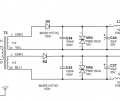
1602605658934.png
 

Thread Starter

fieryfire

Joined Feb 14, 2017
150
The LT1170/1171/1172 should never see a voltage on the SW pin that is above 65 volts. (LR117xHV=75V)
I do not know what the input voltage range is. At mix input voltage the Zener needs to keep the SW voltage below 60 volts.
---------------------------
Different subject: Reversing D6 will reduce the AC loss inside the transformer. If you wind the two secondarys at the same time they will couple better. (+12V and -12V cross regulation)
View attachment 219502
The input voltage is between 20V to 50 V but nominally around 30V. I m think to simply replace the 15V with 100V. I suppose this should fix the problem i have. unless it doesnt interfere with any other part of the circuit.

Im gonna simulate reversing D6 to observe the results in LTSpice. But the idea being is that the lower secondary windings needs to generate the -12V.

Could you explain, what you mean by winding the two secondary windings at the same time? do you mean have just 1 winding of 66T instead of 2 x 33 turns?
 

Thread Starter

fieryfire

Joined Feb 14, 2017
150
But its breakdown value can't be below the normal flyback voltage from the transformer.
I did not understand this completely, the VSW is typically at 75V and the flyback as you calculated is at 18~19V right. so i should choose a diode which has a zener voltage in between 19V and 75V? so as to not clip the VSW signal?
 

ronsimpson

Joined Oct 7, 2019
4,693
The input voltage is between 20V to 50 V but nominally around 30V. I m think to simply replace the 15V with 100V. I suppose this should fix the problem i have. unless it doesnt interfere with any other part of the circuit.
With a 50V input you will "flyback" above the 65V limit. This is the wrong part for you! There is a "HV" version with a 75V MOSFET inside. I think even it is too low voltage for what you want to do.
1602684919883.png
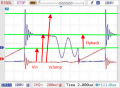
See picture. Vin is 20-50V. Flyback is 19V The Zener is to clamp the ring to under 60V and defiantly under 65V.
The Zener is standing on top of Vin so it takes a little math.
Do not think about 100V zener. Just remove it if you are going down that road.
I am surprised you did not kill the Zener and soon the IC.
 

Thread Starter

fieryfire

Joined Feb 14, 2017
150
Hello Thomson,
With a 50V input you will "flyback" above the 65V limit. This is the wrong part for you! There is a "HV" version with a 75V MOSFET inside. I think even it is too low voltage for what you want to do.
View attachment 219585
See picture. Vin is 20-50V. Flyback is 19V The Zener is to clamp the ring to under 60V and defiantly under 65V.
The Zener is standing on top of Vin so it takes a little math.
Do not think about 100V zener. Just remove it if you are going down that road.
I am surprised you did not kill the Zener and soon the IC.
With a 50V input you will "flyback" above the 65V limit. This is the wrong part for you! There is a "HV" version with a 75V MOSFET inside. I think even it is too low voltage for what you want to do.
View attachment 219585
See picture. Vin is 20-50V. Flyback is 19V The Zener is to clamp the ring to under 60V and defiantly under 65V.
The Zener is standing on top of Vin so it takes a little math.
Do not think about 100V zener. Just remove it if you are going down that road.
I am surprised you did not kill the Zener and soon the IC.
Hello Simpson,

I am indeed using the HV version, which means my VSW should be around 75V.
Are you saying that , if i use a 100V Zener Diode, then i will completely suppress the VSW of making switching impossible?
50V is the maximum(but theoretically in my design its almost impossible, Nominally it will rest at 30V and at the worst case it can fall to 20V.

If my statement above is correct, i should be able to get by with a 25V Zener diode right?

Also, by "clamping the ring" do you mean to reduce the Switching regulator ring? i.e. the flyback being 20V and 75V being the VSW, so if i put the 100V Zener then the circuit would literally kill the 75V VSW? sorry i didnt completely understand this point?
 

crutschow

Joined Mar 14, 2008
38,507
sorry i didnt completely understand this point?
The Zener voltage is on top of (adds to) the supply voltage during the flyback, so the maximum voltage at the VSW terminal will be the supply voltage plus the Zener voltage (and the diode is series with the Zener).
So if the maximum supply voltage is 50V, then the Zener should be no more than about 20V to avoid exceeding 75V at the VSW terminal.
 
Last edited:

ronsimpson

Joined Oct 7, 2019
4,693
then the Zener should be no more than about 20V to avoid exceeding 75V at the VSW terminal.
And the flyback is 20V which heats up the Zener. Normally you want the main body of the flyback to not turn on the Zener. Just the ring should hit the Zener clamp.
Part of the problem is using a 75 volt power transistor at 75V.
 

Thread Starter

fieryfire

Joined Feb 14, 2017
150
The Zener voltage is on top of (adds to) the supply voltage during the flyback, so the maximum voltage at the VSW terminal will be the supply voltage plus the Zener voltage (and the diode is series with the Zener).
So if the maximum supply voltage is 50V, then the Zener should be no more than about 20V to avoid exceeding 75V at the VSW terminal.
Thats strange. cause when i tried simulating with LTSpice , 100V zener diode showed no difference from the 25V zener diode.

in both cases the VSW seems to be around 45V, which is 75V-30V. i dont understand how the diode adds to the voltage. isnt it supposed to be just a valve?
 

Thread Starter

fieryfire

Joined Feb 14, 2017
150
And the flyback is 20V which heats up the Zener. Normally you want the main body of the flyback to not turn on the Zener. Just the ring should hit the Zener clamp.
Part of the problem is using a 75 volt power transistor at 75V.
I see. but placing a 100V Zener shouldnt activate it right?
 

ronsimpson

Joined Oct 7, 2019
4,693
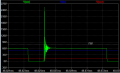
Not using a perfect spice transformer but using a more real transformer with leakage inductance and ringing etc.
Note the ring extends way above the 75V line.
1602768196842.png
During startup the peak ring is much worse.
This is SPICE where overvoltage does not brake transistors.

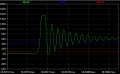
Added a 100V Zener which clamps at 100V+50Vin=150V in this case.
1602768591399.png

25V Zener and with 12.7 volts of flyback not 20V.
1602768830140.png
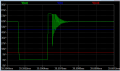
When the Zener voltage is too small there is Zener current for the entire output time. See Zener current in light blue. In this case peaks at 3.2A and slopes down to 1.6A. Very hot.
1602768997341.png
 

Thread Starter

fieryfire

Joined Feb 14, 2017
150
hi ff,
Looking at my LTS sims, indicates a 25Vz will get the job done, give it a try, lets know

E
I have bought a 24V Zener and 36V zener, but i am doing functional tests at Supply voltage of 30V. My tests are currently on the 36V diode and the heating issue is completely gone. which is to be expected. but now there is a risk of the total voltage as you guys pointed out can exceed maximum rating of 75, since if Vin>39V since ( it only clamps vin+36V). But i think ill just replace it with the 24V Zener for better uncertainity of the vin.

Im still rather confused what the circuitry behind the Vc is though? its really strange
 

Thread Starter

fieryfire

Joined Feb 14, 2017
150
Not using a perfect spice transformer but using a more real transformer with leakage inductance and ringing etc.
Note the ring extends way above the 75V line.
View attachment 219684
During startup the peak ring is much worse.
This is SPICE where overvoltage does not brake transistors.

Added a 100V Zener which clamps at 100V+50Vin=150V in this case.
View attachment 219689

25V Zener and with 12.7 volts of flyback not 20V.
View attachment 219691
When the Zener voltage is too small there is Zener current for the entire output time. See Zener current in light blue. In this case peaks at 3.2A and slopes down to 1.6A. Very hot.
View attachment 219693
Wow this is quite clear. Thanks. I was struggling for one week trying to figure out which SPICE doesnt show me the ringing and inductive peaks of the transformer, could you please show me how you modelled a real transformer? or if you could post the model or .asc file here.

and yes, i see the reasoning now, and I've switched it too 24V Zener. Now, it should technically fix the problem, of excessive heating. Thank you for the detailed explanation. :D
 
Top