Flickering DC power

Thread Starter

Icanmakeit67

Joined Sep 23, 2018
210
Hello,
I’ve got a project for a display that I was asked to provide with a fake broken/ripped apart clock. On the face of the clock will be a word made of letters on each of the 4, 7 segment displays. 4 letters on 4 displays. A total of 16 LED segments will be lighted. Yellow segments I want to operate at 6 vdc, each less than .02ma. I’ve found I want to use a 220 ohm resistor in series with each segment for good brightness. Here’s the rub. I want the whole word to flicker randomly as if the clock has been broken enough to stop working at any moment.
Any ideas? I want to use a 6vdc, 1000ma wall wort and some sort of circuit in series to nicely flicker the power, hence flicker the clock?
Any help would be super helpful
Thanks.
 

dl324

Joined Mar 30, 2015
18,326
I want the whole word to flicker randomly
What does this mean? All segments of all letters flicker randomly, but together? The same segment in all letters together? All segments flickering independently?

Any time you add randomness to the requirements, you're looking at using a microcontroller or single board computer.
I’ve got a project for a display that I was asked to provide with a fake broken/ripped apart clock.
Does this mean the display is multiplexed?
 

Thread Starter

Icanmakeit67

Joined Sep 23, 2018
210
What does this mean? All segments of all letters flicker randomly, but together? The same segment in all letters together? All segments flickering independently?

Any time you add randomness to the requirements, you're looking at using a microcontroller or single board computer.
Does this mean the display is multiplexed?
Right. The effect is just meant to flicker all at the same time. All segments, we want the word to be legible when lighted, but just randomly flickering.
 

Thread Starter

Icanmakeit67

Joined Sep 23, 2018
210
Be careful of your units.

Did you really mean 0.02mA ( 20 microamps) or did you mean 0.02A (20 milliamps)?

If you really mean 0.02mA that might be barely visible in total darkness.
Each segment is barely .02a a
Be careful of your units.

Did you really mean 0.02mA ( 20 microamps) or did you mean 0.02A (20 milliamps)?

If you really mean 0.02mA that might be barely visible in total darkness.
18.4 ma on the multimeter each segment.
 

ElectricSpidey

Joined Dec 2, 2017
3,334
Get 3 556s. (dual timers)
Set the timing as long on times and short off times.
Make the long times slightly different.
Connect all six outputs to the gate of an N-Channel MOSFET with diodes.
Connect a single pullup resistor to the gate.
Configure the MOSFET as a low side switch for the LEDs.

Be sure to properly de-couple the timers or they may get in sync.
 

WBahn

Joined Mar 31, 2012
32,823
I seem to recall hearing about some cheap chips that produce random (or seemingly random) output voltages specifically for doing candle-like effects. I never looked into them, so you will have to do the research to track them down (if they actually -- or perhaps still -- exist).
 

Irving

Joined Jan 30, 2016
5,114
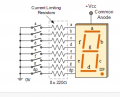
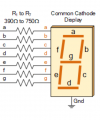
Are your displays common anode (ie +6v is common), or common cathode (ie ground is common)?

1714420957407.png 1714421025172.png

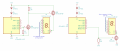
Either way, a simple 8-pin microcontroller and a few other parts is a simple and cheap solution. Stored in memory is an 8-bit random number sequence giving 256 different time delays that control the on and off times of the displays. This runs completely independently of the display segment drivers. Additionally, rather than simply turning the displays on and off, they can easily be faded in and out at random rates..

1714424645640.png
 

Thread Starter

Icanmakeit67

Joined Sep 23, 2018
210
Get 3 556s. (dual timers)
Set the timing as long on times and short off times.
Make the long times slightly different.
Connect all six outputs to the gate of an N-Channel MOSFET with diodes.
Connect a single pullup resistor to the gate.
Configure the MOSFET as a low side switch for the LEDs.

Be sure to properly de-couple the timers or they may get in sync.
Could I trouble you to scetch the schematic?
 

ElectricSpidey

Joined Dec 2, 2017
3,334
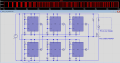
Here ya go.
The top timing resistors are...
500k
510k
520k
530k
540k
550k
The lower timing resistor is 10k.
The pullup resistor is 5k.
And the timing cap is 10uf.
The diodes are small signal 1N4148.

These were just values I picked at random, you should choose based on how you want the effect to look.

I'll be back online later to answer any questions.

1714436691661.png
 

Thread Starter

Icanmakeit67

Joined Sep 23, 2018
210
Here ya go.
The top timing resistors are...
500k
510k
520k
530k
540k
550k
The lower timing resistor is 10k.
The pullup resistor is 5k.
And the timing cap is 10uf.
The diodes are small signal 1N4148.

These were just values I picked at random, you should choose based on how you want the effect to look.

I'll be back online later to answer any questions.

View attachment 321219
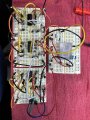
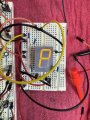
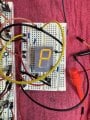
Breadboarded this up using one 7segment display with only the segments for the letter I wanted. Went over schematic a half dozen times. Checked every wire several times. No joy, not working. Big pic is all connected. Small pic is powered on 7seg display showing it works with letter P. Any suggestions?
 

Attachments

ElectricSpidey

Joined Dec 2, 2017
3,334
What MOSFET are you using?

Can you check to see if the timers are working, remove the diode and hook up a LED with a series resistor.

Hook the LED to the positive rail thru the resistor and it should "wink off".

Next pull the connection from the MOSFET gate to the diodes and the display should light if that section is ok.

Honestly the only concern I have with this circuit is if the timers couldn't pull the MOSFET gate low enough, but failure in that case would be the display would remain "on" all of the time...not off.

On your BB I see the connection from the MOSFET to the display but I also see what looks like a connection from the negative rail to the display, that can't be right.

Another thing to check is some of those BBs have a break in the power rails right at the center.

As I look closely it looks like the display is not properly connected. The output from the MOSFET should be connected to the negative of the display and the positive should be connected to the positive rail.
 
Last edited:

Thread Starter

Icanmakeit67

Joined Sep 23, 2018
210
What MOSFET are you using?

Can you check to see if the timers are working, remove the diode and hook up a LED with a series resistor.

Hook the LED to the positive rail thru the resistor and it should "wink off".

Next pull the connection from the MOSFET gate to the diodes and the display should light if that section is ok.

Honestly the only concern I have with this circuit is if the timers couldn't pull the MOSFET gate low enough, but failure in that case would be the display would remain "on" all of the time...not off.

On your BB I see the connection from the MOSFET to the display but I also see what looks like a connection from the negative rail to the display, that can't be right.

Another thing to check is some of those BBs have a break in the power rails right at the center.

As I look closely it looks like the display is not properly connected. The output from the MOSFET should be connected to the negative of the display and the positive should be connected to the positive rail.
You caught it. I blew the mosfet connection! Fixed it and it took of flickering. Now I need to play with the timing resistors. Genius man and I’m grateful! I have a short video but trying to add it, not sure I can
 

Attachments

Thread Starter

Icanmakeit67

Joined Sep 23, 2018
210
What MOSFET are you using?

Can you check to see if the timers are working, remove the diode and hook up a LED with a series resistor.

Hook the LED to the positive rail thru the resistor and it should "wink off".

Next pull the connection from the MOSFET gate to the diodes and the display should light if that section is ok.

Honestly the only concern I have with this circuit is if the timers couldn't pull the MOSFET gate low enough, but failure in that case would be the display would remain "on" all of the time...not off.

On your BB I see the connection from the MOSFET to the display but I also see what looks like a connection from the negative rail to the display, that can't be right.

Another thing to check is some of those BBs have a break in the power rails right at the center.

As I look closely it looks like the display is not properly connected. The output from the MOSFET should be connected to the negative of the display and the positive should be connected to the positive rail.
I don’t see how to put in a short video of the circuit working. To answer one of your questions, I only had a 2N7000 MOSFET in my supplies. It’s working fine though.
 

ElectricSpidey

Joined Dec 2, 2017
3,334
Oh, I almost forgot...add a couple bulk caps to the BB (across the rails) and a de-coupling cap at each 556.

I realize I forgot to add them in the sim...mostly because the sim doesn't need them.

About 100uf on the rails and about .1uf at the chips, values not critical, but they are needed to be sure the timers don't sync up and throw off the actual effect.
 
Top