Flashing LED with Analog Signal

Thread Starter

rroberts509

Joined Oct 12, 2018
3
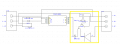
Hello I am new to this forum this seemed like the most appropriate place to ask this question. I have been struggling with a design at work with a LED that is flashing with an analog signal. The signal comes from a flow meter through the circuit to make the LED flash and then out to a controller. LED Signal1.png This first schematic was from the original design. I helped design it 3 years ago. After it was drawn up the implementing it into our system was done by some one else. I don't know if he changed anything to get it to work. I can't ask he as he has since retired and I was laid off shortly after I helps design the circuit. With this design installed the signal does not make it out to the controller but it will make the LED blink.
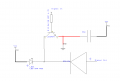
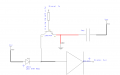
LED Signal2.png The second design I think at one point we figured out the diode was backwards so I tried turning around again no signal back to the controller but with this design it won't even turn on the LED.
Any help or suggestions would be greatly appreciated thank you in advanced
 

dl324

Joined Mar 30, 2015
18,360
Welcome to AAC!

Do the LEDs or transistors burn out? The way the circuit is drawn, when the transistor is on, the LED current will only be limited by it's internal resistance.

If this circuit is for a commercial product, it should be designed more conservatively.
 

Thread Starter

rroberts509

Joined Oct 12, 2018
3
Welcome to AAC!

Do the LEDs or transistors burn out? The way the circuit is drawn, when the transistor is on, the LED current will only be limited by it's internal resistance.

If this circuit is for a commercial product, it should be designed more conservatively.
This is a new development it does go out to customers. I pulled the original schematic from an old part that had a flashing LED on it in the same perspective. We only have a handful of them out in the field right now.
 

Marc Sugrue

Joined Jan 19, 2018
222
Hi, As DL234 alludes the LED will need a series resistor to control the current flow through the LED as switching the Transistor on could kill the LED and potentially the Transistor. Secondly if whatever connects to the signal out channel has a relatively Low impedance it will provide a alternative current path for the LED if the 2nd circuit is correct.
 

Thread Starter

rroberts509

Joined Oct 12, 2018
3
Hi, As DL234 alludes the LED will need a series resistor to control the current flow through the LED as switching the Transistor on could kill the LED and potentially the Transistor. Secondly if whatever connects to the signal out channel has a relatively Low impedance it will provide a alternative current path for the LED if the 2nd circuit is correct.
Ok so the LED needs a resistor to regulate the flow other wise it will blow correct? Something i will need to look into in the future for sure. For now I need to figure out why its not allowing the signal through. Unless that is possibly the issue? as far as the impedance of the signal out I am unsure of what it would be. This is for agricultural equipment the signal that is being sent through tells the controller what the flow of the fertilizer is so it displays on a screen in the cab of the tractor and the farmer can trouble shoot if he is not hitting the correct rates. This LED circuit was added as a "feel good" light so the farmer can look and see the light flashing.

Here is the original schematic I pulled the flashing LED circuit from. This was used as a divider circuit to lower the Hz of a signal so the older equipment was able to read it. Divide by.png
 

noweare

Joined Jun 30, 2017
115
Are we talking about a d.c current from the flow meter? What is the signal from the flow meter. The transistor is wired like a switch so I dont know how the original signal would be conserved. I think you need to give us more info.
 

Marc Sugrue

Joined Jan 19, 2018
222
Ok so the LED needs a resistor to regulate the flow other wise it will blow correct? Something i will need to look into in the future for sure. For now I need to figure out why its not allowing the signal through. Unless that is possibly the issue? as far as the impedance of the signal out I am unsure of what it would be. This is for agricultural equipment the signal that is being sent through tells the controller what the flow of the fertilizer is so it displays on a screen in the cab of the tractor and the farmer can trouble shoot if he is not hitting the correct rates. This LED circuit was added as a "feel good" light so the farmer can look and see the light flashing.

Here is the original schematic I pulled the flashing LED circuit from. This was used as a divider circuit to lower the Hz of a signal so the older equipment was able to read it. View attachment 161436

For your original circuit the
Ok so the LED needs a resistor to regulate the flow other wise it will blow correct? Something i will need to look into in the future for sure. For now I need to figure out why its not allowing the signal through. Unless that is possibly the issue? as far as the impedance of the signal out I am unsure of what it would be. This is for agricultural equipment the signal that is being sent through tells the controller what the flow of the fertilizer is so it displays on a screen in the cab of the tractor and the farmer can trouble shoot if he is not hitting the correct rates. This LED circuit was added as a "feel good" light so the farmer can look and see the light flashing.

Here is the original schematic I pulled the flashing LED circuit from. This was used as a divider circuit to lower the Hz of a signal so the older equipment was able to read it. View attachment 161436
It appears that the intention of this circuit was more digital than than analogue. The direction of the output diode in the original circuit leads me to believe it was intended to be 'Open Collector' with the Diode acting as a reverse protection to the output channel. The transistor could possibly be sinking the current from the LED and the external load. I suspect in rotating the diode you are preventing the external load from getting switched as it was probably intended.

If the direction of the diode in your new circuit is correct, at best your 'signal' will be Vcc - VLed - VDiode and will be the inverse of the signal in. The LED effectively becomes a semiconductor fuse if you short your output line to 0V

If the output intention is open collector then to work out a series resistor for the LED (Red is approx 2.4V @ 10mA), assume a 1V drop across the transistor and a Vcc of 5V.

To limit the current you'll need to drop about 1.6V accross a resistor. 5V - 2.4V - 1V
R = 1.6/10mA = 160R so pick the nearest available alternative.
 
Last edited:

DNA Robotics

Joined Jun 13, 2014
670
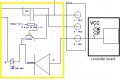
If that white C wire is pulled up to VCC on the controller board, then your flow meter / transistor circuit should pull that white wire low when the transistor turns on and LED glows.
pullup.jpg
 
Top