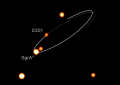
No. ( "interpolation", a method of constructing (finding) new data points based on the range of a discrete set of known data points.) The answer is No, it's an interpretation IMO, because the learning set is not actual images of that blackhole's data points. It's a scientific visualization of a model generated by ML pattern matching using similar simulated images.
Abstract
The sparse interferometric coverage of the Event Horizon Telescope (EHT) poses a significant challenge for both
reconstruction and model fitting of black hole images. PRIMO is a new principal components analysis-based
algorithm for image reconstruction that uses the results of high-fidelity general relativistic, magnetohydrodynamic
simulations of low-luminosity accretion flows as a training set. This allows the reconstruction of images that are
consistent with the interferometric data and that live in the space of images that is spanned by the simulations.
PRIMO follows Monte Carlo Markov Chains to fit a linear combination of principal components derived from an
ensemble of simulated images to interferometric data. We show that PRIMO can efficiently and accurately
reconstruct synthetic EHT data sets for several simulated images, even when the simulation parameters are
significantly different from those of the image ensemble that was used to generate the principal components. The
resulting reconstructions achieve resolution that is consistent with the performance of the array and do not
introduce significant biases in image features such as the diameter of the ring of emission.
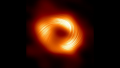
Using the Event Horizon Telescope, a global collection of radio telescopes working in tandem, scientists captured polarized light coming from around Sagittarius A*, which lies about 27,000 light-years from Earth (SN: 4/10/19). Polarized light has waves that wiggle in the same direction, such as up and down or left and right. Mapping such light often gives astronomers insights into underlying magnetic phenomena.
“Once the camera crosses the horizon, its destruction by spaghettification is just 12.8 seconds away,” Schnittman said. From there, it’s only 79,500 miles (128,000 kilometers) to the singularity. This final leg of the voyage is over in the blink of an eye.
I'm beginning to hate these announcements of 'faked' 'AI' data zooms and sharpening.
"it is still a theoretical expectation and not an actual photograph of the supermassive black hole"
It's an image but not a picture of any existing supermassive black hole. It's an impression of what it might look like. It's not DSP, noise reduction or image enhancement. It's generated data designed to make us see something we invented, not what we can actually see is there.
A team of researchers from Japan’s National Astronomical Observatory (NAOJ) is claiming that the groundbreaking image of the supermassive black hole at the center of our galaxy is not accurate.
The original image of Sagittarius A* was constructed from data taken by the Event Horizon Telescope Collaboration, which revealed the picture to the public in May 2022. It showed our galaxy’s central black hole as an ominous black cloud surrounded by a ring of light—the hole’s accretion disk. In its paper, the recent team suggests that the the object is more likely to have an elongated disk. The team published its proposed black hole structure in the Monthly Notices of the Royal Astronomical Society.
We propose that the ring structure found by the Event Horizon Telescope Collaboration (EHTC) as the black hole shadow of Sgr A* is an artefact caused by the bumpy point spread function (PSF) of the EHT 2017 data. The imaging using sparse u-v data requires detailed scrutiny of the PSF. The estimated shadow diameter (
) is equal to the spacing between the main beam and the first sidelobe of the PSF (
), which immediately suggests a potential problem in the deconvolution of the PSF. We show that the ring image can be derived from non-ring simulated data sets (noise only; point source) with a narrow field-of-view (FOV) and an assumed self-calibration, suggesting that the EHT 2017 u-v coverage is insufficient for reliable imaging.
As I said in the previous post (above yours) about this, it's not 'wrong', it's just an interpretation of noisy data.
Just a random thought.
Are we sure this is what it looks like unfiltered by our current scientific expectations?
This is not a naked eye visual image. What we see here is a computer generated construction of data points using theories (using EM theory but that theory is fundamentally constructed from the same space-time theory we use to predict black holes properties) of what 'black hole' objects should look like using space-time calculations of mass/energy radiation from the received signals. I'm sure the data construction is solid and consistent with theory using the predictive power of science, but I'm not sure a human would see the exactly same thing if that person was floating in space near the object.
That a blob is there. If there was sufficient resolution and quality of data there would be no question about what image properties that blob has. The fact we can image the blob is a technological miracle and what's being discussed now is akin to AI image sharpening. How much is 'real' and how much is probabilistic data fitting from similar images. There's not really sufficient evidence to make a completely scientific choice. (Her 'leaning' one way or the other) https://www.moveworks.com/us/en/resources/ai-terms-glossary/probabalistic
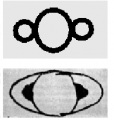
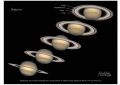
Galileo Galilei was the first to observe Saturn with a telescope in 1610. Because of the crudeness of his telescope, he couldn't determine what the rings were. He incorrectly guessed that there were two large moons on either side of Saturn. Two years later when he viewed Saturn again, the "moons" had disappeared. We know now this is because Galileo was viewing the rings edge-on so that they were invisible, but at the time it was very confusing to Galileo. After another two years, Galileo viewed Saturn again and found that the "moons" had returned. He concluded that the rings were "arms" of some sort.
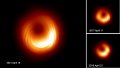
These images of M87*, located around 55 million light-years from Earth, show that the polarization of the magnetic fields around the black hole reversed over a period of four years.
[QUOTE ]These images of M87*, located around 55 million light-years from Earth, show that the polarization of the magnetic fields around the black hole reversed over a period of four years.
Next time I am out that way I'll take some snapshots from the inside out with my cell phone. Would be interesting to see a picture of Earth taken from inside a black hole.
Oh, and don't worry about me getting out I have a plan. I'll tie a rope to my space craft and take the loose end in with me. That way I'll be able to find my way out.
Those are much nicer pictures than the first one they published. I don't think they are actual images of the black hole though, rather, they are computer generated given the captured data and the known physics of the time of what it should look like given the data collected. In other words, it has been decoded from the data.
The way I understand it is that an object can reach the horizon in its own finite time, but us watching it from earth it would seem to take forever.
The way I understand the "singularity" is that it is mathematical entity used to describe something like spacetime where we do not yet have the proper physics for. So it could turn out to be a lot of different things. The math fails there so we can't know what is really happening yet.
Will we ever know? Well, if I don't get back with the photos from inside I guess not
I think you can get an idea how a Black Hole works by using a set of magnets.
First you could bring two weak magnets together and notice that as they get closer to each other they start to pull stronger and stronger until they touch. The limiting attraction in a simplified view is due to the distance between the two magnet centers. The two magnet centers cannot touch though because they are inside the magnet, but imagine if they could, then they would be much harder to pull apart.
If you get two really strong magnets and do the same thing, they are much harder to separate which illustrates the idea.
So the distance is a very important factor. The closer they are, the stronger they attract each other. That's also how gravity works. The closer things are to each other, the stronger they attract each other.
In real life we have distance between the centers of objects and that distance limits the force of attraction. When we get down to particles though, the distance is much smaller so they can get much closer together. At some point the attraction becomes so strong it becomes very hard to separate them.
It's even possible that if something does try to separate them, it might end up being part of the structure which means it gets 'stuck' too
Astronomers have found that, just 200 years or so ago, material falling into Sgr A* got so hot that it emitted bright flares in x-rays—blasting them out at a rate hundreds of thousands of times the sun’s entire luminosity. Even from 1.7 billion km away, that’s a lethal dose of radiation.
The universe is such a chaotic and dangerous place that I often wonder how we are still here. So many things that can 'get' us it's amazing that life has been around for a long time already.
The only thing that bothers me is that the longer we are around the more likely that something will actually 'get' us. Things flying through space at incredible speeds, sooner or later something has got to hit. It's almost impossible that it won't happen. We could have a roaming black hole heading this way and we might not even see it because we can't see it directly like an asteroid. There was a small impact over the ocean near Australia just today.

 Facebook
 Google
 GitHub
 Linkedin