Firework igniter continuity led circuit design help...

Status
Not open for further replies.

Thread Starter

bigjoncoop

Joined Feb 1, 2019
204
I'm in the middle of building a 32 Channel Wireless firework launcher using a ESP32 & I2C relay boards. For the ignition system I'm using Talon igniters. And blocks of spring terminals for each igniter connection...

The datasheet shows 12v - 24v @ 1a minimum firing range.

Some different types of igniters will show in their datasheet, specs for continuity checking. But I haven't been able to find any info / specs on continuity checking these Talon igniters...

Really the only information I found is from a firing system made by cobra. In their specifications it mentions, it pulses 15ma for continuity testing.

I'm assuming that the igniters use nichrome wire as the heating element.

*****

So my initial idea is:

Since I'll be using a 12v source, if I use a 3mm red LED in series with a 680ohm resistor that should keep it under 15ma.

Put them across each of the 32 Spring terminals, and wire them all in parallel connected to a push button. Then after all the igniters are connected, you can briefly push on the push button to confirm continuity across each of the 32 igniters.

I'm pretty sure this will work just fine, I just wanted to do it sanity check with y'all!!!
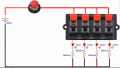
Screenshot 2024-12-08 130935.png
 

sghioto

Joined Dec 31, 2017
8,633
Depends.
Exactly how are the igniters activated through the relay board?
Is one end of each igniter common to ground or 12 volts?
 
Last edited:

Tonyr1084

Joined Sep 24, 2015
9,744
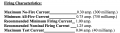
Note the Maximum Test Current . . . . . 40mA. If your LED's are set up to draw no more than 40mA then you should be on the safe side. However, "Safe Side" doesn't mean drawing UP TO the max test current. A Super Bright LED (SB LED) will give you plenty of indication in daytime light at 20mA. When calculating for current be sure to include any resistance from the EM (Electric Match). Don't just go off the snippet I posted, read the sheet attached in post #3. Fully understand the characteristics of all pyrotechnic devices you are working with. No sense in having something go off in your face.

And keep in mind this is the characteristics for the J-Tek EM.
Screenshot 2024-12-08 at 12.18.23 PM.png
 

Thread Starter

bigjoncoop

Joined Feb 1, 2019
204
Depends.
Exactly how are the igniters activated through the relay board?
Is one end of each igniter common to ground or 12 volts?
Yes I am planning on having one side of each igniter connected to common ground, and have the 12v switched through the relays.

Note the Maximum Test Current . . . . . 40mA. If your LED's are set up to draw no more than 40mA then you should be on the safe side. However, "Safe Side" doesn't mean drawing UP TO the max test current. #3. Fully understand the characteristics of all pyrotechnic devices you are working with. No sense in having something go off in your face.

And keep in mind this is the characteristics for the J-Tek EM.
View attachment 337568
Yes sir absolutely! That's exactly why I came here to run the idea by you fellas in order to make sure I wasn't missing overlooking anything!

According to the math a 680ohm resistor in series with a 3mm red LED @ 12v should be well below the rated 40mA test current. I will double check that though before I just run with it...

I'm glad that you found those specifications. I Googled for quite a while trying to find them...
 
Last edited:

sghioto

Joined Dec 31, 2017
8,633
Yes I am planning on having one side of each igniter connected to common ground, and have the 12v switched through the relays.
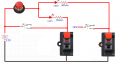
In that case the LED circuit is wired like this:
The switch needs to be rated at least 1 amp as the total current for all 32 LEDs is almost 0.5 amps.
1733690278461.png
 

Tonyr1084

Joined Sep 24, 2015
9,744
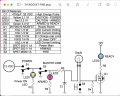
This was my model rocket launch control system years ago. S1 is the Power switch. S2 is the Master Arm switch. S3 is the fire button. Notice power goes to the gate of a 2N7000 MOSFET. No current through the squib (Electric Match). R3 slow charges C1. C1 holds a high current charge for when S3 (Momentary On) is pressed, sending battery power and the high current charge from C1 through the squib to ground. If there is no squib detected LED 3 (READY light) does not light. If S1 or S2 are off, C1 is drained to ground so there is no accidental launch when alligator clips are connected to the squib. That's how I built mine.
Screen Shot 2024-12-08 at 3.16.47 PM.png
 
Last edited:

Tonyr1084

Joined Sep 24, 2015
9,744
According to the math a 680ohm resistor in series with a 3mm red LED @ 12v should be well below the rated 40mA test current. I will double check that though before I just run with it...
I will assume a forward voltage of the diode to be 2 volts and a match resistance of 1 ohm.
(12V - 2Vf) ÷ (680Ω + 1Ω) = 14.7mA of current.

IF THE SPEC SHEET attached in post #3 is EXACTLY the same set of specifications then you are good to go. BUT - - - Whomever built the EM's you have could easily have lower specs. Don't trust the spec sheet I posted; it's BRAND SPECIFIC!. Working with the wrong set of numbers is what causes bridges to collapse. Towers to fall over. Planes to fall from the sky. And yes, fireworks exploding in your face.

The circuit I attached was what I used when flying model rockets a few years back. It's the same principle, current through an EM and you get ignition. That would be basically the same thing as launching fireworks. Assuming 12 volts and a total series resistance of 10101Ω calc's come out to just under 1.2mA of test current through the squib (or Electric Match). Again, I assumed 1Ω for the squib. IF the squib is good and properly connected you will get a green indicator light saying so. HOWEVER and this is extremely important, there have been times when my alligator clips touched each other. I got a green launch light but when I hit the launch button wires got burned. Remember, there's a charged capacitor ready to give a high energy impulse to the squib. After repairs I put a deflector plate located where one alligator clip would be separated from the other so none of them could short out.

I always wanted to build a countdown timer launcher. Set it for 1 minute and it would begin counting down. When it got down to 10 seconds an automotive horn would been for half a second - every second until the launch. Dreams are wonderful. Maybe this year I'll put one together and take the grandkids out flying rockets. Only need to find an open space to fly them.
 

MisterBill2

Joined Jan 23, 2018
27,164
If you use the "super bright" red LEDs you can get an adequate display with FIVE milliamps. And if something goes wrong in that all at once test it will be an awesome "grand Finally" as they all go off at once.
What sort of terminals arrangement does your firing panel have??
What makes sense to me is an accurate low-range ohm meter that provides ten milliamps thru thru probes and then reads the voltage developed across the circuit consisting of the two wires, the connectors, and the igniter. NO ADDITIONAL WIRING in the controller assembly. Then, you can probe each pair of terminals and no chance for a goof-up. It works for remotely detonated Claymore Mines as well.
 

Tonyr1084

Joined Sep 24, 2015
9,744
If you use the "super bright" red LEDs you can get an adequate display with FIVE milliamps.
I've run them at 2mA but you can just see them glowing. At 5mA they're bright enough to be seen in the shop. But in the case of MY rocket launch controller, the red LED was difficult to see in full daylight.

But we're not discussing my rocket launcher, we're discussing a similar project, firing off fireworks. Granted, it will be evening or later when you begin firing them off, so yes, running a low amperage would do well enough. Whatever color you use, whether you use common or superbright LED's - that's entirely up to you (the TS [Thread Starter]).
It works for remotely detonated Claymore Mines as well.
:D
 
Status
Not open for further replies.
Top