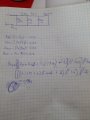
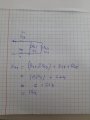
My equation gives me a very far from the correct result..
I think we may have finally identified a core misunderstanding on your part.If R1 and R2 are not in series, then they are in parallel. But why? I used that trick ( i think it was you that mentioned it ) , of the index fingers, and it didnt work for R1 and R2, so i imediatly assumed that they were in series..
The names of the resistances are confuse. But i did understand and i agree.hi A,
Let us go thru step by step.
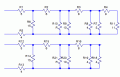
Do you understand and agree with this part reduction of the circuit.?
E
If they are neither, how do i procced? I dont put those resistances in the equation?I think we may have finally identified a core misunderstanding on your part.
You are assuming that any two resistors are either in series or in parallel -- that they must be one or the other. That's not the case. Resistors may be connected in a way such that they are neither.
At this point in your education, you are only being given problems that can eventually be reduced to a single resistor via series and/or parallel combinations. But that doesn't mean that every resistor starts out in either series or parallel with another resistor. You start with a circuit and identify those resistors that are currently in series or parallel and you combine them and replace them with their single-resistor equivalents. In doing so, you have a new, simpler circuit and, because of the changes you made, some resistors that previously weren't in either series or parallel now are in series or parallel with one or more of the single-resistor equivalents that were added.If they are neither, how do i procced? I dont put those resistances in the equation?
I do.hi,
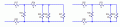
Do you understand and agree with this next part reduction of the circuit.?
Ok, understood!!At this point in your education, you are only being given problems that can eventually be reduced to a single resistor via series and/or parallel combinations. But that doesn't mean that every resistor starts out in either series or parallel with another resistor. You start with a circuit and identify those resistors that are currently in series or parallel and you combine them and replace them with their single-resistor equivalents. In doing so, you have a new, simpler circuit and, because of the changes you made, some resistors that previously weren't in either series or parallel now are in series or parallel with one or more of the single-resistor equivalents that were added.

I completed your work and entered numeric values, please take a look.hi A,
Next part almost done.!
Can you complete the final step, if yes, you should now be able to build an equation, then enter the numeric values into the equation and calculate the Requiv.
Post your work.
E
Note: the 'R' idents are only changing due to the drawing method I am using.
I now understand that. Thank you very much for your effort and patience.Your approach to problem solving needs to be refreshed.
You are trying to apply general made-up rules to all situations and that is wrong.
Who told you that if two resistors are not in series then they must be in parallel is totally wrong.
Instead of trying to apply some made-up rule that is incorrect try a different approach.
1) Find two resistors that you are certain are in series and find the equivalent resistance. Redraw the circuit with the equivalent resistor in their place.
2) Find two resistors that you are certain are in parallel and find the equivalent resistance. Redraw the circuit with the equivalent resistor in their place.
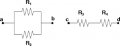
View attachment 221443
R1 and R2 are in parallel.
R3 and R4 are in series.
After you have understood how to solve these types of problems there should be no need for you to keep coming back to asked for validation. It shows that you still need to recognize two resistors in series and two resistors in parallel. Do this first and then you can solve all the questions on your own.
And again, thank you for your patience.hi Chips,
This is what we have been doing for the last dozen or so posts!
E
I am my friend. Will do.Hi A,
Are you now more confident that when given a resistor network that you can reduce the circuit to a simpler layout in order to solve the problem.?
You should attempt the remainder of your assignment on your own and post the final network and answer.
E
His problem was clearly stated in post #1.hi Chips,
This is what we have been doing for the last dozen or so posts!
E
Had TS learned the difference between series and parallel circuits he would have been able to do all of the exercises on his own. This is not rocket science!I really dont understand how to know if a resistance is in parallel or in series. Can someone please give the resolution of the exercise 8 (alines "a" to "g" please) of this file.
Thanks for the help.
| Thread starter | Similar threads | Forum | Replies | Date |
|---|---|---|---|---|
| P | Need help with finding the equivalent R | Homework Help | 5 | |
| A | urgent!!!! Finding equivalent resistance in complex circuits | General Electronics Chat | 5 | |
|
|
Finding Equivalent resistance | Homework Help | 19 | |
| M | Finding equivalent resistance | Homework Help | 9 | |
| A | Wye Delta Transformation finding equivalent resistance Help | Homework Help | 7 |