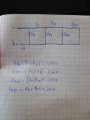
hi A,
I make this part 8,d. OK.?
E
I make this part 8,d. OK.?
E
Attachments
-
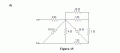
6.7 KB Views: 7
R10 has no effect. I think you meant R11 instead. This is "set up" stage of solving the problem and it is when all of the EE takes place, everything after this is math. If you get the set up wrong, then the math will likely not be able to catch it because, as far as the math is concerned, you are simply solving a different problem. So it pays to set up the problem and then carefully verify that your set up is correct before proceeding. You WILL make these kinds of mistakes throughout your career, what is valuable is to develop the habits, even rituals, that will allow you to catch them as a matter of routine.Yes, i forgot the "R7". Thank you!
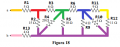
In this circuit i think that R2//R3, R4//R5 and R7, R8, R9 and R10 are in serie.
What do you think?
View attachment 221271
So this equation says that ALL of the current MUST flow through both R1 and R7. Look at the original circuit. Does that make sense? I only see one resistor through which ALL of the current must flow.Hi.
Sorry for taking so long to answer.
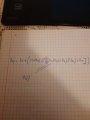
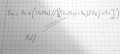
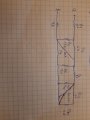
The 11 ohm exercise, i understood it by taking little steps, the whole equation looks a bit confuse but i think this is right:
View attachment 221340
Hello. I believe this is the right equation. What you think?hi A,
I make this part 8,d. OK.?
E
Sorry for the confusion i accidentally caused. I understood the error i made in that equation. Thank you for your responses. Slowly i think i am understanding much better this type of problems.If you are going to have multiple problems being discussed in the same thread (something we highly discourage for just this reason), then you have to be VERY clear in EVERY post exactly WHICH problem you are talking about. Otherwise nothing but chaos and confusion will reign.
So this equation says that ALL of the current MUST flow through both R1 and R7. Look at the original circuit. Does that make sense? I only see one resistor through which ALL of the current must flow.
I'll emphasize it again -- you need to get in the happen of looking at your work and asking if it makes sense. Mistakes often result in things that, even at a casual glance, are glaringly obvious that they are wrong. But you need to be looking to spot them.
The equation of the 8d gave me the right result...hi A,
The answer that equation gives is wrong.
Post your simplified circuit of '8e'
E
The result of the 8d equation is 11 ohm.hi,
The equation of the 8d gave me the right result...
What was the result.??
I see that your answer for 8e gave 22Ω, is that the correct answer.?
If you don't post an original circuit of the problem that you are working on , which shows which resistor is which ie: R1 thru to R8
I cannot follow what you are doing.
E
8,e
You are looking too hard.The result of the 8d equation is 11 ohm.
The exercise 8e gave me the correct result too, 54 ohm.
Trust me, i understood well these two circuits.
The 8f i dont. The equivalent resistance is 0. Why?
The path without any resistance. Got it.You are looking too hard.
Take a walk around the park (figuratively speaking). Stick to the paved path, don't walk on the grass.
Did you get mud on your shoes?
Electrons will stick to the path where there is least resistance. What path would the electrons take?
You keep completely ignoring what it means for two resistors to be in series and for two resistors to be in parallel.The path without any resistance. Got it.
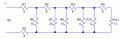
As for this circuit (exercise 8g), i think R1+R2. Then R12 + 3. Then R123 // R4. Then R1234 // R5. Then R12345 + R6. Then R123456 + (R7//R8)... im i going right?
Thanks.
Take a step back and go with the basics -- you are making too many mistakes to be skipping steps. Stick to the fundamentals until you get things well enough under control that you can start skipping things and doing some of it in your head.The path without any resistance. Got it.
As for this circuit (exercise 8g), i think R1+R2. Then R12 + 3. Then R123 // R4. Then R1234 // R5. Then R12345 + R6. Then R123456 + (R7//R8)... im i going right?
Thanks.


If R1 and R2 are not in series, then they are in parallel. But why? I used that trick ( i think it was you that mentioned it ) , of the index fingers, and it didnt work for R1 and R2, so i imediatly assumed that they were in series..You keep completely ignoring what it means for two resistors to be in series and for two resistors to be in parallel.
If R1 and R2 are in series, which is what your R1+R2 requires, then any current that flows through R1 absolutely, without question, must, without doubt, flow through R2.
Do you see that this is not the case?
If so, then R1 and R2 are NOT in series and your very first step is wrong. No point going any further.
hi A,
Read your post understanding the previous problems, OK.
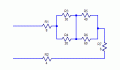
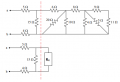
This is Circuit 8g, redrawn, it should enable you to build an equation and a value for Requiv.
Remember always try to redraw a circuit that appears complex to a simpler layout, before solving.
E
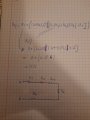
Using the denomination that you established, i procceded to simplifly the circuit.hi A,
Read your post understanding the previous problems, OK.
This is Circuit 8g, redrawn, it should enable you to build an equation and a value for Requiv.
Remember always try to redraw a circuit that appears complex to a simpler layout, before solving.
E
Good morning my friend. I just simplified some resistances, i sent a photo of the simplifyed circuit. I havent done the Req for now..Morning A,
If you make the Requiv = 20Ω, for '8g' it is incorrect.
E
EDIT:
Corrected
What do you make Requ .?
| Thread starter | Similar threads | Forum | Replies | Date |
|---|---|---|---|---|
| P | Need help with finding the equivalent R | Homework Help | 5 | |
| A | urgent!!!! Finding equivalent resistance in complex circuits | General Electronics Chat | 5 | |
|
|
Finding Equivalent resistance | Homework Help | 19 | |
| M | Finding equivalent resistance | Homework Help | 9 | |
| A | Wye Delta Transformation finding equivalent resistance Help | Homework Help | 7 |