Filtering an H-bridge

MaxHeadRoom

Joined Jul 18, 2013
30,699
IMO, The DC resistance of the armature should be obtained by using a locked rotor and reading the current when fed with a known low voltage DC, various points should be tested in order to obtain the lowest reading.
Max.
 

Thread Starter

cmartinez

Joined Jan 17, 2007
8,789
IMO, The DC resistance of the armature should be obtained by using a locked rotor and reading the current when fed with a known low voltage DC, various points should be tested in order to obtain the lowest reading.
Max.
That's something that I definitely can do. I'll perform that test later today and get back here with the results. Thanks for the advice!
 

Danko

Joined Nov 22, 2017
2,180
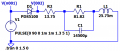
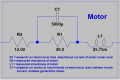
Question, shouldn't the value for L1's series resistance in LTSpice be the same as R2? That is, shouldn't we take R2 out of the circuit and instead feed the 13.75 ohms value into L1 instead?
In model every parameter shall be represent as individual element.
It is convenient for analysis, demonstrably for you and others.
 

Thread Starter

cmartinez

Joined Jan 17, 2007
8,789
Here's the latest data, according to Max's suggested test:

  • 90 mA @ 12VDC while running and unloaded (200 rpm)
  • 1 Amp @ 12VDC with the shaft completely stalled

One could say that the winding's equivalent resistance is 12 ohms, which is in agreement with my first measurements, considering the lowest reading.
 

Danko

Joined Nov 22, 2017
2,180
Measurements were done at 1 KHz. The variations are there because of the carbon brushes (and also possibly because of the presence of the permanent magnets at the stator), and were manifest when I slightly rotated the motor's shaft, so as to test it in different positions.
Not magnets, it is because different number of collector plates are under brushes, when you rotate shaft.
One could say that the winding's equivalent resistance is 12 ohms, which is in agreement with my first measurements, considering the lowest reading.
Simple ohmmeter does the same work (R = V / I).
Now (I think) I get it ... thanks!
Congratulations!
 

Thread Starter

cmartinez

Joined Jan 17, 2007
8,789
Simple ohmmeter does the same work (R = V / I).
:rolleyes: oh, I know that. I was just following Max's recommendation. And I think I see why he said that. It's because with a small current going through the entire assembly the brushes' resistance stabilizes and one gets a more reliable reading.
 

Thread Starter

cmartinez

Joined Jan 17, 2007
8,789
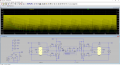
Here's my latest interaction with the sim:

upload_2018-10-8_17-46-10.png

The values used end up reflecting the 1.1 Amps that the motor is actually rated for. Of course, I'm not using regulated 90VDC but a simple rectified 120 VAC source, which is what is going to be used in real life.

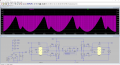
upload_2018-10-8_17-48-3.png

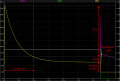
I haven't finely tuned the value of C1 yet, but I think maybe there's no need to be that accurate. With the values used, the inrush current (with 50% PWM active the whole time) lasts for about 0.15 seconds, which is fine by me. All I want to analyze is the noise produced by the system during normal operation. Those 200V spikes will be taken care of by a 180V TVS diode that I plan to connect across the motor's terminals.
 

Attachments

Danko

Joined Nov 22, 2017
2,180
:rolleyes: oh, I know that. I was just following Max's recommendation. And I think I see why he said that. It's because with a small current going through the entire assembly the brushes' resistance stabilizes and one gets a more reliable reading.
Ohmmeter's current on this range usually is 10mA, but you test it with 1A, almost under working condition.
Make sense.
 

Danko

Joined Nov 22, 2017
2,180
All I want to analyze is the noise produced by the system during normal operation. Those 200V spikes will be taken care of by a 180V TVS diode that I plan to connect across the motor's terminals.
Do you want to eliminate spikes?
Take off R6,R7,C5,C6 and connect capacitor 1...2uF between "120VDC" node and ground (in parallel with R15).
 

Thread Starter

cmartinez

Joined Jan 17, 2007
8,789
Do you want to eliminate spikes?
Take off R6,R7,C5,C6 and connect capacitor 1...2uF between "120VDC" node and ground (in parallel with R15).
o_O So you're saying that the RC filters across the high side mosfets are doing nothing? ... I figured that much, the sim behaves exactly the same with or without them.

EDIT: and by the way, I placed R15 there so as to provide a path to ground in the sim, since the AC source is "floating". It's a common practice that I've seen others do, otherwise LTSpice will behave erratically.
 

Thread Starter

cmartinez

Joined Jan 17, 2007
8,789
I worked beautifully :):

upload_2018-10-9_11-12-14.png

Question: what if I were to use a larger capacitor? Say, 5 uF instead of 2 uF? Would that make little difference and be overkill, or would it affect the results in a negative way?
 

Thread Starter

cmartinez

Joined Jan 17, 2007
8,789
This is very interesting. I simmed the circuit with a 5uF cap, and the asymmetry in the voltage wave almost completely disappeared. Then I performed the same sim with a 10uF cap, and the symmetry improved even further, but the motor sub-circuit drew a little less current. It went down from 1.1A to 1.0A. Question, the measurement of which component would better represent the current flowing through the motor? Should it be the current flowing through R2 (or L1), or the current flowing through R1?
 

Danko

Joined Nov 22, 2017
2,180
So you're saying that the RC filters across the high side mosfets are doing nothing? ... I figured that much, the sim behaves exactly the same with or without them
Usually inductive load never has spikes in mosfet H-bridge because of body diodes.
They provide patch for self-induction current back to power supply.
In your case H-bridge separated from PS by diode bridge.
Therefore you need use capacitor as way for self-induction current.
 

Thread Starter

cmartinez

Joined Jan 17, 2007
8,789
Larger capacitor -> feeding current close to pure DC -> better for motor.
In digital circuitry, I've seen the combination of a large capacitor placed in parallel with a small one, so that the large cap would be in charge of stabilizing large voltage variations, while the small one would react to fast spikes. For instance, placing a 10 uF cap in parallel with a 0.1uF one at the output of a 7805 regulator is common practice.

Would such a thing make a difference here (and I mean in respect to EMI)? That is, would it make a difference if I were to use a 200 nF polyester cap in parallel with the 10 uF cap at the diode bridge output?
 
Top