Ferrite core for low frequency GDO coil

Thread Starter

AlbertHall

Joined Jun 4, 2014
12,619
For a low frequency (50kHz to 150kHz) grid (gate) dip oscillator, the coil needs a lot of turns. Would it work with a ferrite rod as the core for this coil?
 

DickCappels

Joined Aug 21, 2008
10,661
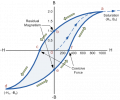
Yes, but one has to wonder whether nonlinearity in B/H curve might be a problem. If you try this (and I hope you do) use the lowest u (permeability) core you can get and keep the magnitude of the oscillation far from where the B/H curve "bends" over.

1757072628961.png
 

sparky 1

Joined Nov 3, 2018
1,218
The nature of resonant parallel inductors has that dip effect and accuracy includes the coupling and Q thus air coils.
The field of an inductor having ferrous material is different so graphing region is convenient.
The difference in powdered iron and additive like Material 15 SG4 is not that different from Material 61 and 67
which is used the make AM loopsticks. The placement of coil helps tune adding correct length to that coil is the key.

If both the transmitter and the receiver use loopsticks having the same resonance raising the Q is possible with more circuit.
Sweeping the inactive resonant circuit with the active, the increase in the inactive resonant circuit rather than a dip.
In an LCR bridge circuit when precisely adjusted is spot and the absolute value of dip and peak is zero.
Would this be true of VLF using Ruhmkorff coil air gap and moving coil, later the vacuum tube showed it was true.
We use a function generator and sweep for peak, Improving accuracy is made in narrowing the sweep range for smaller increase.

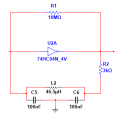
I am including a circuit for center frequency of proposed loopstick.
swapping the caps for 1nF will be heard on 973kHz according to the simulator.
100 kHz.png
 

Attachments

Last edited:

KeithWalker

Joined Jul 10, 2017
3,603
Back in 1961 I made a grid dip meter using a single Philco T.1832 germanium transistor as a Colpitts oscillator, with plug-in coils. It was tuned with a small dual ganged tuning capacitor. For the low end coils I used 1/4" dia. coil formers with ferrite slugs. They worked fine below 100 KHz and up to 2MHz. Above that frequency, I didn't need the cores.
 
Last edited:

sparky 1

Joined Nov 3, 2018
1,218
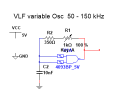
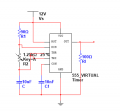
Yes, stable and withh more finite control. In this version R2 is really a 1k 10Turn pot and a 250Ω in series
keeping in mind that the transmit output has a loop stick. Vreg like 78L12 10n NPO or COG

If the transmitter, the active resonant circuit will interact with a non-active resonant circuit
at some proximity the receiver will become active and the field at the transmitter will decrease sharply at the resonant frequency.
We can also say that the receiver's resonant circuit increases. Because an LCR bridge using matching loopsticks will show a Null
an analysis could be made using two uniform fields. An air coil and a loopstick may have a slight difference.

It is only my unfounded opinion that an air coil makes a better sensor with the effect of the ferrous material in measuring
mutual inductance of parallel inductors However, loopsticks make better antennas than an air coil?

VLF adj 555.png-
 
Last edited:
Top