Faint LED light...

Jon Chandler

Joined Jun 12, 2008
1,642
LED blub technology has changed rapidly in recent years.

Aside from reducing brightness, the other reason to modify a bulb is to reduce power consumption. Most bulbs are driving the LEDs pretty hard – reducing the light output a little will greatly extend bulb life.... although I have seen few failed bulbs recently.
 

Thread Starter

Externet

Joined Nov 29, 2005
2,675
Hi.
With the only intention to avoid further skidding from the exact topic; my intention is to dim the light of whatever existent LED bulb in a ceiling by installing a current limiter in parallel to the wall switch. Not modifying the bulb.
Switch on=full normal light. Switch off=faint light

In a couple of houses I installed on the ceilings, the additional light source to avoid turning on the normal 'blinding' at midnight walk to pee and to get a drink. Now the intention is to use the same already installed typical ceiling lamps/lights/bulbs as a faint light source.

1789416927777.png

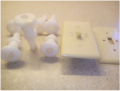
The 3 whiter contraptions fasten to ceiling; protuding at the center, 2 series - 2 antiparallel = a cluster of 4 white LEDs. Capacitively wired parallel to the wall switch. Made many.
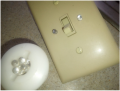
The wall plate on right has added 2 antiparallel white LEDs, also energized when switch is off. Both ways been working for a decade.
1789417248737.png
 

MisterBill2

Joined Jan 23, 2018
28,185
For at least 50 years I have been aware of "illuminated" light switches that include a small neon light inside the toggle lever. I don't know if they are still available. The very funny thing about them as that as they age they reach a point of needing additional light energy to illuminate.
 

MisterBill2

Joined Jan 23, 2018
28,185
To provide that dim light constantly will require a dimmer in parallel with the switch. IFthe installation is to-code, then the power feed is to the light J-box, not theswitch. So the second dimmer can be installed at the light position quite conveniently. Inconvenient to adjust, but it does not need frequent adjustment.
 

WBahn

Joined Mar 31, 2012
33,141
To provide that dim light constantly will require a dimmer in parallel with the switch. IFthe installation is to-code, then the power feed is to the light J-box, not theswitch. So the second dimmer can be installed at the light position quite conveniently. Inconvenient to adjust, but it does not need frequent adjustment.
Maybe I'm not following this, but I thought that the normal way that most lights are wired is that power comes into the junction box where the switch is, as this makes it the most convenient way to switch the hot conductor before sending it on to the light. If it comes into the light, you would then need to send it out to the switch and back to the light. I don't have a copy of the NEC and couldn't find anything on line that indicated that code requires that power come into the junction box with the light. Could you provide a link to a reference for that? Thanks.
 

Jon Chandler

Joined Jun 12, 2008
1,642
IFthe installation is to-code, then the power feed is to the light J-box, not theswitch
I can find nothing to support this claim (assuming NEC in the US).

An interesting new feature is that in most cases, neutral conducts must be included in most junction boxes to support smart sockets & switches which require power. This means running a 3 conductor + ground cable to a remote light socket.
 

MisterBill2

Joined Jan 23, 2018
28,185
I can find nothing to support this claim (assuming NEC in the US).

An interesting new feature is that in most cases, neutral conducts must be included in most junction boxes to support smart sockets & switches which require power. This means running a 3 conductor + ground cable to a remote light socket.
OK, power going first to the light-fixture is the rule in my city. The explanation I got is that it allows fans to be powered without affecting the light control.The simple scheme is to run 3-conductor cable from the ceiling box to the switch box. THAT allows all the options.
 
Top