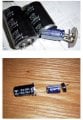
Exploding caps on a COB light control PCB

Thread Starter

Zurn

Joined Mar 4, 2019
122
Hi all, I'm having a problem with exploding filter capacitors on a PCB. The function of these boards is to periodically turn a small camera and COB light using an Arduino. I will also state that I did not design this (nor anything, I'm certainly no designer), and it was manufactured/populated by PCB Way in Shenzhen. Here's the schematic:
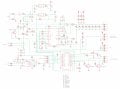
BRUVS-schematic2.jpeg

Here's the exact COB we're using.

The caps in question are the filters for the COB light: C8, C3, C2, C20, C4, C22, C15, and C18. R21 also burns out sometimes too.

I'm wondering if anyone can give some guidance as to how to troubleshoot this. All the analysis I've been able to independently muster has lead me nowhere (as in the design/components all seem to add up perfectly fine). In some cases replacing all the caps has led to a functioning board, but in other cases replacing all the caps has only solved the problem temporarily - after a while one of them just shorts again. I should also say that of the 20 boards we had made, this only happens on 6 of them - the rest work perfectly fine.

Any suggestions would be greatly appreciated!
 

panic mode

Joined Oct 10, 2011
4,864
U1, Q2, L1 and D2 form switching regulator that charges those capacitors. if they are blowing up, it means their rated voltage is exceeded or something is not connected correctly. what voltage they are rated for? what is the U1 part number?
R21 seem to be used to sense charging current so that U1 can control charging (throttle it).
max voltage would be determined by feedback, this seem to be R19 and R15. they form voltage divider to get you 1/28 of the output voltage to overvoltage protection pin OVP . since COB info suggest normal voltage is 34V, OVP seem to have trigger level of some 1.2V. This means the capacitors that blow up need to be rated for more than 34VDC. What are they rated for? (50V or 63V sounds reasonable).

it is a pretty lousy schematics - bunck of key things are not even shown (battery voltage, capacitor voltage, part numbers for D1, U1 etc.. resistor power...).

it looks like Battery is supposed to be 18V so this is essentially doubling voltage.

things that could go wrong and create the issue include:
faulty PCB or soldering mistake (if R15 is shorted, U1 would have no OVP feedback)
R15 or R19 are wrong value or R19 is defective or not properly connected (cold joint)
capacitors are underrated or installed incorrectly (wrong polarity)
etc,
 

Thread Starter

Zurn

Joined Mar 4, 2019
122
Thanks for the very detailed response panic mode. Really helpful.

what voltage they are rated for?
The caps are rated for 50V. Here's the digikey link.

what is the U1 part number?
U1 is a TPS92690PWPR/NOPB LED Driver

it is a pretty lousy schematics
haha yes I agree with this. The battery voltage is 14V nominal, 16.8V fully charged. Both diodes are these.

things that could go wrong and create the issue include:
faulty PCB or soldering mistake (if R15 is shorted, U1 would have no OVP feedback)
R15 or R19 are wrong value or R19 is defective or not properly connected (cold joint)
capacitors are underrated or installed incorrectly (wrong polarity)
I've confirmed the caps do have the correct polarity. I've also confirmed R15 and R19 have the correct values, though I can't confirm the solder joints are bad. From now on I'm making sure to reflow those joints when I replace the caps, however.

Everything seems to keep coming back to bad PCBs. I lack the experience to judge this, but maybe someone else has experience with PCB orders... can some be good and some bad in the same run? What makes them bad?
 

panic mode

Joined Oct 10, 2011
4,864
with small components/clearances of modern electronics, it is not hard to have a solder bridge under the component. the datasheet for the U1 shows that OVP threshold is indeed 1.19-1.23V so yes, the resistor values should be ok. you can probe voltages on various points of your board and compare them with working ones. or you can measure resistance of all resistors in the circuit. readings will sometimes be off but they should never be larger than resistor value - that would mean open circuit. and they should not be zero (that would be short circuit).

for further assistance try posting some pictures of the board, preferably also gerber files. this can help spot any layout issues r traces that may be too close... if drop of solder falls down for soldering iron it splatters... there is usually one large flake and bunch of tiny spheres that tend to find tight spots and may cause problems. this could be result of handsoldering of THT PCN terminals for example or just being close to work area while something else was dealt with. hard to tell without seeing actual product, design, layout, clearances etc.
 
Last edited:

Hymie

Joined Mar 30, 2018
1,347
panic mode has given a very good description of how the circuit works; if it is due to the voltage applied across the capacitors being to close (or above) their rating, you could try replacing resistor R19 with one of 91kΩ, or add a resistor of 1MΩ in parallel with R19 - which will result in a reduced output voltage across the capacitors.

Of course, the LEDs will be slightly less bright, but it might be easier than replacing the capacitors with ones having an increased voltage rating.
 

Thread Starter

Zurn

Joined Mar 4, 2019
122
Hi all, sorry for neglecting this very helpful thread... got pulled away on another project.

Something I'm wondering is could it just be a matter of a bad batch of capacitors? I've noticed that the only caps to short have been ones from the original batch, never one of the new ones I've replaced it with. I'm going to continue down this line until I find an instance of a new cap shorting out...

I'll try and get some photos/gerbers up soon when I'm back to working on this project. Thanks again for all the feedback, it's been very insightful.
 

djsfantasi

Joined Apr 11, 2010
9,237
I’m curious about the original caps on the PCB. Do you still have one that “exploded?

Where did you purchase the boards from? If overseas, perhaps the caps are not what they appear. There are many fake caps out there and if you disassemble one of the originals and find something like the attached pic, you’ll know.

IMG_5362.jpeg
 

Pyrex

Joined Feb 16, 2022
501
I’m curious about the original caps on the PCB. Do you still have one that “exploded?

Where did you purchase the boards from? If overseas, perhaps the caps are not what they appear. There are many fake caps out there and if you disassemble one of the originals and find something like the attached pic, you’ll know.

View attachment 296496
A very old photo, seems to be fake.
Discussed on an audio forum.
Much easier to fit a fake label on the housing
 

Pyrex

Joined Feb 16, 2022
501
to Zurn

You may check how the OVP work- simply disconnect wires from J1-1, 2 , 3 , 4 terminals and apply a DC voltmeter on the terminal. What is the voltage with no load? If voltage exceed 50V, it's something wrong with overvoltage protection.

Secondly, those 10 capacitors in parallel at the output. Allowable current according to the datasheet is 0.7A each, so 7 Amps allowed. Not so much , as COB requires as high as 2 Amps. Blown current sensor R21 indicates high current thru capacitors, too. If there's free space on the PCB, add some capacitors in parallel to C8-C18, this may help. Or, replace those capacitors to another, rated at 50V and of lower ESR and higher capacity
 

Poyntat

Joined May 24, 2022
60
l encountered similar problems with a battery charger design a few years ago.
To cut a long story short the problem was exploding tantalum capacitors that were placed on the output of a battery charging device.
The solution was to ensure that the voltage rating of the tantalum capacitor was at least double the voltage expected.
I did some research at the time and found quite a few scholarly articles regarding the potential failure modes of tantalum capacitors and found that one of the main failure modes was short circuiting after being subjected to transient voltage spikes.
Also R21, the current sense resistor will need to handle the power generated by a short circuit for as long as it takes for U1 to switch off the output and for the other capacitors on the output to discharge.
 

LesJones

Joined Jan 8, 2017
4,511
It looks like the design is a switching boost constant current regilator. If the cain of LEDs goes open circuit (Or the voltage required by the chain of LEDs is higher than 50 volts) then the capacitors will be destroyed. I had this problem with a switch mode boost regulator modified for constant current when one of the LEDs in the chain failed open curcuit. I have since modified it by adding a zener diode between the output and the voltege sense pin on the regulator to limit the maximum output voltage.

Les.
 

panic mode

Joined Oct 10, 2011
4,864
yes. in this case that is what OVP input on this chip is for. something is preventing it from working correctly and that could be wrong component values, bad connections, etc. but the TS never shared photos or at least gerber files to see if something is out of place.
 
Top