ESO Push/Pull Button Shut Down Pool Pumps

Thread Starter

Learning101

Joined Jan 12, 2022
12
In most industrial applications, where there are multiple motors that each have a starter, such as is described in this post, things are a bit different.
First, each motor has a a separate start button, because starting all of the motors at once puts a very large transient load on the power feed. Usually each motor has it's own stop button, but not always.
The emergency stop will switch off all of the motors, and none of them will start when the E-Stop is reset. So if the system is set up that way, then the set of contacts on the E-Stop button that close when it is pressed can sound the audible alarm, because resetting the E-Stop button does not start anything. That arrangement is often used for industrial systems, where a machine could harm an operator if it started at the wrong time.
If those "relays" are actual motor starters then they should have another contact for holding the coil powered when a start button is pressed.
So the big expense of this change will be getting four normally open, momentary action, start buttons.
And the maintained position E-stop button will need to have a set of contacts that close when it is pressed, in addition to those that open when it is in the "stop" position.
Thank you so much for the response! Everything you've stated makes sense and I 100% agree with you. What I didn't know is the large transient load on the power feed; I didn't even think of that.

In this scenario, having multiple stop buttons is simply not an option but it's a good idea. Not all pump motors run all the time and not all at the same time.

The EPO button is maintained push / pull---closed when pulled; open when pushed--- EPO Maintained Push / Pull. What if I added something like a contact block onto the EPO button and utilize the NO contacts, would that give the ability for the 120V to operate the audible alarm?

The exterior mounted 2 gang box cover would look something like this...
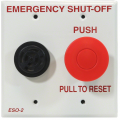
1659913113168.png

The relays I'm using are below. I did not check if those relay were actually motor starters.
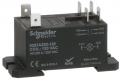
1659912908160.png

Should I be using something different other than the power relays above?

-Jake
 

Thread Starter

Learning101

Joined Jan 12, 2022
12
The arrangement I suggested in post #7 does not require any changes to the breaker panels nor adding a sub panel. It does require adding start buttons for each motor, which those can be on the enclosure of the motor power relays. And it may require a different emergency stop button. So the materials will cost several hundred dollars less. In addition, the controls for reset can be in an accessible location. Also, they will not be using breakers for motor control, which breaker contacts are not rated for motor starting. Instead it uses circuits the same as have been reliable for manufacturing operations for many years.
Currently the motors are hardwired to a DPST toggle switch as a disconnect for servicing the motors. You can look at the photos in the link below.

Marbella Community Pool

My idea was to have (4) power relays, each operating a single motor but the power relays operated by a set of contacts from a master control relay.

In the event of an emergency, and for purposes of clarity to the public, is to have just one E-stop that controls all four motors. Ideally, best case scenario without a budget, would be to have an E-stop button for each body of water---three separate bodies of water exist but the spa has (2), a spa filter motor and a booster motor---and you'd be correct to have each motor on it's own E-stop button.

What I'm trying to understand is if my solution, given the parameters and scope, is the correct way economically (budget-friendly), safely (contacts don't get hot and melt), and to code.
 

Thread Starter

Learning101

Joined Jan 12, 2022
12
OP, where are the pool heaters in all this? There should be another interlock between the pumps and heaters, in the existing panel. Just to make sure the E-stop, stopping the pumps does not cause heaters to over temp.
Also, the E-stop button likely to be in the pool area so there should be electrical requirements for shock hazard.
The only heater is for the spa and it's operated by natural gas and tied into the spa filter motor. And you're correct, the E-stop button is located with 5 feet of the main body of water---there are three separate bodies of water: main pool, wading pool, spa. you can take a look at the photos in the link below.

Marbella Community Pool

-Jake
 

Thread Starter

Learning101

Joined Jan 12, 2022
12
All Pool-Pumps are required to be on a GFCI-Circuit-Breaker according to the NEC.
Not complying with the NEC is a sure-fire way to loose a Law-Suit.

The NEC does not make any recommendations for a remote Kill-Button,
but does specify that the means of disconnect
is UL-Approved, "within-sight", and readily accessible at all times.
.
.
.
You are correct about all pool pumps are required to be on GFCI circuit breakers NEC 680.21(C) & 680.21(D) GFCI Protection.

NEC probably does not make any recommendations for an E-stop button; however, the 2021 International Swimming Pool and Spa Code does have provisions.

-Jake
 

Thread Starter

Learning101

Joined Jan 12, 2022
12
Although the pump motors are 208/230VAC it's common to use a lower voltage for the control logic. A 120VAC control transformer or 24VDC power. This would not be on the GFIC and needs to be confirmed before wiring that to an E-stop circuit.

It would be best and safest to see pictures of the control panels or wiring diagrams. There could be simple motor START/STOP logic or it could be tied into water level sensors etc. and any temperature controls.
Would you suggest I bring the 120VAC from the service panel into a transformer for 24VDC and control the E-stop with 24VDC due to the E-stop not being on GFCI protected?

Currently, the pump motors are hard-wired in and operated by a DPST toggle switch as a means for a disconnect to service the motors. You can take a look at the photos and videos in the link below.

Marbella Community Pool


-Jake
 

Thread Starter

Learning101

Joined Jan 12, 2022
12
OP, you could use one E-stop relay per pump motor, and those relays all supplied by the E-stop button loop. It might be easier using separate relays if each pump has a complicated controller and panel. A single E-stop relay could be used as well but the wiring is a bit more complicated. Let us know what you prefer- I can't tell what your existing motor controls look like.
I am uncomfortable running 120/208V out to the E-stop at pool side without its own dedicated GFCI, or going low voltage.
Full disclosure: I'm not a pool guy and won't even pretend I understand pool equipment. I do know, or at least assume, the spa booster motor is controlled by a timer out by the spa; other than that knowledge, I don't know nor understand what controls the pool pump motors. I see a number of small black tubing running out of the plumbing and those may be pressure switches.

All I'm looking to do is to break the supply voltage to all (4) pump motors at one time in the event of an emergency by utilizing a maintained push / pull E-stop. The simplest solution I could come up with: (1) 120VAC E-stop button to a master control relay (MCR). MCR would control the audible alarm and energize/de-energize (4) separate power relays with 120VAC coils and 30A contacts.

The feedback has been great thus far, but now I'm a bit unsure if my solution is correct based off the responses on this post.

I do like the idea of having low voltage out to the E-stop; it's actually a damn good idea and I would never even have thought of that. The pump motors would each have their own GFCI breaker but the dedicated circuit to the E-stop would not be GFCI; therefore, the low voltage is a really good idea.

-Jake
 

MisterBill2

Joined Jan 23, 2018
27,514
Is the arrangement in post #1 how the system is wired? Or a version of how it might be wired? Would all of the motor relays be in one location, or each in a separate enclosure near each motor? And are those motor switches near each motor or at a separate master control location?
What would be very handy is motor relays similar to the photo but with three normally open contacts instead of only two sets. of contacts. Those would be listed as "3-phase" motor relays. The extra contacts will serve for the latching function when start buttons for each motor are added.
The E-STOP button will be in series with the supply for all of the motor control relays. That line will feed a parallel combination of the N.O. start button and the third contact of the relay. The other side of that perallelcombination will connect to one side of the relay coil, the other side of the coil connects to the coil power source common return line.
So for each motor the operation is: When the E-STOP button is out, the contact is closed and power is supplied to the start buttoand the NO contact.When the start button is pressed power id supplied to the relay coil and all three contacts close. So now power is supplied to the relay coil through the third contact. If the power is interrupted by the stop button OR a mains power failure, the relay will release and when power is available the motor will not restart until the start button is pressed.
The motor is still made safe for servicing by the existing DPDT switch in the motor power leads. THAT has not changed.

For the alarm sounder, there should be a second contact on the E-STOP button that is closed when it is pressed and latched. So when the button is pressed and latches , the alarm sounds. Quieting the alarm is done by pulling out the E-STOP switch, which only silences the alarm but does not start any motors.
 
How does the existing Emergency Shut-Off Switch work? I don't see any motor controls, motor control panel, relays or contactors in the pics beyond a light switch which is not enough for so many motors. It must be for just one pump?
The breaker panel shows no GFCI breakers although some feeds are labelled "GFCI" so there might be some local at an outlet? How that got approved by the City Building Safety Division seems dodgy, Article 680.21 it calls for them. {edit: yes in 2008-2017 NEC, changed in 2020 NEC for <150V motors}
There is also a breaker labelled "KILL" something something that might be for the kill switch? If so, it could be changed to a GFCI and then 120VAC E-stop and wiring would be OK.
Usually a motor contactor is used for motors, they are a relay that can handle the high inrush currents as the motor spins up - but centrifugal pumps have almost nothing for inertia. I think you've got T92 relays which are low cost and OK to use.
Your equipment list needs to include an enclosure to mount the relays in, extra wire for the E-stop lamp (and add it to your wiring diagram) . So far it looks like you are on the right track. I would revisit the site in search of GFCI and if the old E-stop location meets the 5ft requirement, not around the corner or hidden in a bush etc. The electrical work seems to have missed pool specific requirements.
Note Article 680 has a bunch of changes coming for 2023. The GFCI's, corroded ground wiring, quite a bit. They seem to have a new class SPGFCI with higher trips for the pumps, not for shock protection, which leaves the E-stop needing something Class A.
 
Last edited:

MisterBill2

Joined Jan 23, 2018
27,514
@P-M: back to post #1, there is no master E_Stop button. And what needs to be within 5 feet of what?? These are not service shutoff switches being discussed, I am presuming that those are already present, although I suspect unplugging a pump to work on it would be acceptable, if the plug were close enough.
The arrangement I have proposed is for the E-STOP function only, because there is no need to confuse anybody with every demanded improvement all in one proposal.
GFCI is an entirely separate concern as well, but it is not related to adding a master E-STOP ability.
Likewise, a service shutoff of some kind, near each pump, is needed, but that also is simply not part of an E-STOP addition.

This response has degenerated into a pile-on attack of heaping on every possible addition to a request for one bit of help.
It offers not much help for so many to recite every rule that they think might apply to what they assume is being discussed.
 
The E-stop wiring diagram to us is straightforward but the extra requirements for pool safety is important to mention. Of course one would consult an electrical inspector or professional engineer to confirm the E-stop will meet NEC requirements.
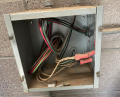
From the existing site photos, they show an existing outdoor "Emergency Shut-Off Switch" likely in series with one pump? - and no GFCI for it, despite the proximity to the pool and busted switch plate and let's add some rain. OP can confirm if this is the case.
680.41 "Emergency Switch for Spas and Hot Tubs. A clearly labeled emergency shutoff or control switch for the purpose of stopping the motor(s) that provide power to the recirculation system and jet system shall be installed at a point readily accessible to the users and not less than 1.5 m (5 ft) away, adjacent to, and within sight of the spa or hot tub."
So that's located 5-50ft. Anything (outlets, luminaires, loudspeakers, fans) close to the pool requires GFCI. The 680.2 "low voltage contact limit" is defined less than what we are used to because of extra wet people in water: 15Vrms, 30VDC.
I would design it for the risk of being a wet E-stop switch, so adding a GFCI or using a suitable low voltage power supply.

From what I can ascertain, the pump motors are fed directly by breakers in the electrical panel. There are no contactors, controllers, relays etc. 3-phase motors require external overload protection so I thought there would be something existing OP could use or tie into. But these are single-phase Pentair pumps. So it looks like OP must add relays/contactors for the pumps' shutoff.
I also see no GFCI breakers despite labelling and NEC changed several times what is required. NEC 680.21 "All swimming pool motors that are on branch circuits are required to have Class A GFCI protection for personnel. This applies to replacement pump motors as well."
2008-2017 680.21(c) it's all pool pump motors 120/240V requiring GFCI - but then 2020 changed to "150V or less, 60A or less" and OP's are 208/230V.
I'm mentioning this because of post #8,#12 etc. and the change is odd. 2023 NEC has amendments for SPGFCI protection on pump motors >150V. It still sounds mixed up. Not relevant to OP's question but good knowledge.
 

Thread Starter

Learning101

Joined Jan 12, 2022
12
Is the arrangement in post #1 how the system is wired? Or a version of how it might be wired? Would all of the motor relays be in one location, or each in a separate enclosure near each motor? And are those motor switches near each motor or at a separate master control location?
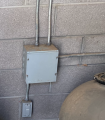
Currently the system is NOT wired as in post #1; that is a proposed rewire of the system. The existing wiring consists of what you see in the photos: 20A, 1P breaker feeds the existing SPST toggle switch utilized as an emergency stop that cuts power to the main pool pump motors [only] and is mounted within 5 feet of the main pool; hence, it shuts down only the main pool motor; the wading pool and spa pump motors still run; there's no way to shut them down, currently. From the service panel, you can see there are (4) separate non-GFCI breakers that feed into (4) separate DPST toggle switches to which (4) individual motors are wired.

I'd be bringing the project up to code by removing the (4) GFCI breakers for the pool pump motors and the (1) for the E-stop switch and installing all new GFCI breakers. I'd also be removing the existing SPST E-stop switch and replacing with a maintained push / pull button with LED and adding an audible alarm.

What I was thinking of doing was utilizing the pool equipment enclosure junction box on the backside of the service panel to house all the relays and mount them on din rail.

1659972186240.png1659973579474.png


What would be very handy is motor relays similar to the photo but with three normally open contacts instead of only two sets. of contacts. Those would be listed as "3-phase" motor relays. The extra contacts will serve for the latching function when start buttons for each motor are added.
The E-STOP button will be in series with the supply for all of the motor control relays. That line will feed a parallel combination of the N.O. start button and the third contact of the relay. The other side of that perallelcombination will connect to one side of the relay coil, the other side of the coil connects to the coil power source common return line.
So for each motor the operation is: When the E-STOP button is out, the contact is closed and power is supplied to the start buttoand the NO contact.When the start button is pressed power id supplied to the relay coil and all three contacts close. So now power is supplied to the relay coil through the third contact. If the power is interrupted by the stop button OR a mains power failure, the relay will release and when power is available the motor will not restart until the start button is pressed.
The motor is still made safe for servicing by the existing DPDT switch in the motor power leads. THAT has not changed.

For the alarm sounder, there should be a second contact on the E-STOP button that is closed when it is pressed and latched. So when the button is pressed and latches , the alarm sounds. Quieting the alarm is done by pulling out the E-STOP switch, which only silences the alarm but does not start any motors.
Amazing---what you've suggested here is a phenomenal solution!!! I cannot say I fully understand because I will visually need to see the diagram drawn out for my comprehension, so I'll work on that and repost when I get it completed for confirmation that I understand and it's correct.

-Jake
 
For 120VAC power for the E-stop, I wonder if you can use the pool room GFCI outlet as the take off?

I have used the Potter & Brumfield now TE Connectivity T92 relays (Schneider is just private labelling them) in commercial products (heating controllers) and did run into problems with them. Although rated to 30A, the relays were running too hot and IR thermal imaging revealed the flange connections as the problem.
It turns out 1/4" spade crimp connectors crap out at 20A, they are not great to use past that due to the limiting spring pressure, and they must be high quality (thick copper) as well not the stuff off eBay. The same relay (flange type) is rated for only 20A by VDE, yet 30A by UL. Sorry I forgot about that. If you can get the relay without spade connections, or check the current they are running at. Also they normally do make heat at least 2-4W due to the coil and contact resistance, so mounting them in close quarters I would avoid. They need some spacing for cooling.
 

MisterBill2

Joined Jan 23, 2018
27,514
For 120VAC power for the E-stop, I wonder if you can use the pool room GFCI outlet as the take off?

I have used the Potter & Brumfield now TE Connectivity T92 relays (Schneider is just private labelling them) in commercial products (heating controllers) and did run into problems with them. Although rated to 30A, the relays were running too hot and IR thermal imaging revealed the flange connections as the problem.
It turns out 1/4" spade crimp connectors crap out at 20A, they are not great to use past that due to the limiting spring pressure, and they must be high quality (thick copper) as well not the stuff off eBay. The same relay (flange type) is rated for only 20A by VDE, yet 30A by UL. Sorry I forgot about that. If you can get the relay without spade connections, or check the current they are running at. Also they normally do make heat at least 2-4W due to the coil and contact resistance, so mounting them in close quarters I would avoid. They need some spacing for cooling.
I suggest looking at the "Automation Direct" catalog / website. All of their stuff that I have used has been OK. Especially the E-STOP buttons. You DO need an e-stop button with both NO and NC contacts so that when it is pushed the alarm will sound. That is the simplest, cheapest, and most reliable method of enabling an E-STOP alarm, and letting folks know where the reset is.
 
What I find is typically the original contractor went cheap, cut corners on a few things, and then everyone afterwards did the same. So older sites can get pretty bad and open up a can of worms with a upgrade such as this. Still wondering where the original GFCI's went for the pumps, for example. The pump ground wires look pretty skinny compared to code requirements.

Normally you'd use motor contactors, the pump motors have a built in thermal overload.
But this is big and expensive so the lure to use a smaller, lower cost relay. Newark sells Schneider 92S7A22D-120 relay for $27.
Automation Direct offers low cost WDP contactors, 2-pole 32A $11.50 but a bit big and ugly.
Hmmm, save $50 but need an additional enclosure to fit all this.
Because these relays are on almost all of the time, they heat up and age and don't last as long as expected. I fuse the coil path to way less than the branch feed of 20/30A in the case of a coil shorting, it will not burn things or the E-stop switch. I also like panel lights to indicate if something is on but my style is to spend a bit more money on projects.

There should be some interlock or protection for the heater to switch off if the pump is not circulating. It might have a flow switch for that. If not, it will just boil a bit...
 

MisterBill2

Joined Jan 23, 2018
27,514
Bjgger and ugly for a motor control relay is often better because of more material to spread the heat. And since an enclosure to mount the individual start buttons , and possibly also the service shutoff switch, is already required, what is wrong with a motor power relay in an enclosure. A power relay in a pretty little box would never ever be used in automotive production equipment, where power on times can run for weeks. And keep in mind that whatever relay is selected, there needs to be an additional contact for the latching on function. That is quite important, really.
And for the heater interlock, consider this installation is in Arizona, probably near Phoenix. No pool heater needed, ever.
 

Paul L

Joined Aug 28, 2020
1
When I first saw this q, its a BIG question with pools have a lot of (new) NEC and other requirements and so do EPOs.
- also does power control and relay theory (why, how to link together operation of 3 systems, whether colocated or not).
- also concept of operations (ConOps: why shutting down, how to restart, operator experience, training, maintenance)
And OP's question
- touches so many.
- Many standards have had a LOT of recent changes (like grounding, GFCI and handling suction).
- in past, multipole GFCI were very expensive, they must have gotten cheaper and more available

With EPO, event like smoke, clogs, personal injury causes a panicked, limited info, response.
- Eventually systems must be brought back in an orderly fashion. (Another poster mentioned surge being another reason)
- When someone tripped an EPO our labs, usually inadvertant, it was hours to eval and bring up the system again.

Decades ago pool suction went from
- large raised grills with side entries,
- to two separated exit grills that a human cannot span (to avoid swimmers from being trapped at the bottom),
- to next-NEC-rev pumps that sense restrictions and trip (seems like could cause nuisance trips).
So I would recommend also investigating future needs if an existing motor fails, what do the replacements need and offer

Our labs used shunt trip too. Seems like would make an orderly individual restore easier.
And avoid the concept of having a 115vac EPO circuit daisy-changing through the 3 wet pool areas.
Of course then if the pool is open at night, then still have to partition loads carefully to not leave public swimming in the dark.

I also second having your AHJ (authority having jurisdiction) as a minimum consulted in addition to thinking through ConOps.
 

MisterBill2

Joined Jan 23, 2018
27,514
When I first saw this q, its a BIG question with pools have a lot of (new) NEC and other requirements and so do EPOs.
- also does power control and relay theory (why, how to link together operation of 3 systems, whether colocated or not).
- also concept of operations (ConOps: why shutting down, how to restart, operator experience, training, maintenance)
And OP's question
- touches so many.
- Many standards have had a LOT of recent changes (like grounding, GFCI and handling suction).
- in past, multipole GFCI were very expensive, they must have gotten cheaper and more available

With EPO, event like smoke, clogs, personal injury causes a panicked, limited info, response.
- Eventually systems must be brought back in an orderly fashion. (Another poster mentioned surge being another reason)
- When someone tripped an EPO our labs, usually inadvertant, it was hours to eval and bring up the system again.

Decades ago pool suction went from
- large raised grills with side entries,
- to two separated exit grills that a human cannot span (to avoid swimmers from being trapped at the bottom),
- to next-NEC-rev pumps that sense restrictions and trip (seems like could cause nuisance trips).
So I would recommend also investigating future needs if an existing motor fails, what do the replacements need and offer

Our labs used shunt trip too. Seems like would make an orderly individual restore easier.
And avoid the concept of having a 115vac EPO circuit daisy-changing through the 3 wet pool areas.
Of course then if the pool is open at night, then still have to partition loads carefully to not leave public swimming in the dark.

I also second having your AHJ (authority having jurisdiction) as a minimum consulted in addition to thinking through ConOps.
Usually any authority is given on the basis of longevity rather than any technical ability. And political favors also seem to have some effect. And often those individuals seem to lack any ability to actually think, being able only to recite a script.
As for the shutdown scheme, I did create the design for a master E-STOP for a hydraulic pump test lab. That system included multiple starters for the three voltages used there, 120 single phase, 240 3 phase and 480 volts 3 phase. And each position had its own start/stop buttons as well. So it was sort of complicated.
My point being that such a concept would be quite beyond what a lot could even understand.
In the case of the multiple pool systems a single E-STOP button string and individual start buttons is the rational approach.
 
Top