ESD - Wooden chopsticks

Thread Starter

bootloader9800

Joined Jan 12, 2021
79
Hi folks, hope all is well!
Does handling/placing/moving ESD sensitive components with wooden chopsticks give the same protection as wearing an ESD wrist brace ( or any other anti ESD device ) ?
Thank you for your replies!
 

Deleted member 115935

Joined Dec 31, 1969
0
Hi folks, hope all is well!
Does handling/placing/moving ESD sensitive components with wooden chopsticks give the same protection as wearing an ESD wrist brace ( or any other anti ESD device ) ?
Thank you for your replies!

The idea of ESD protection, is to keep everything at the same voltage / potential.

So you do NOT want to insulate , you want to conduct.

Aim is bench , tools, yourself, equipment are all at the same potential,
Even if your all at say 2Kv, it does not matter as the potential between you and the other bits is "zero"

Thats why we strap our self to a reference point, strap the bench to same, use conductive bags to move stuff, so every thign is at the same volts.

In the silicon labs I entre, we have to wear full suits,
yes to keep dust out , but also , they are conductive, so we are all at the same potential.


So

Do you think wooden chop sticks, as a fairly good insulator would work ?
 

Sensacell

Joined Jun 19, 2012
3,784
ESD is a complex subject, there is no "one thing" that fixes it, it's about creating systems and environments where the chance of discharge is minimized.
 

Tonyr1084

Joined Sep 24, 2015
9,744
Wood is fairly low on the triboelectric scale. The closer to the zero point the better. Wood is not likely to generate much static, nor is it likely to conduct high static voltages. However, it is one of those items that are frowned upon at an electric bench. Paper is another - but then again, it's made from wood pulp. Plastic cups are a horrible NO-NO. Aluminum foil, while conductive, can be TOO conductive and can lead to problems. Click on the triboelectric scale below for a complete list of items and their potential for generating static charges.

Triboelectric scale

Like andrewmm said, you want everything at the same potential. That way there's no transfer of potentials leading to sudden high current discharges.

On cold dry mornings when you walk across the carpet and grab the door knob you can get a hell of a shock. Why? Well, the door knob is not grounded, and the wooden door is relatively non-conductive. So why the huge snap when you touch it? It's the difference in potential. And the human body can store up to 50KV Static Charge. Even when you're carrying 3KVSC you won't notice it when you touch something grounded. Not unless you're paying hyper-attention to it. I mean REALLY trying to sense the current when you touch ground.

That's why I always use stainless steel tweezers to place small components. That or probe it and position it with a steel pick.
 

Lo_volt

Joined Apr 3, 2014
370
Aluminum foil, while conductive, can be TOO conductive and can lead to problems.
Indeed, too conductive is an issue as the static discharge current will be too high. Static mats and wrist straps are conductive but at a high impedance so as to limit the current.

On a side note, one manufacturer I was working for received a circuit board returned for repair that had been wrapped in aluminum foil when shipped. It was impossible to tell what had been wrong with it before shipment as the damage done because of the foil was so extensive. There were almost no working IC's on the board.
 

Deleted member 115935

Joined Dec 31, 1969
0
Indeed, too conductive is an issue as the static discharge current will be too high. Static mats and wrist straps are conductive but at a high impedance so as to limit the current.

On a side note, one manufacturer I was working for received a circuit board returned for repair that had been wrapped in aluminum foil when shipped. It was impossible to tell what had been wrong with it before shipment as the damage done because of the foil was so extensive. There were almost no working IC's on the board.
Al foil. would create a faraday cage,
how did the foil damage the board ?
 

Lo_volt

Joined Apr 3, 2014
370
Al foil. would create a faraday cage,
how did the foil damage the board ?
It was a through hole PC board. The aluminum foil contacted every pin on the bottom of the board as well as any conductive points on the top of the board. A faraday cage typically only contacts the ground plane of the board. It's impossible to say how much static the board took or where it went on the board.

Most antistatic bags are not low impedance. This is to limit the current from a static disharge.
 

Tonyr1084

Joined Sep 24, 2015
9,744
Even if the leads were touching the foil it still should have conducted any static fields around the board to ground. The damage must have occurred elsewhere. Even being in a cardboard box in a truck full of cardboard boxes without the proper protection still shouldn't cause a problem. The foil should have protected it.

I, too, did some repair on customer returns in the banking market. Got many things back with descriptions of what was (supposedly) wrong with the unit. However, upon discovery of Coca-Cola having been spilled on the electronics - is a good reason to toss it in the bin and sell them a new unit. Other sweet drinks just meant washing the boards and putting it back into service. Just because a customer tells you what's wrong doesn't mean that's what's wrong with it.

Lo_volt the only way I can see foil becoming a problem is if it was sandwiched between layers of foil and each layer was isolated from the other, forming a capacitor.
On a side note, one manufacturer I was working for received a circuit board returned for repair that had been wrapped in aluminum foil when shipped. It was impossible to tell what had been wrong with it before shipment as the damage done because of the foil was so extensive. There were almost no working IC's on the board.
If the foil is continuous then all the current from the static field should be conducted around the board to ground - or to some other level of charge nearby. Nothing should have passed through the board. But yes - aluminum foil DOES present a rapid discharge danger. So AF is not a good idea for static protection.

On the subject of "Chopsticks" - they also make plastic chopsticks. STAY THE HELL AWAY FROM THOSE! Now, if you can find stainless steel chopsticks - go for it. Another name for stainless steel chopsticks is "Tweezers". There are even plastic "Static Conductive" tweezers available, but they're more money for no-more protection. The only benefit I can see from plastic tweezers is when you drop them in your lap and you quickly close your legs to catch them - they don't stab you in the leg. Well, another benefit - they don't bend their tips when they hit the floor tip first.
 

Tonyr1084

Joined Sep 24, 2015
9,744
It was a through hole PC board. The aluminum foil contacted every pin on the bottom of the board as well as any conductive points on the top of the board. A faraday cage typically only contacts the ground plane of the board. It's impossible to say how much static the board took or where it went on the board.

Most antistatic bags are not low impedance. This is to limit the current from a static disharge.
Best practice is to have the board nestled on a bed of conductive foam and placed in a Velostat bag. (I believe "Velostat" is a name brand - it's a metallized plastic bag with the metallic surface on the outside). The conductive nature of the bag will pull the static charge around the bag and to ground without sending any charge through the board. Industry standard says you're not to puncture or use a bag that has been punctured. While I'm pretty adept at ESD control, this one has always eluded me as for the reason why. They say static can leak through the pin-holes. Remember, static is not like water, it's like lightning. If it can find a hole it will simply discharge to the walls of the pierced point. Nevertheless, in the electronics industry, they throw out bags that have been stapled or pierced in any way, shape or form.

Another highly recommended method of shipping ESD sensitive boards is to put them on a foam bed inside a cardboard box that is lined with a conductive surface inside the box. Even better still is to use that same box with the board in a Velostat bag.
 

Tonyr1084

Joined Sep 24, 2015
9,744
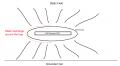
The static field will discharge along the surface of the bag and radiate to ground. The closer to ground the more thoroughly the static field will be dissipated. Current does not pass through the bag. Aluminum foil should be the same principal. Even if pins are touching the conductive layer. Remember, everything at the same potential - no current flow - no damage.
1629547749294.png
 

Lo_volt

Joined Apr 3, 2014
370
The problem with aluminum foil is the low resistance. If the wrapped board does take a contact hit there is now a high potential sending (now very high) current through who knows what path on the board, very likely many paths.
Antistatic bags will conduct a contact static hit at low current due to the high resistance of the bag material. Note that they're typically meg-ohm resistance not non-conductive.
 

Tonyr1084

Joined Sep 24, 2015
9,744
Again, if there are multiple layers of AF then you have to worry about charge moving from one to the other. But if there is a single contiguous layer of AF then current would have no place to go. Even if the foil was at 100KVSC (Kilo Volts Static Charge) the board would be held at that same potential. A contact of any of the components, whether copper trace or component body -there wouldn't be any movement of charge.

Aluminum Foil IS a problem and not recommended for use. However, in dire circumstances, AF can be used with fairly good results.

Imagine you're trapped inside a metal sphere. Someone applies high voltage to the surface of the sphere. Remember, you're inside. Wearing shoes that insulate you. What happens when you touch the charged sphere? Same thing that happens when a bird lands on the power lines behind my house (7KVAC)? The bird doesn't get a shock and die. In fact, since the birds return time and again I have to imagine it's not even painful. If it were then they wouldn't land there. If it were lethal then someone would be hollering about protecting birds from power lines. Somewhere in the mid west (I think) there was a report of eagles landing on top of power poles. When they'd drop off the pole between the two lines, their wings would contact both lines and get electrocuted instantly. In that case there was a huge potential between the two lines and contacting both lines at the same time meant death. But touching just one line never bothered any birds. Now, I don't recall ever seeing birds on transmission lines, maybe the extreme voltage does present some sort of unpleasantness to it, but I've seen videos of helicopters with linesmen working on those high voltage lines while powered. They have to reach out and connect a line from the copter to the wire being worked on in order to keep both the copter and worker at the same potential as the transmission line. If it's unpleasant - I've never heard that stated.

So a board inside a Faraday Cage of AF should not have caused the entire board to be blown to smithereens. Something else got the board.

Now, when was the last time we heard from the TS ? ? ? 8/19 (last Thursday) So he's apparently gotten his answer. Or lost interest in this thread.
 

DickCappels

Joined Aug 21, 2008
10,661
Yes, clean, dry chopsticks are probably much safer than using your hands. I am thinking about the unvarnished and unpainted wooden type.
 

Deleted member 115935

Joined Dec 31, 1969
0
just for reference,
as far as I know here are three basic types of anti static bags

The pink ones, they are only pink by convention, I work for one company that has them made blue !

these "pink" bags, are fairly low strength , easy to puncture,
and cheep,
they work by the plastic being "conductive" , well its normally called dissipative, as its a fairly low conductivity.

The silver ones.
These are much more rugged, resistant to puncher
these have an inner layer of the above plastic, but no pink dye added,
middle is a foil, normally aluminium
outer is again the conductive plastic, some times this layer has black" conductive" stripes printed on them,
They work just as the above bag, but the metal layer adds an effective faraday shield.


The third is the dangerous one,

It look much like the second one above,
its "metalized" , but cheap
its made using a NONE conductive plastic,
some times the metallisation is just on one side of the plastic.

Think of the construction
These make a perfect capacitors with the bench
bench outer plastic metal inner plastic,

At best they make a faraday shield,
but being insulated, they hold charge
 
Last edited by a moderator:

Tonyr1084

Joined Sep 24, 2015
9,744
just for reference,
as far as I know here are three basic types of anti static bags

The pink ones, they are only pink by convention, I work for one company that has them made blue !

these "pink" bags, are fairly low strength , easy to puncture,
and cheep,
they work by the plastic being "conductive" , well its normally called dissipative, as its a fairly low conductivity.
This is a misnomer. Pink Polly bags are not static shielding. Nor are they conductive. They simply are extremely low on the triboelectric scale. In short - they don't produce static. Other plastic bags WILL produce static. In fact, Pink Polly was an accidental discovery. I can't relate the story fully - and probably chocked with inaccuracies, but I think it goes something like this: A lab worker was supposed to clean beakers at the end of the day. He cleaned them all but forgot to rinse one of them. The next morning it was noticed that the other beakers had collected dust whereas the one he forgot to rinse didn't. The discovery was accidental. I'll google it and if I find it I'll add the link.

The other two types of bags are the metalized bags. They are like the one in my illustration where a static field is being pulled to the conductive surface and then radiated below to the grounding mat. They are rugged - and conductive. However, I don't know what level of conductivity they have. For all I know, they could be as conductive as foil. I just don't know; and won't say something I don't know when I'm talking about it. The only other bag I'm familiar with is the black conductive bags. I believe they fell out of use because their coating can rub off on the board and contaminate the solderability. But that - also - I don't know for sure. The Pink Polly - that I know.
 
Top