Engineering Mistake

SamR

Joined Mar 19, 2019
5,470
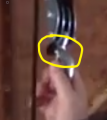
It's missing a cleat for the end of the line on one of the sheaves... Looks like they just tied a knot at the end to keep it from coming out of the sheave!
1698166949138.png
 
Last edited:

SamR

Joined Mar 19, 2019
5,470
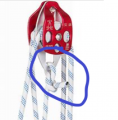
That is NOT a block and tackle!

Correct
1698167166040.png

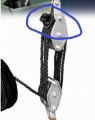
Incorrect and Very Dangerous! Not to mention also backwards, you don't pull UP!
1698167294483.png
 
Last edited:

Thread Starter

MaxHeadRoom

Joined Jul 18, 2013
30,562
OK I will give it to you,. :)
The way it is sold, the ratio does not achieve the 7:1 possible, just 6:1.
What I did was take the end of rope cleat and fasten to the top of the bottom block.
Or top block, depending on the ratio.

Why is it not a Block & Tackle??
 
Last edited:

Thread Starter

MaxHeadRoom

Joined Jul 18, 2013
30,562
The other error I found on mine, was that the bolts that carry the sheaves are threaded the whole way, which after some time of use, cuts into the plastic pulleys, causing greater and greater effort to use over time.
The answer is to fit shoulder bolts of the correct length.
 

SamR

Joined Mar 19, 2019
5,470
It would be a block and tackle if one of them had the bottom connection cleat to anchor the line. As is, it's just a double set of misrigged pulleys. I did notice that the side plates appeared to be loose as the nuts on the pulley bolts weren't even tight against the side plates. Very crudely made. The picture of it rigged to pull UP on the line to hoist is ludicrously done by someone who knows nothing on how to rig a block and tackle for lifting and has it upside down. I have an old 7-part block and tackle of my grandfathers who ran a shipping company with stevedore labor crews in the early 1900s. That's 2 triple blocks with one having the anchoring cleat. When I was teaching pulleys in science class, I'd take the ~15 kids in class outside and set up the block and tackle anchored to a tree and let one of the girls in class play tug of war against the rest of the class. The single girl on the line usually won against the rest of the class on the hook.
 

Thread Starter

MaxHeadRoom

Joined Jul 18, 2013
30,562
I had to do a bit of work on the one I got to get it up to snuff!
The first thing was to replace the rope, on the one I picked up, cheapo stuff, replaced it with double braided.
 

WBahn

Joined Mar 31, 2012
32,707
OK I will give it to you,. :)
The way it is sold, the ratio does not achieve the 7:1 possible, just 6:1.
What I did was take the end of rope cleat and fasten to the top of the bottom block.
Or top block, depending on the ratio.

Why is it not a Block & Tackle??
I don't see where they claim that the mechanical advantage is 7:1 (or anything else, for that matter). I'm probably just missing the obvious.
 

Thread Starter

MaxHeadRoom

Joined Jul 18, 2013
30,562
The mechanical advantage of a block and tackle is based on the amount of pulleys, the degree of reduction.
IOW, on a 7:1 block (7 pulleys) , for every 7ft you gain on a pull, the the resultant lift pulley raises the lifted object 1ft.
 

WBahn

Joined Mar 31, 2012
32,707
I know how to find the mechanical advantage of a pulley system, but you seem to be saying that the advertised block and tackle only had a mechanical advantage of six while it claimed to have an MA of seven. I'm saying I don't see where the ad claimed any particular mechanical advantage at all, but perhaps I'm just not looking in the right spot.

Beyond that, you can't just claim that the MA of a block and tackle is simply the number of pulleys. A single pully offers no mechanical advantage if it is fixed (i.e., rove to disadvantage), but that same single pully offers a an MA of 2 if it is rove to advantage by being mounted on the moving object.

Looking at the pictures in the ad, I can't convince myself definitively how that unit is wrapped, but I just looked at the second video (the third one that you referred to didn't tell me much, so again I might just be missing something) and it shows someone assembling it (does it not come assembled?) and how the rope is being anchored effectively removes one of the six pulleys from use. Thus you only have five operational pulleys and so you will get a mechanical advantage of either five or six, depending on whether it is reeved to disadvantage or advantage, respectively. That is determined by which hook is connected to the fixed point and which to the moving. If the rope is pulled in the same direction that the load moves, it is reeved to advantage.
 

MrChips

Joined Oct 2, 2009
34,629
I would count the number of vertical ropes, not the number of pulleys.
The running end should be coming down from the top pulley so that you pull down, not up.
If the running end is coming down from the bottom pulley I would deduct one rope. Hence I see 6 - 1= 5:1 advantage.

Also, I agree that that knot should have been tied off at one of the blocks.
 

Thread Starter

MaxHeadRoom

Joined Jul 18, 2013
30,562
I have one similar and have visited a few stores where they sell various versions of these and in almost all cases, the block end is not attached to the top (or bottom) of the sheave which depends on whether it is a 6:1 or 7:1.
If not secured in the right place, the result is that one (last) pulley Never rotates.
I am aware they are not claiming anything, but why make a 7:1 when the result is 6:1?
This guy pretty much sums it up.
 

SamR

Joined Mar 19, 2019
5,470
7:1 requires 2 blocks with 3 pulleys each with the "dead" end anchored to the bottom of one of the blocks. The way they have it rigged does take one pulley completely out of use. I see it as a 5:1.
 

MrChips

Joined Oct 2, 2009
34,629
7:1 requires 2 blocks with 3 pulleys each with the "dead" end anchored to the bottom of one of the blocks. The way they have it rigged does take one pulley completely out of use. I see it as a 5:1.
I see 4 pulleys on the top block and 3 pulleys on the bottom for 7:1.
If the end is to tied to the top block of 3 pulleys then I see 6:1.
 

WBahn

Joined Mar 31, 2012
32,707
I have one similar and have visited a few stores where they sell various versions of these and in almost all cases, the block end is not attached to the top (or bottom) of the sheave which depends on whether it is a 6:1 or 7:1.
If not secured in the right place, the result is that one (last) pulley Never rotates.
I am aware they are not claiming anything, but why make a 7:1 when the result is 6:1?
This guy pretty much sums it up.
I agree that they've made one pulley useless. As for the why, I can only speculate, of course, but it is likely just a simple matter of economics. It is possibly cheaper to make 2X blocks having three pulleys than X blocks having 3 pulleys and X blocks having two. As for not connecting the rope to the block, that would add expense to the block compared to the simple plate that they supply. I rather doubt that they were unaware of the issue -- whatever I tend to think of their general practices of making cheap crap, I don't think that they are stupid. Their priorities are just very different.
 

WBahn

Joined Mar 31, 2012
32,707
7:1 requires 2 blocks with 3 pulleys each with the "dead" end anchored to the bottom of one of the blocks. The way they have it rigged does take one pulley completely out of use. I see it as a 5:1.
Whether it's 5:1 or 6:1 depends on whether it is reeving to advantage or disadvantage. Connect it Block A to the load and Block B to the support and you have one, swap the blocks and you have the other.
 

WBahn

Joined Mar 31, 2012
32,707
The running end should be coming down from the top pulley so that you pull down, not up.
Depends on exactly what you are doing and where you are located relative to the load and the support points. Pulling up is very commonly done when you are lifting something from a lower level to you.
 
Top