That's all great but it's not germane to the simple question of is the superset of ELECTRIC conventional current only restricted to the physical movements of the ELECTRON current subset. The answer to that is clearly no.
Electric current is a flow of electric charge. Charge can be positive (protons) or negative (electrons), and conventional current is not wrong or backwards.
Understanding electric circuits in terms of electron flow (as long as the conductors are solids) is fine for a technician repairing a circuit. It's just not current flow, by definition in electrical theory. The end game in electronics is to control the force of electrical energy by the manipulation of magic smoke in physical devices. Oh, people talk about electrons and such but it's really the magic smoke trapped inside that does your bidding.
Understanding electric circuits in terms of electron flow (as long as the conductors are solids) is fine for a technician repairing a circuit. It's just not current flow, by definition in electrical theory.
That's all great but it's not germane to the simple question of is the superset of ELECTRIC conventional current only restricted to the physical movements of the ELECTRON current subset. The answer to that is clearly no.
Electric current is a flow of electric charge. Charge can be positive (protons) or negative (electrons), and conventional current is not wrong or backwards.
Apparently it is not germane to YOU because you are interpreting the original question as completely open ended. But questions like this are usually asked because the asking person already knows there are two interpretations of what electric current is. They usually want to know exactly what it is physically or to put it another way, what is moving in reality. In other words, we dont ask which way to drive down a one way street unless we cant see the sign, and if we dont know it is a one way street then we have to ask so we dont go the wrong way. So asking alone implies some intent.
What you are saying is the second interpretation which is not a true movement of a particle in reality, although in theory it is allowed. In theory we pretend a lot of things are true that really arent, just so we can calculate stuff.
If you open a physics book, they will go on and on about how a positive charge does this and does that, but it cant do anything if it is BOUND to a solid, which in a wire it is, and it's not actually anything other than the lack of an electron so the proton charge takes over and makes the local region behave like a "positive charge".
Think about it. If we dig one hole 1 foot deep in the back yard someone will come over and say, "hey you dug a hole in the back yard", and we must reply, "yes that is entirely true". But if before they came over, we dug so many holes in the back yard that the entire ground level went down by 1 foot, but left one area of dirt the size of a hole they would come over and say, "hey, nice back yard, planning to plant any tomatoes? BTW, what is that mound of dirt for?"
In case 1 there was only something missing, not something new added.
In case 2, he didnt come over and say, "hey how come all those holes are there?", because the more significant thing was the mound of dirt in the middle of the yard.
But this starts to ring of pure philosophy again, "Is a hole in the ground real or not".
If we want to know what has physically changed though we have to do that based on what had actually moved. When the 'holes' seem to 'move' they dont really move, it's a new hole that opens up. When electrons move, they actually move to another physical position.
Positive charge is said to move in "Theory", but theory is not always reality.
In a wire, the electrons flow one direction but the charge flows the other (because the electrons carry a negative charge). Since electric current is defined as the flow of charge (not of charge carriers) then electric current is in the direction opposite the flow of electrons.
Since the carrier of charge is the electron, and since current is defined as the transport of charge across a fixed point for a fixed interval of time, current falls out of the equation as the number of electrons which cross that point in the allocated time.
Since the carrier of charge is the electron, and since current is defined as the transport of charge across a fixed point for a fixed interval of time, current falls out of the equation as the number of electrons which cross that point in the allocated time.
Whether Ben made the best choice or not is irrelevant. The fact remains that the charge on the electron is currently defined as a negative quantity and the voltages we work with have polarities that are consistent with that definition.
If a positive number of electrons cross a given point, in the reference direction, in the allocated time, the charge that has crossed the point, in the reference direction, is a negative quantity and current is defined not as the number of electrons that cross the point per second, but as the amount of charge that crosses it. Hence, if a positive number of electrons cross a given point, in the reference direction, in the allocated time, the current that crosses that point in that direction is negative.
I dont think we have to bring time into it, but Ok, here's a question.
We have two spheres connected by a horizontal thin wire.
The sphere on the right has a net negative charge at t=0.
The sphere on the left has a net positive charge at t=0 equal to the negative charge at t=0.
After some time passes, equilibrium is reached such that both spheres have a net charge of zero.
The question is, what happened in the wire that made the two spheres end up having equal (and balanced) charges?
In theory we can state that positive charge moved from left to right.
But we can also say that negative charge moved from right to left.
Either way we get the same end result, but it's quite easy to understand that electrons moved from right to left because there is nothing else physical that can move.
In order to physically move a positive charge we'd have to move one of the atoms in the wire from left to right, and i dont think that is going to happen anytime soon
because they are bound to the structure, bound by more (bound) electrons that hold them tightly in place.
But if we are somehow accepting all theory as reality itself, then we can say all kinds of stuff is true. When we lift a 100 pound weight 10 feet off the ground, it somehow attains more 'energy' than it had before we lifted it, according to theory. But if we move two bodies apart in space that have gravitational attraction and we say that body B has more energy now, then what happens if we remove body A, where did our 'energy' go Energy just doesnt disappear.
Apparently it is not germane to YOU because you are interpreting the original question as completely open ended. But questions like this are usually asked because the asking person already knows there are two interpretations of what electric current is.
Well, that person is mistaken and it's a good thing to set them on the right path. I understand the reasons to think in terms of physical particles in the right context but teaching electron flow was an early shortcut for military technicians in the 40's who'd never had any science classes (I've been to several military electronic schools) to get up to speed with tube circuits and in that context the electron flow in tubes with the water flow analogy as energy flow was intuitive to students in simple circuit analysis. My personal belief is the water/physical analogy intuition is a prime driver for this debate as I see it used frequently by people who seem to see a great importance in the physical particle current flow as maybe a means of energy flow in most modern electrical circuits. When we say a digital circuit is sourcing and sinking current do we care about electron flow?
I dont think we have to bring time into it, but Ok, here's a question.
We have two spheres connected by a horizontal thin wire.
The sphere on the right has a net negative charge at t=0.
The sphere on the left has a net positive charge at t=0 equal to the negative charge at t=0.
After some time passes, equilibrium is reached such that both spheres have a net charge of zero.
The question is, what happened in the wire that made the two spheres end up having equal (and balanced) charges?
In theory we can state that positive charge moved from left to right.
But we can also say that negative charge moved from right to left.
Either way we get the same end result, but it's quite easy to understand that electrons moved from right to left because there is nothing else physical that can move.
In order to physically move a positive charge we'd have to move one of the atoms in the wire from left to right, and i dont think that is going to happen anytime soon
because they are bound to the structure, bound by more (bound) electrons that hold them tightly in place.
But if we are somehow accepting all theory as reality itself, then we can say all kinds of stuff is true. When we lift a 100 pound weight 10 feet off the ground, it somehow attains more 'energy' than it had before we lifted it, according to theory. But if we move two bodies apart in space that have gravitational attraction and we say that body B has more energy now, then what happens if we remove body A, where did our 'energy' go Energy just doesnt disappear.
What you keep dancing around, but won't deal with, is what is the electrical current in the connecting wire in amperes?
If you want to point the reference current in the direction that electrons actually flow, that's perfectly fine. But the current that is flowing in that direction is NEGATIVE!
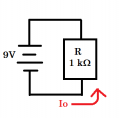
Consider the following circuit:
If you want to use electron current instead of conventional current, fine. What is Io, in amperes?
Irrelevant. The electron, which IS carrying the charge, is carrying a charge that is NEGATIVE! What happens when you multiply a positive number times a negative number?
Well, that person is mistaken and it's a good thing to set them on the right path. I understand the reasons to think in terms of physical particles in the right context but teaching electron flow was an early shortcut for military technicians in the 40's who'd never had any science classes (I've been to several military electronic schools) to get up to speed with tube circuits and in that context the electron flow in tubes with the water flow analogy as energy flow was intuitive to students in simple circuit analysis. My personal belief is the water/physical analogy intuition is a prime driver for this debate as I see it used frequently by people who seem to see a great importance in the physical particle current flow as maybe a means of energy flow in most modern electrical circuits. When we say a digital circuit is sourcing and sinking current do we care about electron flow?
I don't think the water flow analogy is the problem. It's that so many people can't grasp that there is a difference between counting charge carriers and counting the charge that they carry. I think a bigger underlying problem in that is that there are few instances in every day life where we routinely deal with something that can have positive or negative values. Humans are not good at dealing with negative quantities, and so we have gone out of our way to banish them from everyday life as much as possible. About the only instance where it is natural to have bipolar quantities that I can think of immediately off the top of my head are financial transactions, and even there we mask this nature by splitting things into "debit" and "credit" transactions and embedding the polarity distinctions in the formulas we use to combine them.
Understanding electric circuits in terms of electron flow (as long as the conductors are solids) is fine for a technician repairing a circuit. It's just not current flow, by definition in electrical theory. The end game in electronics is to control the force of electrical energy by the manipulation of magic smoke in physical devices. Oh, people talk about electrons and such but it's really the magic smoke trapped inside that does your bidding.
- " Oh, people talk about electrons and such but it's really the magic smoke trapped inside that does your bidding " What magic smoke.
Trapped inside what.
Since the carrier of charge is the electron, and since current is defined as the transport of charge across a fixed point for a fixed interval of time, current falls out of the equation as the number of electrons which cross that point in the allocated time.
-Electric Current is defined as flow of charge, BUT no charge will flow anywhere without a CARRIER which this post originally stated as the ELECTRON and IT'S current
Irrelevant. The electron, which IS carrying the charge, is carrying a charge that is NEGATIVE! What happens when you multiply a positive number times a negative number?
-" What happens when you multiply a positive number times a negative number "
We both know what happens.
- " The electron, which IS carrying the charge, is carrying a charge that is NEGATIVE! "
SO WHAT! It's the only " thing " with charge that can move in the wire.
Well, that person is mistaken and it's a good thing to set them on the right path. I understand the reasons to think in terms of physical particles in the right context but teaching electron flow was an early shortcut for military technicians in the 40's who'd never had any science classes (I've been to several military electronic schools) to get up to speed with tube circuits and in that context the electron flow in tubes with the water flow analogy as energy flow was intuitive to students in simple circuit analysis. My personal belief is the water/physical analogy intuition is a prime driver for this debate as I see it used frequently by people who seem to see a great importance in the physical particle current flow as maybe a means of energy flow in most modern electrical circuits. When we say a digital circuit is sourcing and sinking current do we care about electron flow?
It is well past the point for us to accept that the TS is either not interested in learning anything (i.e., is just trolling) or is incapable of learning anything. In either event, further discussion (with him) is a waste of time.
Like everything else in science, the problem is the MATH definition of current.
Charge flow or electron flow.
If current is defined as charge flow, then current will be symmetrical. And you will have flow polarity and flow direction.
Mathematicians love this. It makes their work much easier. It does not matter to them that positive charge flow does not exist. The positive charge never moves. It's inverted or negated electron flow. But they will refuse to admit it. Because the equation says it is positive flow. Math has had supremacy for the last one hundred years in our science. One hundred years of ignorance. All of our modern theories are proven with these false equalities. Math is the only evidence of almost all these theories.
If you define current as electron flow, current is not symmetrical. Because there is no positive counter part flow. And the plus and minus signs for current is a direction reference only, not a polarity reference. So the current will always be express as a positive flow value.
Electron current is not symmetrical like voltage is. This is good, because this is the reason current flows. If we had symmetrical charge carriers, we would never have any current. AND it is the real electron flow that causes the charge flow to have symmetry and polarity in mathematics.
Current is not natural. We have to set up and offset the natural symmetry to achieve it. When you do see natural current, it is resetting symmetry.
The forces of nature are un-aware of math. Nature uses symmetry to achieve balance, which gives order (sequence) and establishes law. (relates cause and effect)
Whether Ben made the best choice or not is irrelevant. The fact remains that the charge on the electron is currently defined as a negative quantity and the voltages we work with have polarities that are consistent with that definition.
If a positive number of electrons cross a given point, in the reference direction, in the allocated time, the charge that has crossed the point, in the reference direction, is a negative quantity and current is defined not as the number of electrons that cross the point per second, but as the amount of charge that crosses it. Hence, if a positive number of electrons cross a given point, in the reference direction, in the allocated time, the current that crosses that point in that direction is negative.

 Facebook
 Google
 GitHub
 Linkedin