Facebook
 Google
 GitHub
 Linkedin

I am simulating two gate drivers to get an idea about the losses of both at different frequencies and different currents. The output simulates approximately the phase of a motor, i.e., R + L
First gate driver EPC2152:
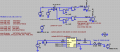
Secondo gate driver LM5109B:
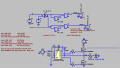
I didn't report it explicitly in the schematics above, but I simulated both the circuits with .step param D 0.05 0.1 0.15 0.20 0.25 0.3 0.35 0.4 in order to obtain an output current range from 6A to 50A
With the .meas on the left I found the following data for EPC2152:
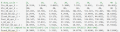
With the .meas on the left I found the following data for LM5109B:

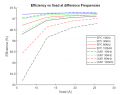
In this first graph I plotted Efficiency vs Iload at difference Frequencies for currents up to 25A (so ducty cycle max 20%):
figure 1
In this second graph Efficiency vs Iload only at 60kHz but for currents up to 50A (so ducty cycle max 40%)
figure2
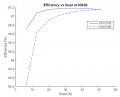
What I don't understand is precisely the trend of figure 2, which does not take into account switching losses (because the frequency is always the same 60kHz) but simply takes into account conduction losses R*Iload^2:
figure 3
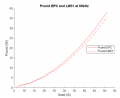
Since conduction losses increase with increasing load current (figure 3) ... shouldn't efficiency (in figure 2) decrease as Iload increases? ..which does not happen (figure 2) .. the opposite happens!
At this point I also ask you for feedback on figure 1
First gate driver EPC2152:
Secondo gate driver LM5109B:
I didn't report it explicitly in the schematics above, but I simulated both the circuits with .step param D 0.05 0.1 0.15 0.20 0.25 0.3 0.35 0.4 in order to obtain an output current range from 6A to 50A
With the .meas on the left I found the following data for EPC2152:
With the .meas on the left I found the following data for LM5109B:
In this first graph I plotted Efficiency vs Iload at difference Frequencies for currents up to 25A (so ducty cycle max 20%):
figure 1
In this second graph Efficiency vs Iload only at 60kHz but for currents up to 50A (so ducty cycle max 40%)
figure2
What I don't understand is precisely the trend of figure 2, which does not take into account switching losses (because the frequency is always the same 60kHz) but simply takes into account conduction losses R*Iload^2:
figure 3
Since conduction losses increase with increasing load current (figure 3) ... shouldn't efficiency (in figure 2) decrease as Iload increases? ..which does not happen (figure 2) .. the opposite happens!
At this point I also ask you for feedback on figure 1
Attachments
-
6 KB Views: 0
-
534 bytes Views: 0
-
5.5 KB Views: 0