Dynaco solid-state pre-amps (resistor values, 1/4 or 1/2 watt)

Thread Starter

oh_uh_okay

Joined Aug 24, 2025
56
I am restoring a Dynaco SCA-80 int. amp.

Most Dynaco solid state amps of this vintage (late 60s and 1970s) use carbon comp. resistors.

The manuals for both the PAT-4 and SCA-80 state: "All resistor values are 1/2 watt, 5%, unless otherwise noted."
PAT-4 manual: https://www.updatemydynaco.com/documents/PAT-4ManualPart1.pdf
SCA-80 manual: https://www.updatemydynaco.com/documents/SCA80.pdf

The PAT-4 and SCA-80(Q) have almost identical preamp sections (the SCA-80 is an int. amp, while the PAT-4 is just a stand-alone preamp. The SCA-80, which came out after the PAT-4 and ST-80, essentially combines the ST-80 power amp and PAT-4 preamp, into one compact unit).
Note that voltages to the pre-amp board on the SCA-80 are 24vdc and 17.5vdc volts, while the PAT-4 uses 38vdc and 17.5vdc for the same respective points.
In my parts bin, I have modern 1/4 watt metal film and/or 1/4-watt carbon film R's. I do have some at 1/2-watt, but mostly they are carbon-film and, even then, not in the values needed for the pre-amp section.
QUESTION:
Can anyone see problems or issues if I used
only 1/4-w R's in the SCA-80 pre-amp board?
==========
Other notes:
The PAT-5 preamp, which apprered about 4 years after the SCA-80, is here: https://www.updatemydynaco.com/documents/PAT-5Original.pdf
(Note most R's are now rated 1/4 watt. Yes, the PAT-5 designs differs quite a bit from PAT-4/SCA-80).
The PAT-5 at mains AC line specs: 12w at 120vac
The PAT-4 at mains AC line specs: 5w at 120vac
The SCA-80 at mains AC line specs: 21.5w at 120vac (I measured this myself with a Killa-watt, while unit is simply idling. The manual does not provide idling specs. Note that the pwr amp section of this int. amp is most of the idling pwr draw. )
 

Thread Starter

oh_uh_okay

Joined Aug 24, 2025
56
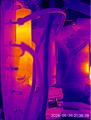
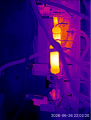
One thing I do is use my thermal camera to measure and capture heat. I have noted that, for the same current, the older carbon comp tend to run a bit cooler (may be as much as 10 F). So, if I have 2.2K 1w carbon comp in the orig. 1971 unit, the replacement 2.2K 1w carbon FILM will run about 10 F warmer. Not sure why.

The FLIR image here shows part of the L channel of PC-18 power board, on my SCA-80, with two new 2.2k 2w carbon film Rs, R15 and R9, which I have also raised to help with circulation. Note that I upgraded to 2w for new carbon films as I found new 1w 2.2k carbon films running a bit too warm for my comfort.


IMG_2068.PNG


There are two similar others on the R ch board. These are orig. carbon comp. 2.2k. 1w .
IMG_2073.PNG

This just documents some of my procedures during upgrades and troubleshooting.


So I think the lack of response here at AAC suggests there is no way to guesstimate based on the manual, the schematic, and the given specs. Yes?

Note comment #3 here about PAT-4:
https://audiokarma.org/forums/threads/dynaco-pat-4-resistor-ratings.758853/

My guess is that back in those "early" days, Dyna and others just used what was most economical. Note that the SCA-80's pwr amp PC-18 board also uses mostly 1/2 watt carbon comps ("except where noted") . PC-18 uses 71vdc.

Those early days used topologies (not just in audio) that drew the higher watts. So, for the sake of economics and simplicity, the pre-amp was also populated with 1/2 watts even if 1/4's would work also.

Solution:

Since I had the two preamp boards out anyway for restoration, I simply turned on the amp with a Killawatt connected. I already knew that the whole amp draws 20.5w when on (idling; see first post again). W/o the preamp boards, it now draws 20.0w. So both L/R preamp boards draw 0.5w together.
 
Last edited:

B-JoJo-S

Joined Jan 3, 2026
357
Since the manual states using 1/2W unless otherwise stated, I'd assume they know what they're talking about.

Why do you want to change to 1/4W? Doing so will concentrate the heat and possibly scorch the board or other nearby components. Not to mention the shortened lifespan of the resistor. If there's room for a 1W resistor THAT would be more robust and likely to never need to be replaced unless there's a problem in the circuit and too much current is drawn. Question: Is there a problem with the board?

When in doubt - stick with the stated specs. Or go bigger.
 

B-JoJo-S

Joined Jan 3, 2026
357
Wait: I just had another look at the pictures. You said the right channel has 1W resistors. That case - using 1/4W resistors would likely be disastrous. Clear pictures of the components, both the R chan and the L chan (not IR) will be helpful.
 

BobTPH

Joined Jun 5, 2013
11,566
When that kit was designed, 1/2 W resistors were the default. I suspect most could be lower wattage.

One way to determine this is to take the power supply voltage and calculate the power each resistor would dissipate with that voltage across it:

P = V^2 / R

Say the voltage is 12V. T determine if a 1/4 Watt resistor would be OK, use the above equation:

0.25 = 144 / R

R = 144 / .55 = 576

Any resistor above 576 would not dissipate mote than 1/4 W.

This assumes the board does not create voltages greater than the PS voltage, which seems likely for a preamp.
 
Agreed with Bob.
Back then 1/2 watt , 10% carbon comps were the bread and butter, and used universally unless the circuit required a higher powered or improved tolerance component.
 

Thread Starter

oh_uh_okay

Joined Aug 24, 2025
56
One way to determine this is to take the power supply voltage and calculate the power each resistor would dissipate with that voltage across it:

P = V^2 / R

Say the voltage is 12V. T determine if a 1/4 Watt resistor would be OK, use the above equation:

0.25 = 144 / R

R = 144 / .55 = 576

Any resistor above 576 would not dissipate mote than 1/4 W.

This assumes the board does not create voltages greater than the PS voltage, which seems likely for a preamp.
Are you serious?! Each resistor? Do you know how many there are? And to get probes in at there at very difficult probing position , in situ, risking shorting or electrocution, is is not an option!

Did you look at my simple solution with Killawatt test?
 

dl324

Joined Mar 30, 2015
18,393
Are you serious?! Each resistor?
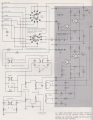
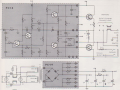
You can do it from the schematic. I'd give some examples, but the schematics are crap and don't give resistor values or voltages.
1782760197209.png
1782760148038.png

Metal film resistors will have more inductance than carbon composition, so I'd be more inclined to substitute carbon film to be on the safe side. You probably couldn't hear a difference, but that's just me.
 

Thread Starter

oh_uh_okay

Joined Aug 24, 2025
56
You can do it from the schematic. I'd give some examples, but the schematics are crap and don't give resistor values or voltages.
View attachment 368864
View attachment 368863
I can't believe I'm reading this comment on a purported EE forum? The component values on next page (18), bro. Component Values section. Duh!!!
C'mon folks. Dyncao made 100s of thousands of kits, that were assembled by Joe 6-packs all over the world. They were popular because their products, manuals and simple instructions were well though out.
 
Top