Dual Zone Wine Kegerator - Getting Both zones to sync

Thread Starter

sbstoval

Joined Aug 22, 2024
1
I purchased a used mIcromatic wine kegerator and have been working on converting it to serve beer. The left side (blue) that was designed for white wine works great now and gets down to the necessary 37-40 degree temp, but the right side (red) designed for red wine does not get low enough (maybe 55 degrees at the lowest, even when set for lower).

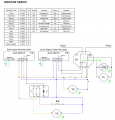
After taking a look at the schematics / wiring diagram, it looks like the compressor is operated by the "White Wine" control which provides a baseline appropriate for white wine. That side also has its own evaporator fan. And then there is a "Red Wine" control that has its own evaporator fan - and a resistor module (heat source!) - that together are used to shift the temperature "upward" on that side into red wine territory.

To align the two, could it be as simple as removing the RW resistor on the red wine side? Only other idea I had was to connect the red wine evap fan to the white wine electronic controller. Below is the link to the unit's manual and snip of the wire diagram, let me know if anyone has ideas!

https://media-cdn.micro-matic.com/v...fe90bb1f4a38/Pro-Line Wine User Manual_v1.pdf
1724337807811.png
 

MrAl

Joined Jun 17, 2014
13,667
Hello,

It looks like both controllers are the same so the only way to change the Red channel temperature would be to pulse the relay on and off like a typical low cost microwave oven. That would mean that wiring the VE for the Red channel direct as the White channel is wired.

Please note that it is a little hard to determine what this thing is doing without making some measurements. You could measure line "C" and see if it turns on and off repeatedly and that would help to confirm the above description of the operation. I've never seen one of these before.

There is another possibility though and that is to modify the T1 sensor for the Red channel. If you can fool the controller into thinking that the Red channel temperature was higher than it actually was, it would keep it turned on longer and thus drop the temperature more. Since the sensors appear to be NTC type, as the temperature rises the resistance decreases, so adding a parallel resistance would make it look that the temperature was higher. What resistance that would mean though would have to be tried. You could try to measure the resistance of the T1 sensor at room temperature and see what it measures, then measure when it gets 'cool', then determine a starting resistance to add.
If you can't do that, then start with a 1 Megohm resistor and see if that alters the temperature, and if not, decrease the resistance a little and try again. Eventually it will have to make a difference, and it should not destroy anything. I would say go in logarithmic steps, which means 1 Meg to 500k to 250k to 125k to 62k to 33k to 15k to 8k to 4k to 2k to 1k, like that. If you make a measurement though you can figure out a better starting point, like perhaps 100k. NTC sensors vary a lot, but the most typical is 10k at 25 degrees C, so you might want to start with 100k, then 50k, then 25k, etc. Once you find a resistance that works you'd have to watch the temperature while you use it for a few weeks to a few months as the summer/winter seasons change to make sure it always works. If not, you might have to choose a potentiometer instead.
One thing nice about doing it this way is that it should not bother anything else in the system because everything else should work the same.

Just note that I've never seen one of these before and the drawings are not that great and I only have that limited information to go by.
 
Last edited:

MisterBill2

Joined Jan 23, 2018
27,181
It may indeed be as simple as disconnecting that resistor marked "RW". That might be as simple as disconnecting the "red wire" from terminal #7 of the relay and moving it to terminal #3, on the unused half of the relay. That would be a modification that could be easily undone.
 

MrAl

Joined Jun 17, 2014
13,667
It may indeed be as simple as disconnecting that resistor marked "RW". That might be as simple as disconnecting the "red wire" from terminal #7 of the relay and moving it to terminal #3, on the unused half of the relay. That would be a modification that could be easily undone.
Hi,

It looked to me like that RW is not in the circuit when the evaporator for that channel is 'on'.
 

MisterBill2

Joined Jan 23, 2018
27,181
Given that the "RW" is described as a wall heater, it makes perfect sense that it would only supply heat when heat is being removed. How else to easily reduce the cooling rate?
 

MrAl

Joined Jun 17, 2014
13,667
Given that the "RW" is described as a wall heater, it makes perfect sense that it would only supply heat when heat is being removed. How else to easily reduce the cooling rate?
You could be right, but I was thinking PWM like a microwave oven. RW is not 'on' when the evaporator is on but maybe that helps with the PWM because it might heat when the evaporator is 'off'. Maybe that is also for when the external temperature is actually lower than inside the chamber?
I am doing a lot of guessing here as we have no measurements to go by.
 
Top