Dual Tracking Power Supply

dl324

Joined Mar 30, 2015
18,333
I could not work out how to get KiCad to recognise the bridge rectifier, however the transformer will be a 18-0-18 60VA transformer (no load output is ±20.4V),
I'm not familiar with KiCad, but you could draw the bridge rectifier as 4 discrete diodes and draw a box around them which would indicate they were in the same package.

20VRMS will give you almost 29VDC peak; I'd check the opamp specs to see if it can handle 37V, which I doubt, not many will.
 

Thread Starter

Ed Bray

Joined Feb 1, 2017
46
Thanks again Dennis.

I could actually put in a standard Bridge rectifier but it didn't have the correct dimensions to be able to transpose it too a PCB so I decided not to bother.

According to TI a TL071 can handle 36V, is this too close for comfort :)

Just out of interest how does the OpAmp get 37V? It is fed from a +8V supply from the 78L08.
 

crutschow

Joined Mar 14, 2008
38,524
Just out of interest how does the OpAmp get 37V? It is fed from a +8V supply from the 78L08
You forgot the negative supply. ;)
You have to add the magnitude of the negative supply voltage to the positive supply voltage to get the total.

You could go to a 7805 to give +5V and reduce the maximum if necessary.
 

crutschow

Joined Mar 14, 2008
38,524
To get even a little more voltage headroom for the op amp you could power it from +3V (or possibly less depending on the op amp) since the highest positive voltage it has to go to is 0V (when both outputs are at the minimum).
The 3V could be provided by another LM317 with the appropriate ADJ resistor values.
 

Thread Starter

Ed Bray

Joined Feb 1, 2017
46
To get even a little more voltage headroom for the op amp you could power it from +3V (or possibly less depending on the op amp) since the highest positive voltage it has to go to is 0V (when both outputs are at the minimum).
The 3V could be provided by another LM317 with the appropriate ADJ resistor values.
Great Idea:

Actually, that really does sound like a plan, I have a lot of LM317s (more than I could ever use) I'll do a little research and see if I can work out the required resistance values and how they should fit in the circuit.
 

crutschow

Joined Mar 14, 2008
38,524
and see if I can work out the required resistance values and how they should fit in the circuit.
To avoid a more complex formula equation, I solve the problem piecemeal.

1) Solve for the current through R1:
If resistor R1 (between output and ADJ) is 120Ω, then you know that the nominal current through it is always 1.25V / 120 = 10.4mA.

2)Solve for the value of R2 using this current:
To get 3V output, the voltage across R2 (between ADJ and com) for this current must be (3V - 1.25V) = 1.75V.
(The ADJ pin current is very small).
Then R2 = (1.75V / 10.4mA) =168Ω.
 

ian field

Joined Oct 27, 2012
6,536
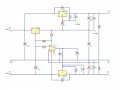
I have been looking for a Dual Tracking Power Supply circuit to build and the schematic below was recommended as an upgrade to a circuit on the JoeBrown.org.uk website. I understand the schematic was designed by Harry Brunts.

View attachment 122040

The OpAmp's tested have been either an LM108 or an LF351 but as I don't have either of those to hand could I use a different type?

I've got available: RC4136N, TL071, 072, 074, 082, NE5532P, LM833N, LM1458N, LM358P & 4560D, which of these would be the best match for this circuit? If one of these are used would I need to change anything else to get a similar end result (perhaps need a different regulator than the 78L08)?

I have almost everything required apart from the 15-0-15 50VA Transformer, but I do have a 18-0-18 50VA Transformer. All the Electrolytics will be 50V versions aside from the two 4700uF which are only 35V. I have the 4 resistors required as 1W 1% and have selected those closest to the required values, the two 10K resistors are both identical giving the same readings on each of my meters.

I have lots of 1N4001s, 1N4003s & 1N4007s so will use 1N4007s for the six diodes.

I cannot find a C2, has the author just miss counted or should there be another Capacitor in there somewhere?

Hoping you can advise, you have given me good advice to date so looking for more. :)
AFAICR: the 5532 and 833 have pretty good drive capability, they're primarily Hi-Fi AF types so they have good bandwidth too.

Manufacturers like Unitrode and Raytheon etc used to do single chip dual rail controllers - but maintaining those product lines probably hasn't been profitable for quite some time.
 

Thread Starter

Ed Bray

Joined Feb 1, 2017
46
To avoid a more complex formula equation, I solve the problem piecemeal.

1) Solve for the current through R1:
If resistor R1 (between output and ADJ) is 120Ω, then you know that the nominal current through it is always 1.25V / 120 = 10.4mA.

2)Solve for the value of R2 using this current:
To get 3V output, the voltage across R2 (between ADJ and com) for this current must be (3V - 1.25V) = 1.75V.
(The ADJ pin current is very small).
Then R2 = (1.75V / 10.4mA) =168Ω.
Thanks for that, and even better, I actually understood it too.
 

Thread Starter

Ed Bray

Joined Feb 1, 2017
46
Thank you for your input Ian.

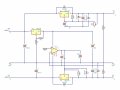
I have changed the schematic to reflect the changes previously discussed. I am not sure what should be going in on pin 3 of the TL071.

If there are any mistakes, could you please point them out.

Dual TS 2x LM317.jpg
TIA again.
 

crutschow

Joined Mar 14, 2008
38,524
You made a few errors in connecting the LM317 in place of the LM7808. ;)

U2-2 goes only to R3, U3-7 and C8.

The junction of R1 and R3 goes only to U2-1. (U2-1 does not go to ground).

R3 should be 120Ω (for 3V out).

The bottom of C5, C7, and D5 go to to ground.

What happened to the pot?
 

Thread Starter

Ed Bray

Joined Feb 1, 2017
46
Thank you again, I'll get the hang of this eventually I hope, the circuit is getting quite complicated now. :)

The pot was just taken from the pads 2kVR1, but I have reinserted it as a component in the latest changes you have advised to the schematic.

What if anything should now go to U3-3 (Non Inverting Input)? Is R2 still required if it is connected?

Dual TPS 1203.jpg
 

crutschow

Joined Mar 14, 2008
38,524
'll get the hang of this eventually I hope, the circuit is getting quite complicated now.
I don't see why.
All you've added to the original schematic is two resistors to set U2's voltage.
The pot was just taken from the pads 2kVR1, but I have reinserted it as a component in the latest changes you have advised to the schematic.
You need to connect the pot the same as it was connected in the original schematic.
As shown it won't work.
The ADJ pin must always have a current path to ground.
What if anything should now go to U3-3 (Non Inverting Input)? Is R2 still required if it is connected?
R2 goes to ground, as it did before.
Why would you think it changed?
You could connect U3-3 directly to ground without the resistor.

You should make an effort to better understand how the circuit works. to help avoid obvious errors in the circuit connections. :)
 

Thread Starter

Ed Bray

Joined Feb 1, 2017
46
Sorry, I will try to understand better, but I thank you and appreciate your input greatly.

I have read through the 25 page document of the LM317T and think I understand it more now. I was amazed at the amount of internal circuitry involved in the LM317T.

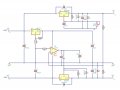
I have tried again, hopefully this time I have rectified the issues?Dual TPS 1203.jpg
 

crutschow

Joined Mar 14, 2008
38,524
Looks okay now.
The only nit I see is that you used a different ground symbol at the pot, implying that it's a different ground (such as chassis ground versus circuit common).
You should use the same symbol everywhere.

I just looked at the TLO71 data sheet and it's worst-case input common-mode range only goes to within 4V of the supply voltages.
This means that its positive supply should be 4V minimum with the input a 0V (common).
So the value of R1 should be increased to at least 267Ω.
 

Thread Starter

Ed Bray

Joined Feb 1, 2017
46
Thank you again, I have changed the value of R1 to 270Ω. I thought I had selected the same GND symbol, I didn't realise I hadn't until you pointed it out. I will take more care in future.

I am just putting the final touches to a pcb so all being well will be in a position to build it tomorrow.
 

Thread Starter

Ed Bray

Joined Feb 1, 2017
46
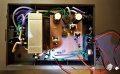
Just a quick update, I finally finished my Dual Tracking Power Supply and thought I should show you the results.

Quite pleased with this project as I reused some old bits (and a few new ones) including the transformer and case (which was from an old Durst Enlarger). I designed the PCB myself using the freeware version of diptrace and used my laser printer to print it onto some copped clad board which was then etched in Ferric Chloride (took two attempts as the first one was a mirror of my mirrored design, not sure what happened but I only discovered the mistake when I went to insert the components).

I used the fully available space for the board which should allow for some space for heat transfer.

I did add another circuit which took a feed from the initial DC +ve immediately after the 4500uF capacitor to feed a small buck converter which took it down to 5v to feed a 5v to 5v DC to DC isolator converter to give a separate supply for the power to the digital ammeter.

Circuit is good for just under 2v (need a separate meter to measure below 3v) through to just over 20v.

Thanks again all those who helped, 1st full project completed for over 30 years.

DTPS open.jpg

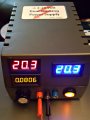
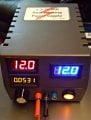
The following were taken whilst the supply was sent through a 330 ohms 10w resistor. Red voltage is +ve Blue voltage is -ve.

DTPA 20v.jpg

DTPS 12v.jpg
 

Thread Starter

Ed Bray

Joined Feb 1, 2017
46
Yeah, sorry, printed the pattern onto photo paper in the laser then ironed onto the PCB. Knew what I meant, didn't put it across properly.
 

dl324

Joined Mar 30, 2015
18,333
Yeah, sorry, printed the pattern onto photo paper in the laser then ironed onto the PCB. Knew what I meant, didn't put it across properly.
No problem. Many people struggle with toner transfer if they don't use paper designed specifically for that purpose.

I've read of people attempting direct printing with ink, but not (successfully) with laser printers.
 
Top