Facebook
 Google
 GitHub
 Linkedin
I'm working on a hobby circuit that is powered by 6 volts and regulated to +5 volts and -5 volts. It uses the +6 volts as ground. I've tried to attach part of the regulator below.
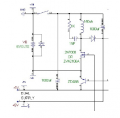
The circuit has several op-amps which are all powered by +5 and -5 volts. The inputs on the amps are using ground (+6V) to (in+). Hopefully as can be seen in the photo below.
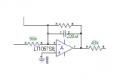
I've built this circuit before and it does work although with some instability and oscillation. I'm adding decoupling caps and considering using one side of the pcb as a ground plane. I've read part of most of the data sheets and they indicate locating, usually a monolithic capacitor, as close to each IC as possible between -5v and +5v. My question concerns the +6 volt ground. If I create a ground plane should it be with +6 volts or -5volts?
I can't quite comprehend why the +6 volt ground. Anything to do with "differential"?
Thanks for being here!
The circuit has several op-amps which are all powered by +5 and -5 volts. The inputs on the amps are using ground (+6V) to (in+). Hopefully as can be seen in the photo below.
I've built this circuit before and it does work although with some instability and oscillation. I'm adding decoupling caps and considering using one side of the pcb as a ground plane. I've read part of most of the data sheets and they indicate locating, usually a monolithic capacitor, as close to each IC as possible between -5v and +5v. My question concerns the +6 volt ground. If I create a ground plane should it be with +6 volts or -5volts?
I can't quite comprehend why the +6 volt ground. Anything to do with "differential"?
Thanks for being here!