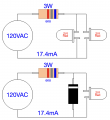
There are no leds that run on 120 Volts AC.
There are led lightbulbs available that run on 120 Volts AC, those have a circuit inside to accomodate the led.
Standard leds can not stand more than 5 Volts reversed voltage.
Step the AC down using a small (as in low power rating) transformer, this will 1) isolate your circuit from the AC supply and 2) greatly reduce the voltage(s) you are dealing with.
Don't screw around with circuits that connect to the unisolated AC supply, there's no need and it can be fatal.
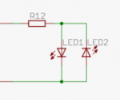
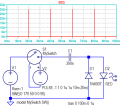
The diode could be a 1N4148 since the reverse voltage is just the LED forward drop.
Alternately you could use four 1N4148s in a bridge circuit, or other small bridge module, to allow the LED to conduct on both half-cycles, reducing the chance of noticeable flicker.
I had problems with my furnace. It runs on 120Vac and 24Vac. I added many lights just like those. From the front panel I can see if the 120 and 24 are OK. If the gas is on, of the fan is on, if the pump is on. I can see if the igniter is on. I no longer need to get the meter out and measure all the test points.
The diode could be a 1N4148 since the reverse voltage is just the LED forward drop.
Alternately you could use four 1N4148s in a bridge circuit, or other small bridge module, to allow the LED to conduct on both half-cycles, reducing the chance of noticeable flicker.
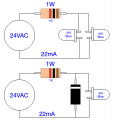
3 options for 24VAC
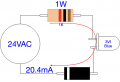
The reason for the 1Ndiode is because the LED will not stand much more than 5V reverse. A quarter watt resistor will be too close to its max rating. Better to size up to prevent premature circuit failure. 1W is advised.
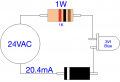
Notice in both posts I've left off the polarity. You should know that yourself. (Option 3) The 1Ndoide will block the reverse current and protect the LED.
EDIT: Just noticed that you want a blue LED for the 24VAC circuit. (see post#12) I cut-n-pasted for the 24VAC circuit without considering the Vf for a common blue LED. Values will change a little. The current will be slightly lower depending on the actual Vf of the blue LED.
Actually, the third option has to consider both the LED Vf and the 1Ndiode (typically 0.6Vf).
Assuming 3.0Vf for the blue LED:
(24VAC-3Vf-0.6Vf)÷1000Ω=20.4mA
24V x 20.4mA = 490mW (very close to max for 1/2W resistor. Go with 1W)
EDIT: Correcting the drawing for post #11.
EDIT #2: OK, I'm done messing with these drawings.
At 490mW that's very close to the max for a 1/2 watt resistor. No head room. Since they don't make 3/4W resistors, at least not that I've ever heard of, going with a 1W seems prudent.
I was trying to point out that current only flows 50% of the time in this example. So the resistor will heat 1/2 as much and the average LED current will be 1/2 as much.
Yet another reason why I never became an engineer. Yes, you're right. I hadn't thought of that. I may know what AC is but I don't always account for its behavior. Thank you for pointing that out.
There you go Kim Sleep. A good reason why hearing from many others is a good idea. Some boob may give you inaccurate information. Ron is right. In the third example on post #11 and post #17 current will flow only half the time, resulting in half the heating of the resistor. In the first two examples where there are two LED's or one LED and one diode current will flow in both directions. In those cases the 1W resistor is advisable.

 Facebook
 Google
 GitHub
 Linkedin