driver compression logic question

Alec_t

Joined Sep 17, 2013
15,119
But the LT1028 is not driving the load.
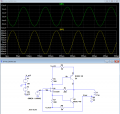
Not the inductive load directly, but LTS says the load seen by the output pin of the 1028 is about 315 Ohms. At the input signal peaks the supply voltage of the 1028 is reduced by the series resistors and the output pin struggles to get within ~2.6V of either rail, resulting in clipping. This is consistent with the opamp not being a rail-to-rail type, as evidenced by the datasheet.
 

Ian0

Joined Aug 7, 2020
13,132
Not the inductive load directly, but LTS says the load seen by the output pin of the 1028 is about 315 Ohms. At the input signal peaks the supply voltage of the 1028 is reduced by the series resistors and the output pin struggles to get within ~2.6V of either rail, resulting in clipping. This is consistent with the opamp not being a rail-to-rail type, as evidenced by the datasheet.
I disagree.
This circuit does not need a rail-to-rail op-amp to produce a rail-to-rail output.
The TS wants an output current of 5V/25Ω=200mA.
This would require 5.6V across R2 and R4 for positive and negative peaks. That means that the op amp must draw 5.6V/200Ω=28mA through its supply pins.

If the TS used the alternative version of the circuit where the right hand end of R5 is connected to ground, it would stand a better chance.
 

Alec_t

Joined Sep 17, 2013
15,119
I disagree.
I'm only going by what LTspice is telling me. Have you run the post #9 simulation?
That means that the op amp must draw 5.6V/200Ω=28mA through its supply pins.
I agree with your maths. But the opamp draws an internal standing supply current of 7mA, so the actual peak output current is only 21mA, as confirmed by the sim.

Edit:
Using an LT1007 instead of an LT1028 for the post #9 circuit eliminates the clipping (but does introduce a bit of cross-over distortion). An AD8032 is even better (being rail-to-rail).
 
Last edited:

Thread Starter

yef smith

Joined Aug 2, 2020
1,459
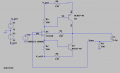
Hello, The problem is i got the circuit below manufactured already. So i am stuck with the LT1028 and the bjt's.
my only degree of freedom is the resistors.
My only requirement is is to supply 50 mA current on L1 without any saturations as a function of Vin.
i have change my original circuit resistor to the configurations below.
The Ltspice circuit is attached.I got the desired response for L1 in the simulation.
However i am afraid i could burn the LT1028 or the BJT in the process.
As you can see belowi got 140mW RMS and 210mW on Peak Rja so POWER_RMS*Rja=0.14*226.85=31.75
Also i got 26mA current peak on my OPAMP as shown below
looking at the data sheet below could you please help me understand given this configuration if the OPAMP or BJT will function properly?
(i will try to put heat sink if necessary)
The full LTSPICE simulation file is attached.
https://www.alldatasheet.com/datasheet-pdf/pdf/16110/PHILIPS/BC807-40.html
https://www.alldatasheet.com/datasheet-pdf/pdf/70264/LINER/LT1028.html
1702882215388.png

1702882193515.png
1702883092543.png
 

Attachments

Last edited:

Thread Starter

yef smith

Joined Aug 2, 2020
1,459
Current Vs Vin on both Bjt shown below.
i am worried that although i get the proper responce on L1 inductor my BJT or OPAMP will burn.
Thanks.
1702885748471.png
1702885718694.png
 

MisterBill2

Joined Jan 23, 2018
27,522
I have seen the earlier version of that circuit using an LM301 op amp many years ago, it requires a few capacitors to prevent oscillation, as is obvious from the plot.
 

crutschow

Joined Mar 14, 2008
38,508
i am worried that although i get the proper responce on L1 inductor my BJT or OPAMP will burn.
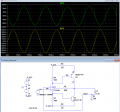
If you increase R1 to 200Ω and reduce R6 and R8 to 50Ωk (top sim) the op amp output current (green trace) is reduced while still maintaining the desired output current (yellow trace).

I see no problem with excess power in the op amp or transistors.

To reduce the power you could reduce the power supply voltages, along with the value of R4 and the signal amplitude.
See bottom sim with the voltages set to 10V, R4 set to 20Ω and the signal set to 1V.

1703177169500.png

1703178230390.png
 
Top