Drain holes for planters...

Thread Starter

Externet

Joined Nov 29, 2005
2,627
Hi. Waaay off-topic.
Always been pushed to have/put holes in the bottom of planters. Found too often that soil dries out and kills plants. If such drain holes are not there, soil floods and kills plants.
Other 'self-watering' planters have that wet tray, supposed to help the drying condition.

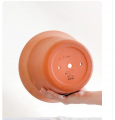
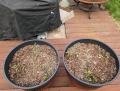
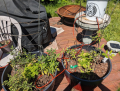
1713275896187.png1713276177816.png

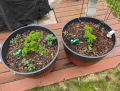
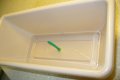
What is your opinion if an overflow hole is placed by mid height of a planter wall ? Would it keep wet the bottom of soil and avoid full drying for longer periods with no watering/rain ?
 

killivolt

Joined Jan 10, 2010
836
Plant Care

Another important function of drainage holes is to allow water to flush the soil of excess salts from any fertilizers that you apply. Without a drainage hole, those salts can get trapped in the soil and affect the health of your plant.
Overly damp, poorly-draining soil can be a problem for any plant, but especially for plants that enjoy moisture. That’s because while you might be giving them a healthy amount of water, that water has nowhere to go and ends up sitting around the roots, causing root r
I’m not a plant person but this is what I found on why the holes are at the bottom. Overflow pan beneath the pot just there to catch prevent puddling.


kv
 

nsaspook

Joined Aug 27, 2009
16,257
Yes, there should be some sort of weep hole and a drainage layer to reduce root rot.

For the larger sizes I normally place some empty plastic bottles (I don't use rocks) on the bottom and a soil barrier cloth on top of that to provide a spacer for the water pool. I then drill holes weep holes slightly below the top of the spacer layer and fill up with layers of peat-moss on the bottom, composted soil in the middle and a layer of pine needles or a similar mulch on the top for moisture retention.

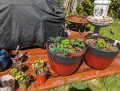
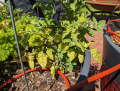
1713278336435.png
Some 'Early Girl' tomato plants.
 

BobTPH

Joined Jun 5, 2013
11,466
The lovely wife Morticia is the gardener in this household. She uses pots with drain holes in the bottom and places the pot in a tray to catch any over watering.

Her black roses are marvelous, a perfect prop for our tango.
 

Thread Starter

Externet

Joined Nov 29, 2005
2,627
Thanks. :)

... I then drill holes weep holes slightly below the top of the spacer layer...
OK, so am not that far off the chart about doing a mid-height weep hole instead of the bottom. Good photo. I do the oxheart tomatoes only... plus artichokes, garlic, pears, plums, apples...
 

nsaspook

Joined Aug 27, 2009
16,257
Thanks. :)


OK, so am not that far off the chart about doing a mid-height weep hole instead of the bottom. Good photo. I do the oxheart tomatoes only... plus artichokes, garlic, pears, plums, apples...
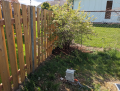
I have a side garden that needs some spring cleaning for planting too.
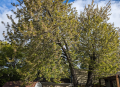
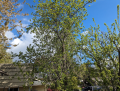
Cherry and plums in the backyard.
1713286118862.png
The birds and possums will have a drunken party when the overripe cherries fall.
 

visionofast

Joined Oct 17, 2018
106
last time I heared the subject was about a pal who had gotten used to put an iron fork in a water proof T-Rex cactus planter for fun,I guess he finally lost a limb or something.
 

Thread Starter

Externet

Joined Nov 29, 2005
2,627
Feels like did a good 'ínvention' Small window planters, with a tight fit tube in hole, glued. Protrudes 1/4" under. Drains when excess water level reaches the level of about half planter height. Am happy.

1713661728959.jpeg
 

Alec_t

Joined Sep 17, 2013
15,106
Another option is to put wicks through drainage holes in the bottoms of the pots, then support the pots in a tray/container of water just above the water level. The plants can then draw up what water they need without their roots being water-logged.
 

Thread Starter

Externet

Joined Nov 29, 2005
2,627
Thanks. My contraption on post #14 did not work, Have to retry with a much larger diameter drain; as rain flooded the planter. One of these days...
 

k1ng 1337

Joined Sep 11, 2020
1,038
I read a single small rock over a drain hole is all that is needed. Apparently you just need to sit there and learn to communicate with the plant to know how thirsty it tends to get. Then you adjust a size of the hole and the rock stopper as needed. I plan on doing this experiment with different hole sizes and stoppers later in the season.
 
Top