Facebook
 Google
 GitHub
 Linkedin
Scenario:
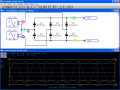
3-phase into a 3-phase rectifier.
The change:
Somebody substitutes the 3-phase input with a single phase input. As long as the ratings are not exceeded, no problem right? The ripple increases, but from the point of view of the rectifier, it is now a single phase full wave bridge that has a pair of unused diodes.
The problem:
What happens if somebody connects a neutral or center-tap to the last diode pair on the rectifier?
I can't see any problem with the open circuit output voltage of the rectifier under ideal conditions, but I'm not sure how things end up with a real load. Would the potential worst case scenario be double current on the neutral leg, or something completely different?
3-phase into a 3-phase rectifier.
The change:
Somebody substitutes the 3-phase input with a single phase input. As long as the ratings are not exceeded, no problem right? The ripple increases, but from the point of view of the rectifier, it is now a single phase full wave bridge that has a pair of unused diodes.
The problem:
What happens if somebody connects a neutral or center-tap to the last diode pair on the rectifier?
I can't see any problem with the open circuit output voltage of the rectifier under ideal conditions, but I'm not sure how things end up with a real load. Would the potential worst case scenario be double current on the neutral leg, or something completely different?