Does a manual/electronically controlled toggle switch exist

Thread Starter

lexlagoon

Joined Jan 21, 2023
1
I am trying to learn circuit design incorporating Raspberry Pi.

I am sorry that I am so inexperienced that I don't know if what I want exists or if it does, then what it is called.

What I want to achieve is to have a physical toggle switch that I can move manually on and off, to open or close a circuit. Then, when it is on I want to electronically turn it off, including physically turning it back to the off position.

Is that a thing?
 

crutschow

Joined Mar 14, 2008
38,314
I found some magnetically-held toggle switches but they are mostly used in aircraft and very expensive.
The cheapest I found was here on ebay.

It might be cheaper to use a momentary, two-position toggle switch to control a flip-flop latch.
 
Last edited:

SamR

Joined Mar 19, 2019
5,470
Why not use a switching transistor? Something like a logic level MOSFET 2N7000.
2N7000.PDF (datasheetcatalog.com) 3-5VDC applied to the gate will switch up to 60V, 200mA (500mA pulsed), for a max of 400mW before temp derating. Just one example of many transistors used as switches...

Edit: Oops shoulda been 400mW
 
Last edited:

SamR

Joined Mar 19, 2019
5,470
Since he is using a Raspberry uP it would be a simple programming job to use a pushbutton to flip flop on/off. Depending on the voltage and current required for the output device, either sourcing from an output pin itself, or using a transistor switch from another voltage source if higher voltage or current is required for the output device than the output pin can provide. Transistors tend to be cheaper and less space and wiring is needed than a relay (unless you are learning about relays). As @crutschow mentioned, what he is asking for is not common and expensive hardware. More than one way to skin a cat.
 

MisterBill2

Joined Jan 23, 2018
27,159
The closest common device that can provide that function, remote turn off, is an external (remote)-trip circuit breaker. That is a device that will open when the current exceeds some value, and also open when an external voltage is applied to a pair of isolated terminals. They will not provide a remote turn on function, but a very reliable remote switch off.
Much less expensive would be an electrically held relay circuit with a start and stop button arrangement. That sort of scheme is very common, very reliable, and well understood.
 

sghioto

Joined Dec 31, 2017
8,633
What I want to achieve is to have a physical toggle switch that I can move manually on and off, to open or close a circuit. Then, when it is on I want to electronically turn it off, including physically turning it back to the off position.
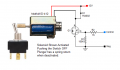
You can make such switch mechanism with the help of a small solenoid, similar to this setup with electronic control.
1674418115069.png
 

MisterBill2

Joined Jan 23, 2018
27,159
The remote trip breaker does provide exactly that function, with the added benefit of providing overload protection. Check the Digikey website. Or search for "remote trip circuit breakers"
No they are neither common nor cheap.
 
Last edited:

ErnieM

Joined Apr 24, 2011
8,415
When every manufacturer I know of makes a smart wall switch for lighting they make it look like a "decorator" SPST switch, but inside it is just two small inexpensive momentary push buttons. ON and OFF are indicated by a small LED.
 
I found some magnetically-held toggle switches but they are mostly used in aircraft and very expensive.
The cheapest I found was here on ebay.

It might be cheaper to use a momentary, two-position toggle switch to control a flip-flop latch.
The ebay link you sent is no longer working; however, there are bi-stable relays, also called latching relays. The idea is they are activated or deactivated by a single pulse and will maintain the state selected indefinitely without additional energizing of the coil. Regular push-button switches can then be used to manually send the pulse to turn on or off.

Here's another person writing about them: https://www.eeweb.com/how-to-read-data-sheets-latching-and-automotive-relays/

Latching relays appear to be very rare, but they are sometimes used in automotive applications, and those are the least expensive, such as the PRC-made "HELLA" brand 4RC 933 364-02 currently sold here https://www.delcity.net/store/Latching-Relays/p_818110.h_818111 for $10.75

One problem here is that this cheap "HELLA" is a single-pole relay, so there is no way to get a separate electrical signal that the relay has engaged / disengaged from a parallel pole for an Arduino to know when to stop the pulse. So the easiest implementation would be to do the pulse for a pre-determined period of time during which the relay is supposed to change state and hope it does. There would also need to be an intermediate non-latching relay or a transistor circuit to drive the pulse from the Arduino pin sending the signal to the latching relay, as the pin does not have the sufficient current and voltage by itself.

Another thing to watch out for is that lots of cheap "latching" relays marketed for use with hobby microprocessors are actually regular non-latching relays "simulating" a latching relay with a flip-flop circuit. But this HELLA relay seems legit.
 
Last edited:

panic mode

Joined Oct 10, 2011
4,864
Latching relay and two mome tary buttons are the closest substitute to mechanical toggle switch. This way state of the relay would be retained indefinitely even after power loss which is not the case with most of alternatives
 

MisterBill2

Joined Jan 23, 2018
27,159
OK, here is a scheme suggestion: Not a toggle switch but what is called a "LEVER SWITCH", because it is operated by a lever. Such a switch could easily have added a link from a small solenoid to bump it towards the center, "at rest" position. It could also have a magnet coil provide just a bit of force to hold it in one of the operated positions. Lever switches are available in bot momentary and sustained positions. Often available in some surplus equipment. BUT they are not compact.
 

MaxHeadRoom

Joined Jul 18, 2013
30,557
Most simple is use the PB for manual, set up a relay with an insulated PB knob situated over the armature and a single push and the retaining contact will take over.
Can then be dropped out turning the coil off via the Raspberry Pi..
The two PB N.O. & N.C. mentioned earlier is all that is needed.
 
Top