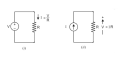
Does a Current Through a Resistor Cause a Voltage Across That Resistor or Does a Voltage Across a Resistor Cause a Current To Flow Though It?

I think since we are going to assume everything is semantics and some people are using personal definitions then this entire thread doesn't matter.

btw, the difference between emf and voltage is explained on countless articles on the web.
 
Last edited:

joeyd999

Joined Jun 6, 2011
6,513
'Hey, Grok, Read this thread: https://forum.allaboutcircuits.com/...urrent-to-flow-though-it.211458/#post-2050114

What really comes first, voltage or current?

Personally, I think they are "flip sides of the same coin" and occur together simultaneously.'

**They are simultaneous — two descriptions of the same electromagnetic process.** Your “flip sides of the same coin” view is the right one.

### What the thread is arguing about
MrAl opened with the practical point: Ohm’s law \(V = IR\) is a *relationship*, not a cause-and-effect statement. The two quantities appear together (or so close together that ordinary measurement cannot separate them). He notes that field establishment along a wire takes finite time, but locally the effects are concurrent. For beginners he recommends just teaching the relation and letting people treat either quantity as the “independent” one depending on the circuit.

The replies split roughly into:
- **Voltage/field first** (LvW, Jerry-Hat-Trick, water-head analogies): an electric field is required to exert force on charges, so potential difference is the precondition for current.
- **Abstractions / neither first** (BobTPH, MrChips, kiroma): voltage and current are macroscopic aggregates of charge behavior. Maxwell’s equations treat \(\mathbf{E}\) and \(\mathbf{B}\) as coupled and simultaneous; asking which derivative “comes first” is meaningless.
- **Special cases** (AnalogKid, ElectricSpidey, capacitor examples): induced currents from changing magnetic fields, open-circuit voltage on a capacitor, solar cells, etc., show that you can have one without the other in particular situations.

MrAl’s later posts (especially the long one on page 2) push further: once the local field is present at a point, the charges respond without measurable delay. Macroscopic inertia analogies (compressing a brick before it moves) do not apply cleanly to electrons in a conductor.

### The physics
In the continuum electromagnetic description the situation is self-consistent and simultaneous:

- Voltage between two points is the line integral of the electric field.
- Current density in an ohmic material is \(\mathbf{J} = \sigma\mathbf{E}\) (or more generally the response of free charges to the local fields).
- The fields themselves are produced by the charges and their motions (Gauss, Ampère–Maxwell, Faraday).

When you close a switch, what propagates down the wires is an electromagnetic wave (at a fraction of \(c\)). The electric field, the surface-charge gradient that supports it, and the resulting drift of conduction electrons are all aspects of that single wave. There is no separable “voltage arrives, then current starts” or vice versa at the local scale. In the ideal lumped-circuit model we simply assume the quasi-static limit in which the relationship is instantaneous.

Edge cases exist (a charged capacitor has voltage with zero current; a superconducting loop can have persistent current with zero voltage; a changing external magnetic field can drive current via Faraday’s law), but they do not restore a universal temporal priority inside a resistor.

### Practical teaching view
For ordinary circuit work it is still useful to say:
- A voltage source or potential difference *drives* current through a resistor.
- Current through a resistor *produces* a voltage drop.

Both statements are correct *as descriptions of the relation*; neither is a deeper causal claim. That is exactly why Ohm’s law can be rearranged as \(I = V/R\) or \(V = IR\) without contradiction.

So your intuition matches both MrAl’s conclusion and the structure of Maxwell’s equations: voltage and current through a resistor are concurrent manifestations of the same electromagnetic interaction. The chicken-and-egg debate dissolves once you stop treating them as independent primitives.
 
Last edited:

LvW

Joined Jun 13, 2013
2,060
:::::::::::::::::::::::::::::::::::::::::::::::
### Practical teaching view
For ordinary circuit work it is still useful to say:
- A voltage source or potential difference *drives* current through a resistor.
- Current through a resistor *produces* a voltage drop.
Yes - of course, I agree. No doubt about it. For practical purposes it does not matter which view is applied - as lomg as we are using correctly the known relation (Ohm).
That`s what we are doing with success since many, many years.

However - as far as I understand, in this thread we are discussing the physical background between both quantities (voltage and current).

So your intuition matches both MrAl’s conclusion and the structure of Maxwell’s equations: voltage and current through a resistor are concurrent manifestations of the same electromagnetic interaction. The chicken-and-egg debate dissolves once you stop treating them as independent primitives.
Of course, I also agree that both (voltager, current) are "concurrent" phenomena in a closed loop with conductive elements. But answers this the question if current can exist without driving voltage?
Up to now - I didn`t see any physical illustrative explanation how a current through a resistor could develop a voltage across the resistor. Which effect then could be the cause of such a current?

Simple circuit: A voltage source Vo (battery) is connected to a resistor R.
We will have a current I=Vo/R.
Does it make sense to say that this current I would generate the voltage Vo ?
Or does such a view can only be applied to a series connection of at least two resistors? If yes, why?
 

joeyd999

Joined Jun 6, 2011
6,513
I didn`t see any physical illustrative explanation how a current through a resistor could develop a voltage across the resistor. Which effect then could be the cause of such a current?
In the special case of a superconductor, a current can flow in the complete absence of an E field. In fact, it's a physical requirement, as dictated by the London equations. The current is driven by a steady-state B field, not an E field. Even impressing a strong E field on a current-carrying superconductor has no effect on the supercurrent.

The dual of this is a capacitor, where the voltage across the plates is established by the E field, in complete absence of a B field.

Simple circuit: A voltage source Vo (battery) is connected to a resistor R.
We will have a current I=Vo/R.
Does it make sense to say that this current I would generate the voltage Vo ?
Or does such a view can only be applied to a series connection of at least two resistors? If yes, why?
I like to think that the ohmic element impresses a back-emf (note: this is not a literal definition of back-emf!) such as to exactly counter the applied V.

In any case, B and E are very closely related -- in fact, they are orthogonal vectors of the same underlying electromagnetic field, and always self-interact simultaneously.
 

LvW

Joined Jun 13, 2013
2,060
In the special case of a superconductor, a current can flow in the complete absence of an E field. In fact, it's a physical requirement, as dictated by the London equations. The current is driven by a steady-state B field, not an E field. Even impressing a strong E field on a current-carrying superconductor has no effect on the supercurrent.

The dual of this is a capacitor, where the voltage across the plates is established by the E field, in complete absence of a B field.
Thank you for your answer.
But excuse my question: Is this really the only example which can be presented to illustrate the subject of our dicussion?
Remember, the question was about simple practical circuits involving a voltage source and realistic conductive parts.
 

joeyd999

Joined Jun 6, 2011
6,513
Thank you for your answer.
But excuse my question: Is this really the only example which can be presented to illustrate the subject of our dicussion?
Remember, the question was about simple practical circuits involving a voltage source and realistic conductive parts.
I think your question has been answered, from a deep, physical point-of-view. I'll let Grok provide the final answer, as it is more eloquent than I, but we are in complete agreement:

Thank you for the clarification. You’re right that the original question was about ordinary practical circuits (a voltage source and realistic resistive conductors), not the special case of a superconductor.

In those ordinary circuits the situation is simply this: Ohm’s law is a constitutive relation, not a causal one. For an ohmic resistor the local fields and the current density are locked together by \( \mathbf{J}=\sigma\mathbf{E} \) (or equivalently \( V=IR \)). When the circuit is completed, the electromagnetic wave that establishes the surface-charge gradient (and therefore the electric field) and the drift of the conduction electrons are aspects of the same process. Locally they appear together; there is no measurable delay that would let us assign temporal priority to one over the other.

In a simple battery–resistor loop it is therefore equally valid to say “the source voltage drives the current” or “the current produces the voltage drop across the resistor.” Both statements describe the same steady-state relation. Neither is a deeper physical cause. That is why circuit analysis works equally well with either quantity treated as the independent variable.

The superconductor was only offered as a limiting case that shows what happens when the linking relation \( \mathbf{J}=\sigma\mathbf{E} \) is removed (resistance → 0). In ordinary resistive circuits that relation is present, so voltage and current remain concurrent. For practical purposes the chicken-and-egg question has no further content once Ohm’s law is accepted as the governing relation.

I think that settles the issue for the circuits we actually use.
 

WBahn

Joined Mar 31, 2012
33,340
Up to now - I didn`t see any physical illustrative explanation how a current through a resistor could develop a voltage across the resistor. Which effect then could be the cause of such a current?

Simple circuit: A voltage source Vo (battery) is connected to a resistor R.
We will have a current I=Vo/R.
Does it make sense to say that this current I would generate the voltage Vo ?
Or does such a view can only be applied to a series connection of at least two resistors? If yes, why?
How about thermal noise in a resistor? Charge carriers move randomly resulting in a random voltage signal. That's easy to explain as a current resulting in a voltage and hard to explain as some voltage from somewhere producing a current.
 

LvW

Joined Jun 13, 2013
2,060
How about thermal noise in a resistor? Charge carriers move randomly resulting in a random voltage signal. That's easy to explain as a current resulting in a voltage and hard to explain as some voltage from somewhere producing a current.
I think, that's a completely different effect from the one being discussed here (see the thread title). The definition of the phenomenon we call “current” in electrical circuits is also different, isn't it?
 

joeyd999

Joined Jun 6, 2011
6,513
I think, that's a completely different effect from the one being discussed here (see the thread title). The definition of the phenomenon we call “current” in electrical circuits is also different, isn't it?
Johnson noise is defined as an AC voltage source impressed across a resistor. How is this not equivalent?
 

LvW

Joined Jun 13, 2013
2,060
:::::::::::::::::::::::::
In those ordinary circuits the situation is simply this: Ohm’s law is a constitutive relation, not a causal one.
No doubt about it!

For an ohmic resistor the local fields and the current density are locked together by \( \mathbf{J}=\sigma\mathbf{E} \) (or equivalently \( V=IR \)). When the circuit is completed, the electromagnetic wave that establishes the surface-charge gradient (and therefore the electric field) and the drift of the conduction electrons are aspects of the same process. Locally they appear together; there is no measurable delay that would let us assign temporal priority to one over the other.
It is certainly not a matter of semantics when I place importance on word choice and phrasing.
Of course, since both quantities (voltage and current in a closed circuit) are related, one could say that they are "aspects of the same process".
But answers this the question, if one is the necessary precondition for the other one?
 

joeyd999

Joined Jun 6, 2011
6,513
No doubt about it!

It is certainly not a matter of semantics when I place importance on word choice and phrasing.
Of course, since both quantities (voltage and current in a closed circuit) are related, one could say that they are "aspects of the same process".
But answers this the question, if one is the necessary precondition for the other one?
I'm checking out.

I don't know what else to say without repeating myself.
 

LvW

Joined Jun 13, 2013
2,060
Johnson noise is defined as an AC voltage source impressed across a resistor. How is this not equivalent?
And what about the currents? Are both currents really comparable in the sense of our discussiin here?
I am still waiting for an example involving practical and real circuits (includig resistors as mentioned in the thread title) which can demonstrate and explain (!) how a current can generate a voltage across a resistor R, similar to the - more or less exact - explanation which shows how and why the E-field enables the movement of charges within the device.
 

MrChips

Joined Oct 2, 2009
35,299
If the objective is to provide a beginner with a basic understanding of the relationship between current and voltage, the best advice I have to offer is: Don't be fixated with either model. Both models are used in circuit theory and analysis.

1794780252200.png
 
Top