do I use a gate or not?

AnalogKid

Joined Aug 1, 2013
12,142
Assuming the "main" LED has a current-limiting resistor, a window comparator circuit (two comparators testing different cases) across that resistor can give three indications:

Too much voltage - LED is shorted or power source voltage has increased beyond normal levels or current-limit resistor is open
Too little voltage - LED is open or power source has failed / been turned off / gone away
Just right voltage - normal operation

ak
 

Thread Starter

clangray

Joined Nov 4, 2018
261
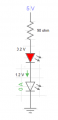
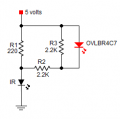
The voltage across the 200 ohm resistor is appx 3. 8 volts when the IR diode is good. That's enough voltage to light the red LED + resistor combo. If the IR LED shorts you now have 5 volts across the red LED which will be brighter and if the IR diode is open then no current can flow through either LED.
For calculating the resistor over the RED Led, do I have to take take into account the resistor value above the IR diode? I am assuming No they are calculated one per LED.
 

sghioto

Joined Dec 31, 2017
8,634
For calculating the resistor over the RED Led, do I have to take take into account the resistor value above the IR diode? I am assuming No they are calculated one per LED.
First you don't need 20 ma through the red LED to be visible. Depending on the LED chosen as little as 1ma can be sufficient. For this example will say 4ma. A typical red LED will have a forward voltage of less then 2 volts at 4 ma. Will say it's 2 volts.
The value of resistor for the red LED has nothing to do with the IR resistor.
To calculate subtract 2 from 3.8 which leaves 1.8 volts across the resistor. Divided by .004A = 450 ohm or 470 close enough for this example.
The IR resistor you listed is 200 ohms, that provides 19ma but now there is also 4ma from the red LED for a total of 23ma through the IR LED.
Correct one needed for each red LED.
 

sghioto

Joined Dec 31, 2017
8,634
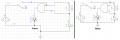
Here's a circuit I tested on a breadboard that easily showed the difference in brightness of the red LED when the IR diode was shorted or R1 was open. The red LED listed is a 3mm super bright.
1674428154780.png
 

MrChips

Joined Oct 2, 2009
34,824
So what is the difference of calculating a "regular" resistor for an LED versus a current limiting resistor. I know the difference is numbers but overall how so?
You are over thinking this and turning it into a problem that isn't a problem.

1) Calculating a "regular" resistor versus a current limiting resistor is one and the same thing.
Current is limited by the resistance, I = V / R.
Resistance is calculated for a given current, R = V / I.

2) The probability of a blown LED is very low.

3) If you want redundancy, install another LED with its own series resistor.

4) Now you tell us that it is an IR LED. If you want an ON indicator, put the visible LED in series with the IR LED.

5) If you want a visible LED to be lit when the IR LED is off, use an analog comparator to measure the voltage at the IR LED.
 

dcbingaman

Joined Jun 30, 2021
1,065
I have a fairly straight circuit that works. I need to add (if possible) some circuit design in which if the rail is "hot" and the junction of the LED and ground is "hot" then conditions are met to declare this circuit as running fine. If either rail or junction of the LED and ground is "not hot" the declaration of the circuit is "faulted". A condition that would cause this is a blown LED. Not included in the drawing but intended is a green LED for "fine" and a red for "faulted".

I've tried the logic gate and, for a sanity test, I connect both pins to the hot line and my virtual voltmeter output displays "5" - which is correct. But if I try to compare a signal from the hot side with a signal from a lead connected to an area in between the resistor and LED, I get an output measuring near 1.25V. Of course the result I want is 5v from the login gate because I've got current in both areas but the improper voltage in one being 1.25 (presence of voltage just not high enough for the pin but still the presence of current in both areas. Do I need to create a "digital" circuit here?

View attachment 285802
I get the basic idea: If the LED is working you get a logic 'low' into the AND gate and the output is low. If the LED is open you get two logic highs on the gate, thus high output. The fuzzy part is the logic 'low' is not really a good logic low (typically needs to be less than 0.8V) and most LEDs are 2V drop on more in forward bias range. I agree with some other entries I read on the forum though: That being an LED has such a low probability of failure, I don't think it is necessary to check for a failure condition.

ok, I read some more entries in the post, so it is an IR LED. Some other posting has a simple way of having both an IR LED and another LED in series to show that the IR LED is on. That seems like a good solution to what you are trying to do.
 
Last edited:

Audioguru again

Joined Oct 21, 2019
6,826
An LED is not a white-hot piece of wire that glows with full voltage and is dimmer with less voltage.

Instead an LED is a diode with a certain forward voltage. Green LEDs are 2.2V for some of them, 2.4V for most and 3.0V for some of them. If a mix of them are in parallel then the 2.2V ones will be extremely bright and the 2.4V and 3V ones will not lught. Then the 2.2V LEDs will quickly burn out one after the other.

LEDs in parallel must have the same forward voltage then somebody must be paid to test and group them.

Thank you for fixing some of the wire jogs on your schematic and making it appear as a normal positive without the Falstaff dots.
I fixed the remaining wire jogs and made the parts closer together.
But I could not remove your distracting mesh in the background.
 

Attachments

Thread Starter

clangray

Joined Nov 4, 2018
261
I get the basic idea: If the LED is working you get a logic 'low' into the AND gate and the output is low. If the LED is open you get two logic highs on the gate, thus high output. The fuzzy part is the logic 'low' is not really a good logic low (typically needs to be less than 0.8V) and most LEDs are 2V drop on more in forward bias range. I agree with some other entries I read on the forum though: That being an LED has such a low probability of failure, I don't think it is necessary to check for a failure condition.

ok, I read some more entries in the post, so it is an IR LED. Some other posting has a simple way of having both an IR LED and another LED in series to show that the IR LED is on. That seems like a good solution to what you are trying to do.
Yeah thanks for the input. The fuzzy logic did throw me for a loop. Finally got it worked out. One signal was around 1.25v which doesn't trigger the comparator. Also an LED has a very low likelihood of failure as you have stated. I have heard this before : )
 
Top