DIY PCB, etching help required.

Thread Starter

anubisanc

Joined Feb 24, 2024
6
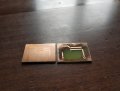
Hi everyone, I've spent some time collecting some supplies to make my own pcb's at home with the photopositive method. I'm using a cheap 50W UV (400nm) LED light for exposing the pcb's. I print the pcb design on plain paper with an inkjet printer then add baby oil to make it transparent and make it stick to the copper clad and I'm currently exposing each pcb for about 3,5 to 4 minutes at a distance of 4 inches give or take. I then dissolve the exposed photoresist in a 1.2% solution of sodium hydroxide (12g/l). The problem I'm having is that when I put the exposed clads in the NaOH solution the traces tend to be overexposed and grainy and I get an overall vignetteing effect around the borders of the clad. I've tried pretty much everything from putting the light closer, further away, exposing without the oil, using foil for extra reflectivity, exposing for longer or shorter time but the vignetteing only seems to disappear when I expose the clad to the point where the traces areIMG_20240224_153250412.jpg already overexposed and faded . Any help or general insight would be greatly appreciated.
 
Last edited by a moderator:

Ian0

Joined Aug 7, 2020
13,097
That's underexposed. It needs longer under the UV light. It's the exposure of the resist to UV light that causes it to dissolve in NaOH.
If it's overexposed, the tracks will etch away.
 

Thread Starter

anubisanc

Joined Feb 24, 2024
6
that's exactly what happens when I try to expose it for longer. Like this I'm getting the vignetteing but the tracks are still intact, if I try to expose it for longer I just end up getting less of the vignetteing but really faded tracks.
 

Ian0

Joined Aug 7, 2020
13,097
that's exactly what happens when I try to expose it for longer. Like this I'm getting the vignetteing but the tracks are still intact, if I try to expose it for longer I just end up getting less of the vignetteing but really faded tracks.
You don't have enough contrast between the dark and light areas. You need more ink and/or more transparent paper.
I always used tracing paper. You can buy 90gsm tracing paper which is ideal. I could etch tracks to 0.5mm TQFP packages that way
 

Thread Starter

anubisanc

Joined Feb 24, 2024
6
Can I print on that with an inkjet? Thanks for the suggestion, I've been locked in my basement for days on end trying to get this right with no significant results.
 

KeithWalker

Joined Jul 10, 2017
3,603
Can I print on that with an inkjet? Thanks for the suggestion, I've been locked in my basement for days on end trying to get this right with no significant results.
Get yourself some transparency sheets for your inkjet printer. Then you can make clear masks with good contrast. You can usually buy small quantities from any shop that does computer printing. For even better contrast, I use two prints taped together. I usually cut the prints to the same size as the PC board so I can tape them around the edges and get good close contact with the copperclad when I expose them.
 

Thread Starter

anubisanc

Joined Feb 24, 2024
6
Get yourself some transparency sheets for your inkjet printer. Then you can make clear masks with good contrast. You can usually buy small quantities from any shop that does computer printing. For even better contrast, I use two prints taped together. I usually cut the prints to the same size as the PC board so I can tape them around the edges and get good close contact with the copperclad when I expose them.
thanks so much
 

Ian0

Joined Aug 7, 2020
13,097
Can I print on that with an inkjet? Thanks for the suggestion,
Yes - it's prints just like normal paper.
I found it to be better than either laser or inkjet "transparencies".

I've been locked in my basement for days on end trying to get this right with no significant results.
In that time you could have sent the files off to China and got the boards back (apart from the fact it's just been Chinese New Year) and it would have cost less than the presensitised board.
 

Thread Starter

anubisanc

Joined Feb 24, 2024
6
Yes - it's prints just like normal paper.
I found it to be better than either laser or inkjet "transparencies".


In that time you could have sent the files off to China and got the boards back (apart from the fact it's just been Chinese New Year) and it would have cost less than the presensitised board.
I'm mostly doing it for fun and to learn the process. I also like the freedom of being able to make lots of prototypes and not having to worry about screwing up since I can just make another one at home.
 

camerart

Joined Feb 25, 2013
3,828
Hi everyone, I've spent some time collecting some supplies to make my own pcb's at home with the photopositive method. I'm using a cheap 50W UV (400nm) LED light for exposing the pcb's. I print the pcb design on plain paper with an inkjet printer then add baby oil to make it transparent and make it stick to the copper clad and I'm currently exposing each pcb for about 3,5 to 4 minutes at a distance of 4 inches give or take. I then dissolve the exposed photoresist in a 1.2% solution of sodium hydroxide (12g/l). The problem I'm having is that when I put the exposed clads in the NaOH solution the traces tend to be overexposed and grainy and I get an overall vignetteing effect around the borders of the clad. I've tried pretty much everything from putting the light closer, further away, exposing without the oil, using foil for extra reflectivity, exposing for longer or shorter time but the vignetteing only seems to disappear when I expose the clad to the point where the traces areView attachment 316060 already overexposed and faded . Any help or general insight would be greatly appreciated.
Hi A,
I've tried various systems for experimental etching, and also had trouble getting the exposures right.
I chose to use a laser, transparent heat transfer, sandwiched in 2x plates of steel, then into a toaster, then ferric chloride. I can produce fine lines.
If you want to try this method, I can explain more, but if you're almost there with you're method keep trying.
I'm now at the stage of using China, for etching, for final PCBs.
C
 

KeithWalker

Joined Jul 10, 2017
3,603
One thing I didn't mention when I told you about using Laserjet transparencies; print a mirror image. Then when you flip it over, the ink side of the print is closer to the circuit board. That will give you sharper edges.
 
Top