Distance is not the problem, it is resistance of the wire. Until you tell us how many amps you need, and over what distance, we cannot tell you what gauge wire to use.
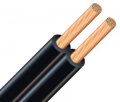
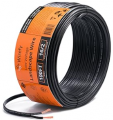
I always use 'Landscape' cable, bit overkill for gauge, but sturdy and built for the job, I have installations that are still working +40yrs on.
Available from HD.
As BobTPH points out once the load is known we choose a cable gauge so you have little to no loss. There are charts for calculating wire resistance for runs to make sure we do not have loss. You may wish to give this a read, HOW TO CALCULATE VOLTAGE DROP FOR LONG PAIRED WIRE RUNS. Keep in mind this is worst case scenario. Your entire load is not going to be 200 feet down the line.
As far as cost goes, if a TS can wind their own transformer using a recycled oven transformer, THAT can be quite effective and also educational. The major down side is that every MWO transformer I have seen is welded after assembly, and so threading in the new is tedious. Eventually I will try using a hand held disc grinder to remove the weld portion. If I make it OK I will share that information here.
For those long runs, it makes more sense to carry the mains voltage to where the 12 volts are required, and step it down there. Same power thru the long wire, but much less current, thus thinner wire works and that is cheaper.
I've done that. Grind out the weld, separate the two parts and slide the HV winding out without damaging it. Then laying in the number of winds I wanted. Used two "C" clamps to hold the core together and checked the output voltage. Adjusted accordingly. Once the voltage was dialed in I welded the former ground out weld. Then buffed the weld so there were no sharp edges anywhere on the weld job. Worked out just fine.
BUT! - - - the darn thing is so damned heavy and bulky. Not advisable for small projects. Don't ask me what amperage I achieved. Don't ask about VA. I don't know. I just know it did what I wanted it to do.
I've done that. Grind out the weld, separate the two parts and slide the HV winding out without damaging it. Then laying in the number of winds I wanted. Used two "C" clamps to hold the core together and checked the output voltage. Adjusted accordingly. Once the voltage was dialed in I welded the former ground out weld. Then buffed the weld so there were no sharp edges anywhere on the weld job. Worked out just fine.
BUT! - - - the darn thing is so damned heavy and bulky. Not advisable for small projects. Don't ask me what amperage I achieved. Don't ask about VA. I don't know. I just know it did what I wanted it to do.
Tony, Thanks for the response! As far as the wattage and performance goes, the core size and the primary set the maximum capabilities, the limitation should be the wire size in the new secondary. So with a thousand watt transformer, you could get at least 50 amps, in theory, from a 20 volt secondary. BUT then consider that the power rating is for short term operation with a fan circulating air,which does cool the transformer a bit, in addition to the magnetron tube. So the constant power rating can still be easily half of the original power rating.

 Facebook
 Google
 GitHub
 Linkedin