Facebook
 Google
 GitHub
 Linkedin

Dear all,
first, thanks for greating me in your community and sorry if I'm posting in the wrong section ! For a quick presentation, I'm from France, I'm 38, I'm an engineer in IT, mostly embedded safety SW for automotive. I've got some basics in electronics from school, but lost most of it in the past years, which means I'm still very prone to incredibly noobie mistakes.
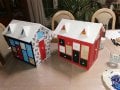
My little DIY project is based on a wooden advent calendar in for of a house. Goal is to detect the opening of the drawers, have lights for each of them, and some audio. The whole is driven by an ESP32 NodeMCU module. I thought I would go with pre-made modules just wiring them together, but in the end, I have a number of small components that need serious integration and thus a little PCB. I'm planing on ordering on PCBWay, in the hope it arrives on time.
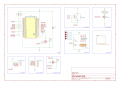
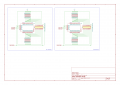
My first question is about the Audio Module (Click for link). There is a blog post "Internet radio with the ESP32 update" from the vendor that includes a 22k and 4.7k resistors on the I2S lines as a divider bridge and I can't figure out why. So after long research (and given that the module board includes a serial capacitor and serial 10k resistor already), I finally decided to get rid of them. But I'm really unsure.
My second question is about the MOSFET usages. There is a first one on the "ESP 32" block, and its role is to cut out the power for almost all external modules. It is driven by a GPIO of the ESP32. The second one is the "Hall Power Switch". I stupidly ordered A3144 hall sensors, which means they are active when the magnet is there, which for me means the drawer is closed, in other words, it's always active except rare times. To lower current consumption, I'll use polling instead of interrupt. Each 1/4s (or so), the ESP 32 will activate the MOSFET to activate the two IO expanders and the 24 hall sensors. After a settling time, the state will be read and the power will be cut. The last MOSFET, in the "Power KeepAlive" block is to drain some power from time to time so that the power bank doesn't go to sleep (yeah, I thought it would be cheaper...). Idea is to drain about 150-200mA for 10ms every 1 to 5 seconds. I'm not entirely sure of my wiring there, though.
Then, of course, any suggestion, other mistakes, remarks, ... are very welcome!
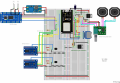
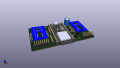
Below are just some illustrations to give a more concrete idea, but beware that this correspond to an old version. These images don't match the current state of the schematics. I still have to redo the PCB, as I learned a lot from my last attempt and I modified quite substential features.
Thank you very much, don't hesitate to ask, comment, ...!
Tehoor
first, thanks for greating me in your community and sorry if I'm posting in the wrong section ! For a quick presentation, I'm from France, I'm 38, I'm an engineer in IT, mostly embedded safety SW for automotive. I've got some basics in electronics from school, but lost most of it in the past years, which means I'm still very prone to incredibly noobie mistakes.
My little DIY project is based on a wooden advent calendar in for of a house. Goal is to detect the opening of the drawers, have lights for each of them, and some audio. The whole is driven by an ESP32 NodeMCU module. I thought I would go with pre-made modules just wiring them together, but in the end, I have a number of small components that need serious integration and thus a little PCB. I'm planing on ordering on PCBWay, in the hope it arrives on time.
My first question is about the Audio Module (Click for link). There is a blog post "Internet radio with the ESP32 update" from the vendor that includes a 22k and 4.7k resistors on the I2S lines as a divider bridge and I can't figure out why. So after long research (and given that the module board includes a serial capacitor and serial 10k resistor already), I finally decided to get rid of them. But I'm really unsure.
My second question is about the MOSFET usages. There is a first one on the "ESP 32" block, and its role is to cut out the power for almost all external modules. It is driven by a GPIO of the ESP32. The second one is the "Hall Power Switch". I stupidly ordered A3144 hall sensors, which means they are active when the magnet is there, which for me means the drawer is closed, in other words, it's always active except rare times. To lower current consumption, I'll use polling instead of interrupt. Each 1/4s (or so), the ESP 32 will activate the MOSFET to activate the two IO expanders and the 24 hall sensors. After a settling time, the state will be read and the power will be cut. The last MOSFET, in the "Power KeepAlive" block is to drain some power from time to time so that the power bank doesn't go to sleep (yeah, I thought it would be cheaper...). Idea is to drain about 150-200mA for 10ms every 1 to 5 seconds. I'm not entirely sure of my wiring there, though.
Then, of course, any suggestion, other mistakes, remarks, ... are very welcome!
Below are just some illustrations to give a more concrete idea, but beware that this correspond to an old version. These images don't match the current state of the schematics. I still have to redo the PCB, as I learned a lot from my last attempt and I modified quite substential features.
Thank you very much, don't hesitate to ask, comment, ...!
Tehoor