Ah yes, that's right. The net charge on the capacitor does not change. A "charge" on a capacitor is actually a separation of charge, giving us the storage of energy.
I take it that you can't answer those simple questions. Why are they so easy to answer for anyone that uses conventional current flow but I can't get anyone that uses electron flow to answer them.
WBahn
I take it that you can't answer those simple questions. Why are they so easy to answer for anyone that uses conventional current flow but I can't get anyone that uses electron flow to answer them. Could it be that people are realizing that they can't give the answers they would like to give without having to face the inconsistency in what they've been doing for years?
As for you question and attempt to derail the discussion, I don't know what the context is that you are talking about. I have a feeling that as soon as I answer that you are going to then ask about electrons "orbiting" a nucleus and how that contradicts what I say, ignoring the fact that one the quantum scale things often contradict the large-scale classical view.
I see no reason to be personal and the crusades were 1000 years ago.
WBahn
Although I asked about a point P in my question, as that is the way such questions are typically stated, I have often qualified similar statements with something like, "or more accurately, through a particular area of interest". If the area of interest (which is assumed to include the point P) cuts both paths that the charge is travelling ("outbound" and "inbound"), then the net current through that area is zero. If you reduce the size of the area so that it just encompasses P, then the net current is zero since your question implies that the charge does not actually pass through the point P. In either case you have set up a scenario that violates the condition of the question, namely that the net current is a given value of I that, in general, is nonzero.
If the area of interest is such that Q passes through it on one leg but returns via a path that is outside the area of interest, then the charge that passes through the area is I·T. It doesn't matter whether the charge over time is made up of the same charged particles over and over or not. Also note that discussion assumes that we are talking about DC current.
Lecturers keep hammering the point about an electrical circuit to students.
I think the point about current direction has already been made in this thread that in a circuit the current must flow in one direction in part of it and the other direction in another part.
It therefore follows inescapably (for those that can't see this for themselves) that in a circuit with two or more batteries in series (you asked for DC) electrons must flow from negative to positive in part of the circuit and from positive to negative in another part.
The convention for current flow is entirely independent of the sign of the charge on the electron.
I see no reason to be personal and the crusades were 1000 years ago.
This is more like a technical discussion.
Lecturers keep hammering the point about an electrical circuit to students.
I think the point about current direction has already been made in this thread that in a circuit the current must flow in one direction in part of it and the other direction in another part.
It therefore follows inescapably (for those that can't see this for themselves) that in a circuit with two or more batteries in series (you asked for DC) electrons must flow from negative to positive in part of the circuit and from positive to negative in another part.
The convention for current flow is entirely independent of the sign of the charge on the electron.
It has been made clear repeatedly that we are talking about the direction of current out in the circuit, not through the batteries. It has been specified over and over that we are talking about the direction of current in specific circumstances. For instance, I have repeatedly been very specific about discussing the current through a resistor connected to a battery or the current into the negative side of a capacitor or the current from one object to another. It has also been noted several time the circuit nature of current flow, for instance in the discussion regarding CRTs.
Furthermore, that is utterly beside the point. It doesn't matter whether the electrons are flowing from positive to negative within a battery or from negative to positive within a load. In either case the flow of charge, i.e., coulombs per second, is in the other direction.
I'll try again. If you have a 12V battery connected to a 12Ω resistor and the electron flow guys insist that charge is actually flowing from the negative terminal of the battery then through the resistor and back to the positive terminal of the battery at a rate of 1A, then how much charge enters the positive terminal of the battery each second?
I'll try again, again. If you have a 12V battery connected to a resistor and a 1F capacitor (initially uncharged) in series, the electron flow guys insist that charge is actually flowing from the negative terminal of the battery to and into the negative terminal of the capacitor. Once everything has reached its final state, how much excess charge exists on the negative plate of the capacitor?
Doesn't it strike anyone as just the least bit interesting that no one can answer the three simple questions in Post #73. That no one can explain how the electron current convention is internally consistent (as used in almost all cases by its proponents).
Wonder why that is?
Perhaps it's because they can't because it ISN'T internally consistent.
I'll try again. If you have a 12V battery connected to a 12Ω resistor and the electron flow guys insist that charge is actually flowing from the negative terminal of the battery then through the resistor and back to the positive terminal of the battery at a rate of 1A, then how much charge enters the positive terminal of the battery each second?
And I'll apologize for that. I guess I was trying to be pre-emptive because I just couldn't see what your point was, especially since you won't answer the question but instead seemed to be trying to set me up.
And I'll apologize for that. I guess I was trying to be pre-emptive because I just couldn't see what your point was, especially since you won't answer the question but instead seemed to be trying to set me up.
Doesn't it strike anyone as just the least bit interesting that no one can answer the three simple questions in Post #73. That no one can explain how the electron current convention is internally consistent (as used in almost all cases by its proponents).
Wonder why that is?
Perhaps it's because they can't because it ISN'T internally consistent.
What are you trying to say here, that we can never use electron current flow?
Lets look at question 1 alone, and maybe you can explain what you are trying to state here with that one question. The first quote above contains all three questions for quick reference.
If we can say that Q=I*t then isnt that valid for both positive and negative charges?
What are you trying to say here, that we can never use electron current flow?
Lets look at question 1 alone, and maybe you can explain what you are trying to state here with that one question. The first quote above contains all three questions for quick reference.
If we can say that Q=I*t then isnt that valid for both positive and negative charges?
It's valid for both positive and negative charges -- it is NOT valid when your current is the flow of charge CARRIERS and not the flow of charge.
Okay, let's see what the implications are.
Q = I*t
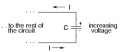
Now lets consider a simple case of a source connected to an initially uncharged 1F capacitor. The capacitor portion of the circuit is shown below and comes directly from the E-book (which uses electron current):
This source maintains a constant current of 1A for as long as it takes to bring the capacitor voltage to 12V and then shuts off (i.e., takes the current to zero). Hopefully everyone will agree that this will take 12s.
How much excess charge is on the negative plate?
Q = I*t = (1A)(12s) = (1 C/s)(12s) = 12C
So there are 12C of charge on the negative plate of the capacitor?
That's according to the electron flow model if they want to use Q=It (which is almost universally the case).
Do you agree with this answer?
If not, what do you need to do in order to get the answer that you know is correct? (Hint: Apply a magical mystery minus sign).
If I is 1A, that means that, by definition, 1 coulomb of charge is flowing in the direction if I, namely onto the bottom plate, every second.
It's valid for both positive and negative charges -- it is NOT valid when your current is the flow of charge CARRIERS and not the flow of charge.
Okay, let's see what the implications are.
Q = I*t
Now lets consider a simple case of a source connected to an initially uncharged 1F capacitor. The capacitor portion of the circuit is shown below and comes directly from the E-book (which uses electron current):
This source maintains a constant current of 1A for as long as it takes to bring the capacitor voltage to 12V and then shuts off (i.e., takes the current to zero). Hopefully everyone will agree that this will take 12s.
How much excess charge is on the negative plate?
Q = I*t = (1A)(12s) = (1 C/s)(12s) = 12C
So there are 12C of charge on the negative plate of the capacitor?
That's according to the electron flow model if they want to use Q=It (which is almost universally the case).
Do you agree with this answer?
If not, what do you need to do in order to get the answer that you know is correct? (Hint: Apply a magical mystery minus sign).
If I is 1A, that means that, by definition, 1 coulomb of charge is flowing in the direction if I, namely onto the bottom plate, every second.
I guess i still dont understand what you are trying to say here. If we change the sign of the charge dont we have to change the sign of the current too?
Let me see if it helps to define what it means to measure current. I'm not sure if this helps or not depending on what you are saying but i will post it here in any case just to be clear.
First, we must agree on a direction that we are going to call 'positive'. It seems simpler to say positive is to the right because that's the same as the number line, so we will say positive is to the right. Next we need to consider every possible charge and its movement direction as it passes a given point and how it affects the total charge. This leads to the following set of rules for measuring current.
1. Agree on a direction that is positive, we'll say for simplicity positive is to the right.
2. A positive charge moving to the right adds one to the total charge.
3. A positive charge moving to the left subtracts one from the total charge.
4. A negative charge moving to the right subtracts one from the total charge.
5. A negative charge moving to the left adds one to the total charge.
So in the bottom lead of your diagram, if we consider electron current flow then a negative charge moving to the right subtracts one from the total charge.
Does this help at all? I guess what i am saying is that i dont see anything magical happening here, but i also realize i may still not understand your point yet.
Scenario of current flow is something like it flows from negative to positive terminal .. But conventional current flows from positive to negative terminal..
I guess i still dont understand what you are trying to say here. If we change the sign of the charge dont we have to change the sign of the current too?
Let me see if it helps to define what it means to measure current. I'm not sure if this helps or not depending on what you are saying but i will post it here in any case just to be clear.
First, we must agree on a direction that we are going to call 'positive'. It seems simpler to say positive is to the right because that's the same as the number line, so we will say positive is to the right. Next we need to consider every possible charge and its movement direction as it passes a given point and how it affects the total charge. This leads to the following set of rules for measuring current.
1. Agree on a direction that is positive, we'll say for simplicity positive is to the right.
2. A positive charge moving to the right adds one to the total charge.
3. A positive charge moving to the left subtracts one from the total charge.
4. A negative charge moving to the right subtracts one from the total charge.
5. A negative charge moving to the left adds one to the total charge.
So in the bottom lead of your diagram, if we consider electron current flow then a negative charge moving to the right subtracts one from the total charge.
I agree. But that is not what the math says if you use Q=I·t and use as your I the flow of electrons, which, again, is NOT the flow of charge.
If the electron flow guys what to admit that they do not have a consistent means of expressing things and admit to people that they encourage to use it that they will have to override the math and apply memorized reasoning in order to compensate, fine.
Does this help at all? I guess what i am saying is that i dont see anything magical happening here, but i also realize i may still not understand your point yet.
The problem hasn't changed. The ampere is defined as a flow of one coulomb of charge per second in the direction specified for that that current (actually, the coulomb is defined in terms of the ampere, but that's a fine point that doesn't impact this discussion). It is NOT defined as minus one coulomb of charge per second. It is NOT defined as the absolute value of the charge being one coulomb per second. It is DEFINED as one coulomb of charge per second. If you say that the flow from A to B is a constant one ampere, (and if B is being retaining the charge, such as a capacitor plate) then you are saying that, by definition,
Q(t+1s) = Q(t) + 1 coulomb
If the electron current guys want to redefine charge such that the electron has positive charge, fine. But they then need to make all of their voltages, such as for batteries and other sources, consistent with that.
If the electron current guys want to use as their definition of current a flow of minus one coulomb per second, fine. But they need to use a name other than ampere because that one is already taken.
If they want to adjust all of their formulas so as to be consistent with their new definition of current, fine. Then Q=-I·t in their system.
But if they want to pretend that their unit of current is the ampere or that their formulas are unaffected by their choice, then they are deluding themselves and anyone that listens to them.
At the risk of again being accused of trying to trap you, when all I am doing is trying to help,
I prefer to amend the above to one coulomb of positive charge.
As I commented, you have two signed quantities,
Charge
Direction
So you need two sign conventions.
I won't quote the rest of your spiel about electron current or redefining the sign of the electronic charge, since it is much the same as I have stated in several past threads about this subject.
That's a superfluous amendment as there is no such thing as one coulomb of negative charge.
As I commented, you have two signed quantities,
Charge
Direction
So you need two sign conventions.
I won't quote the rest of your spiel about electron current or redefining the sign of the electronic charge, since it is much the same as I have stated in several past threads about this subject.
Note that it makes perfect sense to talk about Avogadro's number of negatively charged particles since Avogadro's number is a count of particles. A coulomb is NOT a count nor is it a magnitude. It is a unit of measure of a signed quantity. If you want to refer to a charge that is equal in magnitude to a coulomb, that's fine -- but you need to say so. For instance, the charge on the electron is often described as having an absolute value of 1.602 x 10^-19 C and that's fine. It is NOT fine to say that the charge on the electron is 1.602 x 10^-19 C because it's not. If it were, then the force exerted on it when placed in an electric field would be to move in the direction of the field (the same as any positively charged particle).
And where do the field lines emananting from a positive charge end?

 Facebook
 Google
 GitHub
 Linkedin