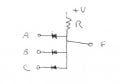
Diodes and grounds

Thread Starter

JoyAm

Joined Aug 21, 2014
126
Hello there, i just started studying microelectronics after getting some basic knowledge of electrical circuits and i find myself terribly confused. In circuits with diodes i see no meshes, instead i see that ground symbol almost everywhere and i get really confused. I know that what i am asking is hard to answer but is there any link you can give me to a tutorial or something so i can understand whats going on ? Thanks in advance :)
 

wayneh

Joined Sep 9, 2010
18,104
In circuits with diodes i see no meshes, instead i see that ground symbol almost everywhere...
Meshes? Why would you expect a mesh? Why would you NOT expect a ground symbol? They commonly denote the low reference voltage in a circuit and not as often true earth ground.

Perhaps if you could post a specific example.

Oh wait, you're not talking about schematics, but circuit drawings in a textbook, right?
 

Thread Starter

JoyAm

Joined Aug 21, 2014
126
Yes, you are right sir i am talking about drawings in a textbook, but i can not understand how things work in such circuits, let me give you an example as you asked. Lets assume we have this circuit ( i am sorry about the very bad quality ) http://prntscr.com/4k0nwq
even if the diodes are on there, how can we have a current as there is no closed route ? and that grounded V, what is that ?
( i am sorry for my stupid and non-consistent questions but i am in great confusion )
 

kubeek

Joined Sep 20, 2005
5,796
V denotes where you measure the output voltage. If all the diodes are not connected to anything, then the reistor will provide current to any load connected to the output.
If any of the diodes is connected to ground, then you will get only 0.7v on the output.
 

Thread Starter

JoyAm

Joined Aug 21, 2014
126
instead of A,B,C there are the values of 3V,2V and 1V and the voltage supply on the top is V volts and i am asked to find the current that goes down the R and the voltage on your F point
 

studiot

Joined Nov 9, 2007
4,998
should this really be in homework?

Take the lowest of the three input voltages, ie 1 volt.

This will pull the output (my point F) down to this voltage.

The other two diodes will then be reverse biased and therefore off.

So the voltage across the resistor will be (5 - the voltage at F).

You can now calculate the current in R.

It is usual to ignore the diode drop in these circuits since the diode will have been a low drop germanium type, probably 0.2 volts forward drop.
 

Thread Starter

JoyAm

Joined Aug 21, 2014
126
No it shouldn't, i am attaching a quick effort i made on a paper that is the same as you did for the i, but i dont understand how we get that for the voltage, i mean how is the output ( F) connected with the voltage in the cathode of diode in point C ?
http://prntscr.com/4k14qp
 

MaxHeadRoom

Joined Jul 18, 2013
30,655
i find myself terribly confused. In circuits with diodes i see no meshes, instead i see that ground symbol almost everywhere and i get really confused. answer but is there any link you can give me
I have raised this issue before, one of the problems is that many text books and other example circuitry use the earth ground symbol indiscriminately, one offender is the book often considered a 'Bible' The Art Of Electronics' they use the symbol throughout the whole publication without even a description and/or definition of the symbol, or any other symbol that I can find anyway.
It is used as a power Common instead of the actual defined use to indicate Earth Ground.
Max.
 

Thread Starter

JoyAm

Joined Aug 21, 2014
126
No, i believe that we make this assumption and if it works then we say that our "educated guess" was correct
what i dont understand is why the VF will be 1
 

Thread Starter

JoyAm

Joined Aug 21, 2014
126
I have raised this issue before, one of the problems is that many text books and other example circuitry use the earth ground symbol indiscriminately, one offender is the book often considered a 'Bible' The Art Of Electronics' they use the symbol throughout the whole publication without even a description and/or definition of the symbol, or any other symbol that I can find anyway.
It is used as a power Common instead of the actual defined use to indicate Earth Ground.
Max.
Thanks for posting Max, what do you mean by power common ?
 

studiot

Joined Nov 9, 2007
4,998
It is not an 'educated guess'. It is required by circuit theory.

Consider the following.

What would happen to a diode if the cathode was connected to +1V and the anode to +3 volts,
Would it be on or off?
 

Thread Starter

JoyAm

Joined Aug 21, 2014
126
It is not an 'educated guess'. It is required by circuit theory.

Consider the following.

What would happen to a diode if the cathode was connected to +1V and the anode to +3 volts,
Would it be on or off?
It would be on
 

studiot

Joined Nov 9, 2007
4,998
It would be on
Exactly.
So it would short out anything it was connected across, including another diode.

So if the A terminal was first connected to +3V, before the B or C terminals then the output at F would be at +3.

If we now connected the C terminal to +1, it would turn on the C diode, shorting the A diode and turning it off, by reverse biasing it.

If, on the other hand, the C diode was connected first, the A diode would never turn on.

does this explain it?
 

Thread Starter

JoyAm

Joined Aug 21, 2014
126
Exactly.
So it would short out anything it was connected across, including another diode.

So if the A terminal was first connected to +3V, before the B or C terminals then the output at F would be at +3.

If we now connected the C terminal to +1, it would turn on the C diode, shorting the A diode and turning it off, by reverse biasing it.

If, on the other hand, the C diode was connected first, the A diode would never turn on.

does this explain it?
As i said in the beginning i am really confused about it so everything you say helps me clear things out bit by bit and i thank you a lot for that .
So if i have understood right only one diode is able to be open and it will be the one that will get connected to the smallest voltage in order to create the maximum current possible?
And the question that still remains is what happens with the voltage at F , why it gets equal with the voltage on the cathode of the open diode ?
 

studiot

Joined Nov 9, 2007
4,998
I am not sure why your source is describing diode-resistor logic circuits, they are obsolete.

In the days when these were used, the a common supply voltage V was +10 volts.
The logic voltages were commonly 0 volts and -10volts.

The diodes were low on-voltage germanium signal diodes with a forward voltage of 0.2 volts.

So it was common to ignore this voltage drop and reckon zero voltage across an on diode.

So if the cathode of the diode C is taken to 1 volt, then the anode will also be at 1volt, if the diode is on.

Normally you would not have different input voltages 1,2, 3 to the inputs. the voltage at an input would be either 0 or -10.
So diodes would be either on or off in parallel.

As regards to your question about meshes or loops as we would probably call them.
The circuit would not normally employ an earth ground or a chassis connection.
The computer power supply probably had +10,-10 and zero separate from these.

The circuit is just a module connected to both an input and an output that used the same zero so the zero would not normally be shown.

Steering diodes and diode logic circuits are tricky to follow until you catch on, then they are easy.
 

studiot

Joined Nov 9, 2007
4,998
How can input B be at 3 volts when it is connected to a source of 2 volts?

Since all the connections to the bottom of the resistor are made along one wire they must be at the same voltage, which we have agreed is 1 volt, because the diode input C must be on.
So there should be no questions marks.

Both the diodes A and B are off, so isolate the 3volts and 2volts at their cathodes, from the 1 volt at their common anode connection with the resistor.
 
Top