Diode Question

Thread Starter

jegues

Joined Sep 13, 2010
733
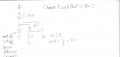
See figure attached for problem as well as my attempt.

I don't see what I'm doing wrong here.

Can someone explain?

I also attempted the problem with the exponential model with no avail.

In the old textbook they have the same question but they give you Id1 and Id2, are these required?
 

Attachments

Adjuster

Joined Dec 26, 2010
2,148
ΩThe diode equation and the fact of the 80mV offset between the two diode forward voltages allows you to estimate the ratio of the two diode currents. Let's say that is K:1 - probably rather greater than 10:1 - you will need to get a more accurate figure than my guess.

So the current in the diode returned directly to ground is K times the current (ID, say) flowing in the diode connected to ground via R.

You will then know that 10mA = (K+1)*ID

Then ID = 10mA/(K+1), and R = ?

Edit: The point to note is that most of the 10mA does not pass through R, so R will not be 8Ω.
 
Last edited:

Thread Starter

jegues

Joined Sep 13, 2010
733
ΩThe diode equation and the fact of the 80mV offset between the two diode forward voltages allows you to estimate the ratio of the two diode currents. Let's say that is K:1 - probably rather greater than 10:1 - you will need to get a more accurate figure than my guess.

So the current in the diode returned directly to ground is K times the current (ID, say) flowing in the diode connected to ground via R.

You will then know that 10mA = (K+1)*ID

Then ID = 10mA/(K+1), and R = ?

Edit: The point to note is that most of the 10mA does not pass through R, so R will not be 8Ω.
So in order to solve for R I must solve for K first correct? How do I do that?
 

Adjuster

Joined Dec 26, 2010
2,148
Can you clarify how I obtain K?
You mentioned the diode equation: ID = Is (e ^(VD / nVT) - 1),

Or approximately ID = Is e ^(VD / nVT), so ID/Is = e ^(VD / nVT)

Suppose we have two conditions, ID1 VD1, ID2 VD2.

ID1/Is = e ^(VD1 / nVT), ID2/Is = e ^(VD2 / nVT)

Dividing the two gives ID2/ID1 = e ^((VD2-VD1)/nVT)

Of course, you don't really know the value of n. It could be 1 to 2, probably assume it is 1. If you know the type of diode concerned, you may be able to get a more accurate value by referring to a data-sheet. (A better value of the logarithmic slope.)
 
Last edited:

Vahe

Joined Mar 3, 2011
75
This problem cannot be solved closed-form and therefore needs to be solved iteratively. Or you can simulate it, but I don't think that is the intent here.

Here is my approach. First denote the diode anode-cathode voltages as \( v_{d1} \) and \( v_{d2} \) and the diode anode to cathode currents as \( i_{d1} \) and \( i_{d2} \). I am naming the D1 as the diode that is connected to ground while D2 has the series resistor. Now we will write some expressions related to the circuit. First, KCL gives
\(
i_{d1} + i_{d2} = 10 \text{mA}
\)
Now assume that the voltage across the resistor \(R\) is at its desired value of 80mV; therefore, by using KVL we get
\(
v_{d1} = v_{d2} + 80\text{mV}
\)
Now we also have the \(i-v\) characteristics of each diode given by
\(
i_{d1} = I_s \exp(v_{d1}/V_T) \\
i_{d2} = I_s \exp(v_{d2}/V_T)
\)
where \(I_s\) is the scale current (assume this is 300pA) and \( V_T\) is the thermal voltage (let's assume this to be 26mV, room temperature). We have four equations and four unknowns but this cannot be solved in closed-form. Here's the procedure of how to solve this iteratively.

1. Choose a value for the value of \( v_{d2} \), say \( v_{d2} = 0.7\text{V}\).
2. Now \(v_{d1} = v_{d2} + 80\text{mV} = 0.78\text{V} \).
3. Calculate the diode currents \(i_{d1}\) and \(i_{d2}\) using the exponential expressions.
4. Calculate \(i_{d1}+i_{d2}\) and see if this is equal to 10mA. The first time through the sum will not be close to 10mA so we will have to go back to step 1. If the sum is higher than 10mA, use a lower value of \(v_{d2}\) in step 1. If the sum is lower than 10mA, use a higher value.

Go through the process until the sum is close to 10mA. Once you are close enough to 10mA. Stop and record the values of the voltages and currents. This is your solution. Then to find the resistance, simple use
\(
R = \frac{80\text{mV}}{i_{d2}}
\)
I actually ran through the calculations, and using the numbers I supplied above. I got the following solutions (I stopped when the current sum was 9.992mA)
\(
v_{d2}=0.60865\text{V}\\
v_{d1}=0.68865\text{V}\\
i_{d1}=9.552\text{mA}\\
i_{d2}=0.44\text{mA}
\)
Therefore \( R = 80\text{mV}/0.44\text{mA} \approx 182 \Omega \).

Sorry for the long post :( but I hope it helps out your problem.

Cheers,
Vahe
 

Adjuster

Joined Dec 26, 2010
2,148
This problem cannot be solved closed-form and therefore needs to be solved iteratively. Or you can simulate it, but I don't think that is the intent here.

Here is my approach. First denote the diode anode-cathode voltages as \( v_{d1} \) and \( v_{d2} \) and the diode anode to cathode currents as \( i_{d1} \) and \( i_{d2} \). I am naming the D1 as the diode that is connected to ground while D2 has the series resistor. Now we will write some expressions related to the circuit. First, KCL gives
\(
i_{d1} + i_{d2} = 10 \text{mA}
\)
Now assume that the voltage across the resistor \(R\) is at its desired value of 80mV; therefore, by using KVL we get
\(
v_{d1} = v_{d2} + 80\text{mV}
\)
Now we also have the \(i-v\) characteristics of each diode given by
\(
i_{d1} = I_s \exp(v_{d1}/V_T) \\
i_{d2} = I_s \exp(v_{d2}/V_T)
\)
where \(I_s\) is the scale current (assume this is 300pA) and \( V_T\) is the thermal voltage (let's assume this to be 26mV, room temperature). We have four equations and four unknowns but this cannot be solved in closed-form. Here's the procedure of how to solve this iteratively.

1. Choose a value for the value of \( v_{d2} \), say \( v_{d2} = 0.7\text{V}\).
2. Now \(v_{d1} = v_{d2} + 80\text{mV} = 0.78\text{V} \).
3. Calculate the diode currents \(i_{d1}\) and \(i_{d2}\) using the exponential expressions.
4. Calculate \(i_{d1}+i_{d2}\) and see if this is equal to 10mA. The first time through the sum will not be close to 10mA so we will have to go back to step 1. If the sum is higher than 10mA, use a lower value of \(v_{d2}\) in step 1. If the sum is lower than 10mA, use a higher value.

Go through the process until the sum is close to 10mA. Once you are close enough to 10mA. Stop and record the values of the voltages and currents. This is your solution. Then to find the resistance, simple use
\(
R = \frac{80\text{mV}}{i_{d2}}
\)
I actually ran through the calculations, and using the numbers I supplied above. I got the following solutions (I stopped when the current sum was 9.992mA)
\(
v_{d2}=0.60865\text{V}\\
v_{d1}=0.68865\text{V}\\
i_{d1}=9.552\text{mA}\\
i_{d2}=0.44\text{mA}
\)
Therefore \( R = 80\text{mV}/0.44\text{mA} \approx 182 \Omega \).

Sorry for the long post :( but I hope it helps out your problem.
Cheers,
Vahe
I do not think that an iterative solution is necessary here. Ignoring secondary effects like changing ideality factor. and ohmic resistance, a given voltage difference defines a current ratio. We know that the current in the diode with the series resistor will be (Total current)/(Ratio+1) so that is all that needs to be found.

Note that I had K= I2/I1= e ^((VD2-VD1)/nVT)≈e^(.08/.026)=21.69, whereas you have ID2/ I1= 9.552mA/ 0.44mA = 21.71.

For my method, ID2=10mA/(K+1) = 10mA/(22.69) =0.441mA, so R=182Ω. What's wrong with that?

Edit: looks like I have assigned D1 and D2 the wrong way around at some point, but the method still stands.
 
Last edited:

Vahe

Joined Mar 3, 2011
75
Adjuster, I like your solution better. You make the approximation in the beginning which simplifies the analysis quite a bit. I approximate at the end on how close the current sum is to the 10mA.

I guess I was trying to try out my posting skills since I just joined this week :).

Best regards,
Vahe
 

Adjuster

Joined Dec 26, 2010
2,148
Adjuster, I like your solution better. You make the approximation in the beginning which simplifies the analysis quite a bit. I approximate at the end on how close the current sum is to the 10mA.

I guess I was trying to try out my posting skills since I just joined this week :).

Best regards,
Vahe
Thanks very much Vahe. Simplified methods are about all I'm up to, especially these days. Note that I didn't quite finish the problem off at first, in the hope that the OP would do so. Not sure if he got it, but never mind.

Cheers,

Adjuster
 
Top