Diode getting continuity both ways.

Thread Starter

Gdrumm

Joined Aug 29, 2008
684
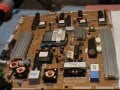
A Samsung UN46D7000LF 46" Class LED 7000 series Smart TV, has red light, and does not power on.
I removed the power board, and without disconnecting components, began to check their values.
All of the capacitors seem to be within range. One diode however is getting strange readings I think.

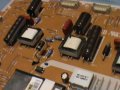
It is an R506 B19, and its reading a direct short, both ways.

I should disconnect it from the board and check it?

Thanks,
Gary
 

cmartinez

Joined Jan 17, 2007
8,727
A Samsung UN46D7000LF 46" Class LED 7000 series Smart TV, has red light, and does not power on.
I removed the power board, and without disconnecting components, began to check their values.
All of the capacitors seem to be within range. One diode however is getting strange readings I think.

It is an R506 B19, and its reading a direct short, both ways.

I should disconnect it from the board and check it?

Thanks,
Gary
I'm trying to imagine the use for a check valve that allows flow both ways! :confused:
 

Thread Starter

Gdrumm

Joined Aug 29, 2008
684
Max,
Can you explain that a little more.
When disconnecting one lead (thanks Brownout) and checking, it test 168 one way, and OL the other.
I think that's normal.

But what is low impedance in parallel, and do I need to look for another issue (ruling out this diode)?

Thanks,
Gary
 

ian field

Joined Oct 27, 2012
6,536
You can disconnect one lead, you don't need to disconnect both.
Can be tricky if its SMD.

One Job I was fault finding on equipment with hundreds of DTL chips, as it was all through plated holes, it was easier to cut a PCB track to isolate a suspected fault. You can't just use any old knife, it'll gouge up the track and board - we used a Swan and Morton scalpel with size 10 blade.

Holding the blade at an angle means the ends of the cut track smooth down with an overlap, we used to smooth them down with a tinned iron and the joint was re-made without using an added link.
 

Thread Starter

Gdrumm

Joined Aug 29, 2008
684
Thanks, but its not an SMD.
It just a small cylinder with two leads, one coming out of the end with the band on it, and the other coming out of the other end.
Looks like a firecracker with two fuses if that makes sense.

I've tested several salvaged of similar size, and I get reading like this.
- on Cathode, + on Anode:
.235
.460
.463
.430
.432

All had OL when leads were reversed.

ONE OF THOSE MADE A BEEPING SOUND, LIKE CONTINUITY (OR A SHORT).

Might this be a Zener , the cylinder is grayish black with a dark black ring.

Thanks

Any idea where I might find a schematic for this board?
 

MaxHeadRoom

Joined Jul 18, 2013
30,566
Max,
checking, it test 168 one way, and OL the other.
I think that's normal.

But what is low impedance in parallel, and do I need to look for another issue (ruling out this diode)?

Thanks,
Gary
You would need to do a little reverse engineering to see what was the nature of the item in parallel.
Is you measurement using the Ohm's scale or the Diode checker?
Most meters cannot check diodes on the ohm scale unless they are shorted.
Max.
 

Thread Starter

Gdrumm

Joined Aug 29, 2008
684
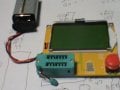
I pulled the suspected Diode and checked it with my cheap ESR meter.
It reads 215 mV, C=0pF

Other salvaged ones had readings like
478 mV, C= 155 pF
271 mV, 0 nF
513 mV, 52 pF.

Where can I find a reference chart to see what Diode values are, and what they mean?

Hey just trying to learn, so I really appreciate your feedback.

Gary
 

ian field

Joined Oct 27, 2012
6,536
Thanks, but its not an SMD.
It just a small cylinder with two leads, one coming out of the end with the band on it, and the other coming out of the other end.
Looks like a firecracker with two fuses if that makes sense.

I've tested several salvaged of similar size, and I get reading like this.
- on Cathode, + on Anode:
.235
.460
.463
.430
.432

All had OL when leads were reversed.

ONE OF THOSE MADE A BEEPING SOUND, LIKE CONTINUITY (OR A SHORT).

Might this be a Zener , the cylinder is grayish black with a dark black ring.
There are several types of diode laying in wait for the unwary.

Most DMMs have a diode check function that reads the diode Vf. The lowest Vf is germanium and Shottky-barrier, you can probably discount the possibility of germanium in any power stage of modern equipment, SB will give very low Vf - maybe as low as 0.1V for a large one, more commonly between 0.2 - 0.4V. Silicon should read about 0.6V although the fast types sometimes read lower. Zeners tend to come in at about 0.7V.

Germanium and SB can show significant reverse leakage - that's normal. On any other type of diode - if you can measure reverse leakage; its a dud.

One exception is zeners - it depends on their zener voltage and what test voltage your meter puts out - you should get no leakage if the test voltage is less than Vz, but look into it further before aiming it at the bin.
 

Thread Starter

Gdrumm

Joined Aug 29, 2008
684
I will begin to study up on it.
Wish me luck.

In the mean time, I think I will begin to pull and check the capacitors one by one, with my ESR meter.

Thanks everyone.

I think it's called an ESR meter, I will post a picture of it, plus the board, plus the Diode.
 

ian field

Joined Oct 27, 2012
6,536
I will begin to study up on it.
Wish me luck.

In the mean time, I think I will begin to pull and check the capacitors one by one, with my ESR meter.

Thanks everyone.

I think it's called an ESR meter, I will post a picture of it, plus the board, plus the Diode.

The kit built ESR meter I ordered from Australia can test capacitors in circuit and should ignore any silicon junctions that may be in parallel with the capacitor being tested.

The DSE ESR meter however, has no built in protection against being connected to a charged capacitor - the advice on a user group for the instrument was to shunt the input sockets with an inverse parallel pair of protection diodes, the instrument is designed to ignore a silicon junction that might be in parallel, so the protection diodes have no effect on the reading.
 

Thread Starter

Gdrumm

Joined Aug 29, 2008
684
There were to many components to test, and I felt uncertain about what I was doing.
I found a replacement power board on Ebay, for cheap, and bought that.

Hopefully I will receive the board this week, and have a decent TV for the wife.

Thanks for all the input.
Gary
 
Top