Diode burnout

Thread Starter

Sam_B_

Joined Nov 22, 2022
4
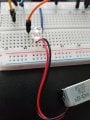
Hello, I am very new to circuits but have taken on a small project to learn more. Part of the circuit involves powering a small solenoid, after testing it a bit I found it works best between 7-9 Volts and my power supply is a tenergy 9v battery. My only issue is that from my understanding I need a diode to protect the rest of my circuit when the solenoid shuts off but the kind I have keep burning out at that voltage but if I add a resistor to protect it can't get the correct voltage to the solenoid. Are there any higher voltage capable diodes anyone can recommend or perhaps ways I can make these work. Apologies as I do not know the part number for said diodes but will include a picture.
 

Attachments

MrSalts

Joined Apr 2, 2020
2,767
Hello, I am very new to circuits but have taken on a small project to learn more. Part of the circuit involves powering a small solenoid, after testing it a bit I found it works best between 7-9 Volts and my power supply is a tenergy 9v battery. My only issue is that from my understanding I need a diode to protect the rest of my circuit when the solenoid shuts off but the kind I have keep burning out at that voltage but if I add a resistor to protect it can't get the correct voltage to the solenoid. Are there any higher voltage capable diodes anyone can recommend or perhaps ways I can make these work. Apologies as I do not know the part number for said diodes but will include a picture.
Your diode needs to be "reverse biased". Which means the white band (cathode) should be connected to the more positive terminal of the coil. If that is already connected correctly, you need a diode capable of carrying more current.
And you should use a regular diode, not an LED because the forward voltage of an LED is too high to protect some semiconductors from reverse bias caused by the inductive kick of the solenoid.
 

WBahn

Joined Mar 31, 2012
32,844
We need a lot more information that what's been given.

Please provide a schematic of the circuit you are working with. A partial picture of a breadboard tells us next to nothing.

What are the specs on the solenoid?

What diode are you using? You picture shows an LED -- you aren't using an LED as if it were just a normal diode, are you?
 

Thread Starter

Sam_B_

Joined Nov 22, 2022
4
We need a lot more information that what's been given.

Please provide a schematic of the circuit you are working with. A partial picture of a breadboard tells us next to nothing.

What are the specs on the solenoid?

What diode are you using? You picture shows an LED -- you aren't using an LED as if it were just a normal diode, are you?
We need a lot more information that what's been given.

Please provide a schematic of the circuit you are working with. A partial picture of a breadboard tells us next to nothing.

What are the specs on the solenoid?

What diode are you using? You picture shows an LED -- you aren't using an LED as if it were just a normal diode, are you?
We need a lot more information that what's been given.

Please provide a schematic of the circuit you are working with. A partial picture of a breadboard tells us next to nothing.

What are the specs on the solenoid?

What diode are you using? You picture shows an LED -- you aren't using an LED as if it were just a normal diode, are you?
Sorry, like I said this is all really new to me. The solenoid I'm using is this one
https://www.ebay.com/itm/122406279598
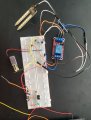
As for what is in the picture I was under the impression it was a diode with an LED but if it is just a straight LED then that would probably just be my entire issue. I don't have a schematic since i kind of just patched this together with tutorials I found online but I do have a picture of the rest of the board.
 

Attachments

Thread Starter

Sam_B_

Joined Nov 22, 2022
4
Your diode needs to be "reverse biased". Which means the white band (cathode) should be connected to the more positive terminal of the coil. If that is already connected correctly, you need a diode capable of carrying more current.
And you should use a regular diode, not an LED because the forward voltage of an LED is too high to protect some semiconductors from reverse bias caused by the inductive kick of the solenoid.
I did get a previous reply mentioning that it was just an LED I wasn't aware that it wouldn't work the same. Thank you for your help I'll definitely be ordering a regular diode now.
 

dl324

Joined Mar 30, 2015
18,328
I don't have a schematic since i kind of just patched this together with tutorials I found online but I do have a picture of the rest of the board.
Your breadboard is too messy for me to even bother tracing. Why don't you just draw a schematic from what you wired?

What is the solenoid current?
 

Papabravo

Joined Feb 24, 2006
22,082
Hello, I am very new to circuits but have taken on a small project to learn more. Part of the circuit involves powering a small solenoid, after testing it a bit I found it works best between 7-9 Volts and my power supply is a tenergy 9v battery. My only issue is that from my understanding I need a diode to protect the rest of my circuit when the solenoid shuts off but the kind I have keep burning out at that voltage but if I add a resistor to protect it can't get the correct voltage to the solenoid. Are there any higher voltage capable diodes anyone can recommend or perhaps ways I can make these work. Apologies as I do not know the part number for said diodes but will include a picture.
Unfortunately, the eBay add tells us less than nothing about how to utilize the part. We (& you) need a manufacturer's datasheet or you need to be able to measure the characteristics of the device. In particular we need to know the inductance of the coil and the DC resistance in order to design a working circuit. If you keep guessing about what components to use and how to use them your progress will be painfully slow.
 

WBahn

Joined Mar 31, 2012
32,844
Sorry, like I said this is all really new to me. The solenoid I'm using is this one
https://www.ebay.com/itm/122406279598
As for what is in the picture I was under the impression it was a diode with an LED but if it is just a straight LED then that would probably just be my entire issue. I don't have a schematic since i kind of just patched this together with tutorials I found online but I do have a picture of the rest of the board.
Draw a schematic of how YOU have connected the components you have. Even if all of the connections were clearly evident from the picture (which they aren't), we can't tell what half of the components are.

But from the picture, it looks like you have the LED in series with the solenoid.

Assuming the solenoid is 12 Ω, the battery is 9 V, and the forward voltage of the LED is ~2 V, you would have an LED current of about 580 mA when the LED is probably rated for something closer to 20 mA. Hence why it is burning up.

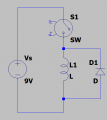
The idea behind an anti-kickback diode is to provide a path for the inductor current to die out in.

1670968927459.png

When the switch is closed, current flows downward through the inductor, but the diode is reverse-biased so no current flows in it.

When the switch is opened, the inductor will produce whatever voltage is necessary, even tens of thousands of volts, to keep the current the same, namely flowing downward at the same magnitude. Without the diode, this would result in a high enough voltage across the switch contacts to cause an arc. But, with the diode present, as soon as the voltage generated by the diode exceeds about 0.7 V, the diode starts conducting and current will flow upward through the diode and then back into the inductor. In doing so, some of the energy will be dissipated and the current will decay. This will continue until all of the energy has been converted to heat.

The peak current in the diode will be the DC current in the coil, which for you will be about 9 V / 12 Ω = 750 mA. But that current won't be there very long -- and to make it decay faster, you can put a resistor in series with the diode.

To be safe, use a diode that is rated for a continuous forward current of at least 1 A (2 A would be better), but this does represent a very conservative approach. If the number of times that this coil is switched off every second is pretty low, you can get by with a diode that is rated for a peak forward current in that range.
 

Thread Starter

Sam_B_

Joined Nov 22, 2022
4
Draw a schematic of how YOU have connected the components you have. Even if all of the connections were clearly evident from the picture (which they aren't), we can't tell what half of the components are.

But from the picture, it looks like you have the LED in series with the solenoid.

Assuming the solenoid is 12 Ω, the battery is 9 V, and the forward voltage of the LED is ~2 V, you would have an LED current of about 580 mA when the LED is probably rated for something closer to 20 mA. Hence why it is burning up.

The idea behind an anti-kickback diode is to provide a path for the inductor current to die out in.

View attachment 282965

When the switch is closed, current flows downward through the inductor, but the diode is reverse-biased so no current flows in it.

When the switch is opened, the inductor will produce whatever voltage is necessary, even tens of thousands of volts, to keep the current the same, namely flowing downward at the same magnitude. Without the diode, this would result in a high enough voltage across the switch contacts to cause an arc. But, with the diode present, as soon as the voltage generated by the diode exceeds about 0.7 V, the diode starts conducting and current will flow upward through the diode and then back into the inductor. In doing so, some of the energy will be dissipated and the current will decay. This will continue until all of the energy has been converted to heat.

The peak current in the diode will be the DC current in the coil, which for you will be about 9 V / 12 Ω = 750 mA. But that current won't be there very long -- and to make it decay faster, you can put a resistor in series with the diode.

To be safe, use a diode that is rated for a continuous forward current of at least 1 A (2 A would be better), but this does represent a very conservative approach. If the number of times that this coil is switched off every second is pretty low, you can get by with a diode that is rated for a peak forward current in that range.
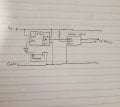
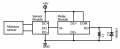
That helps a ton thank you for the walk through. I drew out the circuit although I'm not sure how it should exactly be formatted but I tried to show exactly where I have everything hooked up. I was not able to find a data sheet for the solenoid but found the resistance is 12 ohms the current is 0.48 A - 0.96A. I was able to find a data sheet for the relay in the circuit. I guess I'll definitely need to be more careful when I buy parts in the future.
 

Attachments

WBahn

Joined Mar 31, 2012
32,844
Your relay has two pins to power the coil and three pins for the switch (COM, N/O, N/C). But your schematic has this "IN" pin. What is that? By process of elimination, it would appear to be your N/C pin, but that doesn't make much sense. Also, your schematic shows that the relay is permanently powered since the coil pins (which I'm assuming are your DC+ and DC- pins in the schematic) are hard tied to the power supply rails.

You need to directly connect the relay to the solenoid and then put the diode (a real diode) across the solenoid pins with the cathode (the end that normally has a line across it on most small diodes) on the positive side of the solenoid.
 

dl324

Joined Mar 30, 2015
18,328
I drew out the circuit although I'm not sure how it should exactly be formatted but I tried to show exactly where I have everything hooked up.
Not too bad for a first try. You should try to use the conventions you see others using.

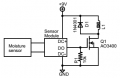
Drawn more conventionally:
1671033994882.png
We prefer for the flow in schematics to be primarily left to right and top to bottom.

I dropped the resistor you had in the sensor module power. That isn't required. I removed the diode you had in series with the solenoid because that isn't required either. D1 is for back EMF from the solenoid coil when it turns off. The diode will increase solenoid release time.

I'm assuming that the relay module will operate from 9V because it looks like a 5V module to me. 9V batteries don't have much capacity.

If you drive the solenoid low side, you can replace the relay module with a logic level N channel MOSFET.
1671035148907.png
 
Last edited:
Top