Dimming Solution for Miniature Theater Lighting

Thread Starter

Scooter80

Joined Apr 24, 2010
8
I am trying to figure a solution to dim some lights I have built in to a project. It is for a scale model of a live performance theater. They draw alot more power than I originally thought they would, so I am having difficulty figuring out what to do next.

These lights are set to be the Red, Green, Blue stage lighting and each color needs to be independently dimmable to get the correct color mix. Three "sticks" of 39 hobby-type (9-16v) incandescent lamps are on one set of three (one for each color) dimmers while another "stick" has its own dimmers.

To achieve the highest brightness in the lamps, I am using 16vdc for the power supply. I am currently using two 16v supplies that supply a total of 10 amps. The project is taking all of that power just fine (any less and it was overdriving the supplies) so I estimate the power requirements of the light "sticks" to be about 40 watts each. Therefore, one set of three dimmers would need to dim 40 watts each while the other set of three would need to dim about 13-14 watts each.

I originally had radioshack's rheostat's in the project as the dimmers. These pass enough power through them and were fine at full "brightness" but began to fail (smoke and smell) when set to a lower output (dimming the lights).

So I need a dimmer solution that is simple as possible as I need six of them. Is a PWM-type the only solution? That is a lot of components I wasn't planning on, but if necessary it is what it is.

Any help would be greatly appreciated. Thanks so much.
 

Bychon

Joined Mar 12, 2010
469
First, using DC does not provide highest brightness compared to AC. That is your biggest mistake. Dimming DC with a rheostat uses a lot of power. That's why rheostats need to be quite large or they will smoke. The best way to do this is to give up on the DC and use triac dimmers with AC. A triac dimmer can be made with about 5 parts and has very little wasted power. This method also eliminates the need for DC supplies. You just use a transformer to get 16 volts AC and use triac dimmers to control the power.
 

retched

Joined Dec 5, 2009
5,207
You may be better off all together switching to LEDs and using PWM or going all AC like bychon said.

You can get dimmable LED drivers that will handle the pwm part. You just apply power, and add LEDs.

Look up the dimmable buck puck. This will do what you want too. (with leds)

Im guessing you already spent a good bit on the power supplies, and LEDs are cheap.
 

Thread Starter

Scooter80

Joined Apr 24, 2010
8
Actually I spent the most time (24 man-hours at least) and money on making the lightsticks. The power supplies are $10 laptop bricks. So switching to LED is not an option at this point. AC would be fine with me if the lamps can handle it. I can't seem to find the specs for them now.

Looking at schematics, it appears I will be able to incorporate a pot similar to my existing rheostats in order to keep my control box intact, but where would I find the other parts to make the 6 triac-type dimmers? Radioshack? And is there any difference between a 16v capable dimmer and a 120v? What would you recommend for transforming to 16vac from the 120vac? And would I do this before or after the dimmers?

Thanks for the input so far!
 
Last edited:

retched

Joined Dec 5, 2009
5,207
Well friend, If those bulbs are not AC, your gonna have some trouble.

Are you trying to dim the whole kit-and-caboodle with one dimmer, or are there separate "areas" and multiple dimmers?
 

Thread Starter

Scooter80

Joined Apr 24, 2010
8
These definitely need to be separate dimmers. Six in total. Three dimmers will control three of these sticks while the other three dimmers will only control one stick. (four sticks in total)

It looks like the bulbs will work. The specs do not say ac or dc, so I guess either would be fine, I just assumed DC. They are the type used for model railroading and dollhouses, etc.
 

Thread Starter

Scooter80

Joined Apr 24, 2010
8
The first post says, "incandescent". They work with AC or DC.
Of course! LOL, it has been quite a long time since my electronics schooling and I am really rusty! This is all probably very easy, but I am at a loss and getting no help/input from the person who requested this project.
 

SgtWookie

Joined Jul 17, 2007
22,230
The devil's in the details. ;)

Really, PWM circuits are not that hard to build using a 555 timer, a couple of resistors, a pot, a diode, a couple of caps, and a power MOSFET. You'll be able to go from around 3% duty cycle to nearly 100%.

One thing about incandescents used in situations like you're doing; you really want to keep SOME current flowing through the filaments to keep them a bit warm.

When incandescent filaments are room temperature (or below), they are at their lowest resistance. When you suddenly apply full current to a cold bulb, there is a very large "inrush current" until the filament heats up. If you've noticed, bulbs usually burn out when they're first turned on; as this initial shock of rapid temperature change tends to kill them quite quickly. As the filament increases in temperature, the resistance increases quite a bit.

If you don't believe me, take an incandescent bulb from a night light and measure it's resistance when the filament is cold. It will have a very low resistance, yet it's only rated for 7-1/2 Watts! How can this be; you're measuring less than 10 Ohms, and when connected to 120VAC RMS, Ohm's Law tells you that P=E*E/R, so that bulb should be pulling 1,440 Watts!

Well when you first apply power, it does! That's why you might notice other lights dim for a moment. But as the filament heats up, the resistance increases to around 1.92K Ohms - so at 120VAC, you get 7.5 Watts power dissipation in the bulb.

You can adjust the minimum PWM duty cycle to keep the filaments warm, but not so hot that they are producing light beyond a dim red glow. If you remember to set the PWM on all your lights to the minimum before shutting the system down, and making sure they're at the minimum before you power back up, your lamps will last quite a bit longer.

If you are interested in pursuing a PWM solution (which would require minimum changes to your existing setup), generating a schematic to do so would be quite easy.

You'll need to buy a few things, of course.

In order for us to help you more efficiently, please put your general location in your profile. You don't have to be specific; country and state/province/general area is good enough. I'm in the USA, and have my favorite suppliers - however, these suppliers would not be useful to people in Europe, Down Under, etc.; as the shipping and import fees would be ridiculous.
 

Bychon

Joined Mar 12, 2010
469
Exactly. 16 volts DC does not produce any difference in brightness (or a highest brightness) compared to 16 volts R.M.S. AC.

Apparently I got this from the same place you did because you are agreeing with me.
 

SgtWookie

Joined Jul 17, 2007
22,230
Exactly. 16 volts DC does not produce any difference in brightness (or a highest brightness) compared to 16 volts R.M.S. AC.

Apparently I got this from the same place you did because you are agreeing with me.
I see; I apparently misinterpreted what you were trying to say. It sounded like you were implying that bulbs illuminated by DC were not as bright as if illuminated by DC, which would not be correct.

I'm willing to let Bychons be Bychons... ;)
 

Bychon

Joined Mar 12, 2010
469
LOL!!

I was disagreeing with post 1 paragraph 3...OP choosing DC because it made the "highest brightness". The good part: Your posts serve a purpose in that they call attention to the fact that I was trying to get the OP to recognize...DC is not any better than AC for this job.
 

SgtWookie

Joined Jul 17, 2007
22,230
I thought that'd get a chuckle from you. I wonder if Retched's keyboard is now dead because he spit his iced tea into it. :D

OK, so at this point, our OP already has a pair of 16VDC supplies, and lots of lamps

Readily available dimmers are designed for resistive loads like light bulbs, not inductive loads like motors or transformers.

Since our OP already has an investment in their DC supplies, and it's working except for the dimming seems most appropriate to go with a PWM approach to avoid disturbing more than necessary.

I suppose they could scrap what they have, and go with six ceiling fan motor speed controls and six 120vac to 16vac transformers, but that's getting a tad pricey - unless they happen to have a salvage source. Either way, it will probably be more bulky and expensive than going with a PWM approach - unless you have a magic wand in your back pocket?
 

SgtWookie

Joined Jul 17, 2007
22,230
Dang. :(

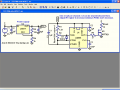
Well, here's a stab at it. It should work OK, and the parts are pretty cheap. The MOSFET choice is kind of up for grabs, but a Vdss of 30v, good Id rating, and a low gate charge will help things out quite a bit. C1's value isn't critical; 0.1uF would be better than 1uF - that will increase the base frequency, and reduce the chance you'd notice flicker at midrange settings. Making it a lot smaller might result in the MOSFET spending too much time in the linear region getting hot.

Increasing the value of R1 will increase the minimum duty cycle. It should not be lower than 100 Ohms per volt of Vcc, or the current via pin 7 of the timer will get to be excessive. As I suggested before, it would be a good idea to increase the minimum PWM duty cycle until the filaments start to glow a bit; this will make for longer bulb life.

The timing cap C1 connections are not standard; that's deliberate. Connecting them this way results in a "soft start" for the first cycle.
 

Attachments

Thread Starter

Scooter80

Joined Apr 24, 2010
8
LOL!!

I was disagreeing with post 1 paragraph 3...OP choosing DC because it made the "highest brightness". The good part: Your posts serve a purpose in that they call attention to the fact that I was trying to get the OP to recognize...DC is not any better than AC for this job.
Sorry if I wasn't clear, I only meant to say I was using 16v as opposed to the 9v (or 12v or otherwise) in order to get the highest brightness... was not differentiating between ac and dc.
 
Last edited:

Thread Starter

Scooter80

Joined Apr 24, 2010
8
Dang. :(

Well, here's a stab at it. It should work OK, and the parts are pretty cheap. The MOSFET choice is kind of up for grabs, but a Vdss of 30v, good Id rating, and a low gate charge will help things out quite a bit. C1's value isn't critical; 0.1uF would be better than 1uF - that will increase the base frequency, and reduce the chance you'd notice flicker at midrange settings. Making it a lot smaller might result in the MOSFET spending too much time in the linear region getting hot.

Increasing the value of R1 will increase the minimum duty cycle. It should not be lower than 100 Ohms per volt of Vcc, or the current via pin 7 of the timer will get to be excessive. As I suggested before, it would be a good idea to increase the minimum PWM duty cycle until the filaments start to glow a bit; this will make for longer bulb life.

The timing cap C1 connections are not standard; that's deliberate. Connecting them this way results in a "soft start" for the first cycle.
Thank you so much for the time and effort on your posts and the schematic. I am not sure my client is willing to pony up the cash, nor me the time for this modification. It might be over my head as I do not have a way to make boards and such. Does anyone know of a decent PWM "module" that anyone puts out? At least so I have options to provide the client. I had fun machining and planning the lightsticks, but electronics and cicuitry have always been hard for me and I do not enjoy it nearly as much.

Thanks again all.
 
Last edited:
Top