Digital Rain Gauge Design

Thread Starter

Dave333

Joined Apr 30, 2026
1
Check the site below. He made a digital rain gauge and circuit that measures rainfall by counting the number of raindrops dripping from a funnel for each 0.01 inch of rainfall.

I am trying to figure out how to make a rain drop counting gauge and not use an electro-mechanical counter as shown in the website
Dave

Homemade DIY Weather Instruments
 

Irving

Joined Jan 30, 2016
5,083
Welcome to AAC

Interesting idea, but needs updating with a better sensing arrangement. The electronic counter side of things is easy to implement and there are many options..

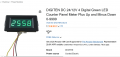
Here's a simple one from Amazon:
1777635869485.png

It will work off a 6v or higher supply, and needs a normally closed 'switch' to ground and counts each time the 'switch' is opened. Replace 'switch' with some form of drop sensor and you've got rain gauge of sorts.

Of course a better gauge would display in actual inches, millimeters, liters/sq m, etc. and there are other ways to capture rainfall amounts, eg by volume or by weight. All of which could be relatively easily implemented.
 

MisterBill2

Joined Jan 23, 2018
27,402
Counting drops is a fun challenge BUT also not very accurate. Rainfalldensity certainly looks variable if you just watch for a while.
Irving is corect!Also, what matters is the total per unit area. The more accurate annd stable schemes use a variation of the tipping bucket device.Those can be very repeatable and quite accurate. And counting is simple.
The most durable sensor uses a coil and magnet to generate a pulse with every tip. No contact and no friction, and only an occasional cleaning.
 

Irving

Joined Jan 30, 2016
5,083
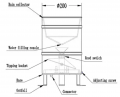
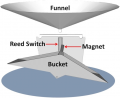
Typical 'tipping bucket' continuous measurement design. There are multiple sense options: reed switch/magnet, magnet/hall sensor, opto-interruptor/vane (my preference as its much easier to implement physically and has no dependence on distances/position).

1777710585890.png
 

MisterBill2

Joined Jan 23, 2018
27,402
Igot a smaller version of one like that. The only pain is that it is RF linked and uses a weird battery. So what I need to do is convert it into a wired version. The fallacy of wireless links is that they constantly require, and use, power, which always seems to be batteries.
AND, is that "200" dimension in mm, or cubits, or inches?? or possibly furlongs??
 

MisterBill2

Joined Jan 23, 2018
27,402
OK, all I need to do is determine a way to sense the tips and add a counter. And mount it up on the roof and run wires inside. No problem. BUT first I need to measure how much rainfall per pulse.
 

Irving

Joined Jan 30, 2016
5,083
BUT first I need to measure how much rainfall per pulse.
The commercial versions use a plastic or thin ally sheet 'cups' which come in various sizes, typically 0.1mm, 0.2mm or 0.5mm based on a 200mm dia funnel.

By my reckoning a 200mm dia collector is 0.2^2 *π/4 = 0.0314m2, is 31.4ml. That is, a rainfall of 1mm/hr = 1l/m2/hr is 31.4ml/hr. So construct a double sided bucket in 1mm sheet as shown by @MrChips above 15cm long, 2cm high in the middle and 2.5cm wide, that's internally 15 * 2.3 * 1 = 34.5ml and it'll tip twice an hour for rainfall around 1l/m2/hr. Calibrate by filling each side with 15.7ml from a syringe and adjusting the starting point for the tip with the screws under each side as per original diagram.
 

MrChips

Joined Oct 2, 2009
34,727
I used thin sheet brass to make the see-saw bucket. The centre divider is rectangular piece that is soldered at the middle. A piece of brass wire is soldered on the underside to create the pivot.
 

MisterBill2

Joined Jan 23, 2018
27,402
I am fortunate to have been given a tipping bucket sensor that suffers from a failed electronics portion. So now I need to add a counter with a display, and determine the rainfall amount per pulse. So this will require some accurate water volume delivery experimenting.
 

Irving

Joined Jan 30, 2016
5,083
Theoretically, the smaller the cup, the faster the tip rate and therefore better accuracy/resolution. There must be some limit to tip rate above which overflow occurs. That will depend on mass of cup, friction of hinge, input & output flow rate and probably a few other parameters.
 

MisterBill2

Joined Jan 23, 2018
27,402
Certainly, at some point in the reduction of the size of the volume of water per tip-cycle, there is a point at which fluid kinematics and friction effects become an accuracy reduction issue. The question becomes one about accuracy versus resolution. AND, certainly DYNAMIC RANGE will enter the discussion as well. The easy answer is multiple rain gauges of different ranges and resolutions, and possibly of different technologies.
 

AnalogKid

Joined Aug 1, 2013
12,103
Counting drops is a fun challenge BUT also not very accurate. Rainfalldensity certainly looks variable if you just watch for a while.
Counting drops in free air is worthless, but counting drops dripping out of a collector is very accurate. One of the very few things I remember from high school chemistry is that there are ten drops per cc. My guess is that the NWS has a more refined opinion. Anyway ...

The tipping bucket approach has always seemed gimmicky to me; I'm surprised to see it is still used. Years ago I played around with an optical detector to count the drops dripping out of the collection funnel, a variation of my 9th grade science fair project. Today, a kinetic variation:

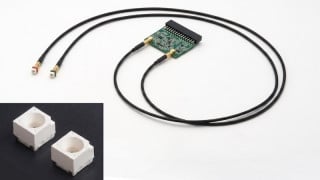
I have no idea if this is an original idea, but here is an alternate thought. Take a bare piezo disk, like one removed from a beeper, put it under the funnel, and let the drops hit it. You get one small voltage spike per drop. The greater the distance between the bottom of the funnel and the disk, the larger the voltage spike (thanks, gravity).

Disk / high impedance amplifier circuit / filter / pulse former / counter / conversion factor / display

Now that I've written it out, it is clear that everything after the amplifier circuit is identical to the tipping bucket method.

ak

Fun variation: the pulse former output drives an integrator. Scale factor the analog output voltage to drive a simple voltmeter. No digital conversion factor calc.
 
Last edited:

MisterBill2

Joined Jan 23, 2018
27,402
Of course, it would certainly be possible to have two tipping bucket sensors in sequence, the first one with smaller buckets, the second one with buckets 20 to 50 times greater volume. Not only would that greatly expand the dynamic range, it could also provide a continuing performance verification.
 
Top