Digital Potentiometer

Thread Starter

775romans

Joined Oct 25, 2017
6
Hello friends,

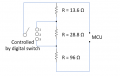
I'm looking for a solution how to switch between positions 1-3

I want to control with a digital switch controlled by plc?

Anyone have an idea?? more ideas?

thank you!
 

Attachments

Alec_t

Joined Sep 17, 2013
15,118
Welcome to AAC!
Why such low resistance values? With a total resistance of only 139Ω you risk stressing the MCU.
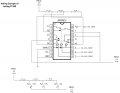
If you had much higher resistance values you could probably use simple, cheap transmission gates (e.g. CD4066) to do the switching.
 

Thread Starter

775romans

Joined Oct 25, 2017
6
Welcome to AAC!
Why such low resistance values? With a total resistance of only 139Ω you risk stressing the MCU.
If you had much higher resistance values you could probably use simple, cheap transmission gates (e.g. CD4066) to do the switching.
I'm trying to simulate PT100 sensor in 3 positions - -10c, 25c, 100c
CD4066 can't work with such resistors?
 

MaxHeadRoom

Joined Jul 18, 2013
30,658
For the outputs of the PLC, obviously you only need two, and probably contact closure outputs.
Is it a digital switch or PLC or are you substituting the name digital switch with PLC?
Max.
 

Thread Starter

775romans

Joined Oct 25, 2017
6
For the outputs of the PLC, obviously you only need two, and probably contact closure outputs.
Is it a digital switch or PLC or are you substituting the name digital switch with PLC?
Max.
I want to switch positions with digital IO of PLC,

I'm also open for other solution for example if you can advise a chip that in the input analog voltage (0-10) and the output will be impedance between 100 - 10K ohm.
 

Reloadron

Joined Jan 15, 2015
7,889
I agree with Joey in that reed relays will give you low contact resistance in the 0.150 Ohm and 0.200 Ohm range. Their coil voltage at 5 VDC requires little current allowing them to be easily driven by a micro-controller. I used quite a few Hamlin reed switches and reed relays and they were always reliable. Coil currents of 10 mA are not unusual and switching times of 1.0 mS. Here is an example of just a few Hamlin reed relays, they make hundreds of types. A Google of Hamlin Reed Relays should get you plenty of hits.

The problem with a quad bi-lateral switch like the 4066 is they have a high resistance and you can't afford an unstable added resistance.

Ron
 

Reloadron

Joined Jan 15, 2015
7,889
Looking at your specification sheet it looks like your version has 16 outputs Transistor, Source (pnp), 24VDC type. Your version does not appear to have relay outputs. I would use as I mentioned earlier, a reed relay having a 24 VDC coil. Your outputs switch a 24 VDC PNP output so one side of relay coil to your source and the other to ground. A Google of "Transistor, Source (pnp), Output circuits" will bring up dozens of examples of what you have. That would be my suggestion based on the data sheet you provided.

Ron
 

MaxHeadRoom

Joined Jul 18, 2013
30,658
You can recommend how to wire such circuit?
I'm using UID-0016T, maybe it simple but I don't see the solution
Thank you
Yeah, that model uses transistor output, apart from snapping in a relay module in the rack, then the other solutions may be the way to go.
Max.
 

Reloadron

Joined Jan 15, 2015
7,889
Have you read the data sheet:
Guaranteed On-Resistance
  • 10Ω max (+5V Supply)
  • 20Ω max (+3V Supply)
  • Guaranteed 1Ω On-Resistance Match Between Channels (single +5V supply)
You have 24 volt switched PNP outputs. Your chip uses 5 volt logic. You are switching resistances to simulate a RTD 100 resistance. Your resistors are likely or should be 1% precision where a small fractional part of an ohm needs to be figured in and you plan to use the above switching? Those guaranteed maximum On Resistance will not even be stable. Wonder what will happen when you hit those switching inputs of your selected chip with the 24 VDC PNP outputs of your controller? Your solution will not work for reasons already covered. However, good luck with it. You do understand the importance of very low resistance switching in your application right?

The relays I suggested also include a diode suppression option (flyback diode) to suppress the back EMF.

Ron
 

joeyd999

Joined Jun 6, 2011
6,279
Nah. You'd need more components if you went the reed relay route, since each relay driver node would require a back-emf protection diode.
While I always strive to keep component count to a minimum, I don't consider the count to be indicative of the complexity or adequacy of a design.

How many components should one use? Just enough.
 

Reloadron

Joined Jan 15, 2015
7,889
While I always strive to keep component count to a minimum, I don't consider the count to be indicative of the complexity or adequacy of a design.

How many components should one use? Just enough.
The correct answer is Four. Worked with a guy for about ten years and Frank's answer was always four. No clue where Frank ended up but always remember "four" as the answer to everything. :)

Ron
 

Thread Starter

775romans

Joined Oct 25, 2017
6
Have you read the data sheet:
Guaranteed On-Resistance
  • 10Ω max (+5V Supply)
  • 20Ω max (+3V Supply)
  • Guaranteed 1Ω On-Resistance Match Between Channels (single +5V supply)
You have 24 volt switched PNP outputs. Your chip uses 5 volt logic. You are switching resistances to simulate a RTD 100 resistance. Your resistors are likely or should be 1% precision where a small fractional part of an ohm needs to be figured in and you plan to use the above switching? Those guaranteed maximum On Resistance will not even be stable. Wonder what will happen when you hit those switching inputs of your selected chip with the 24 VDC PNP outputs of your controller? Your solution will not work for reasons already covered. However, good luck with it. You do understand the importance of very low resistance switching in your application right?

The relays I suggested also include a diode suppression option (flyback diode) to suppress the back EMF.

Ron
1. My plan is to work with Analog output of PLC, so 5 volt is not the problem.
2. I want to use potentiometers for calibrating the required resistance.
 

Attachments

Top