Digital input -1 to 30V which also supports PWM

Thread Starter

p1n6

Joined Dec 5, 2018
5
Hello!

I am designing a control unit that should implement a number of digital inputs. To support a bunch of standards at the same time the digital input should interpret 3-30V as digital high and -1 to 1 as low. It should also be very fast to support PWM with a bandwidth of 10MHz or a timing resolution of 1us.

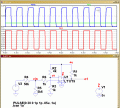
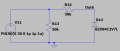
My idea was to do this very simple with a Zener diode to protect the processor. However, all the Zener diodes I have found are to slow to react especially when going from high to low. In the figure we have a voltage source representing the transmitting unit, a 50k pulldown resistor, a 50k resistor to limit the current through the Zener and the processor would be connected at Out6.

To protect the processor I cannot allow the voltage to go over 3V at the processor.

Can anyone recommend a fast enough Zener diode? Or a different approach to solve this issue?

Thankful for all help!
upload_2018-12-5_13-43-59.png
 

danadak

Joined Mar 10, 2018
4,057
Just a thought, being a HS comparator I would add a .01 and .1 uF Ceramic Disk
in parallel to its supply pin to handle the output fast transient current to load, parasitic C.

Look at datasheet for ceramic carefully, not all of same C are good low inductance
performance.

Regards, Dana.
 

ebp

Joined Feb 8, 2018
2,332
I strongly recommend using hysteresis with a high speed comparator. They can be difficult and fussy things at the best of times and with no hysteresis noise could easily cause multiple transitions around the threshold. The reference also needs to be well filtered and power supply decoupling carefully attended to.

An RS-485 receiver carefully applied (used single-ended with regard to the signal with suitable attenuation and bias networks) might be a workable alternative to a fast comparator, though certainly less flexible.
 

ebp

Joined Feb 8, 2018
2,332
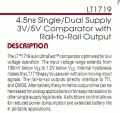
Well that's a surprise! The part is rather expensive, but the requirement sounds rather difficult and problem prone to me, so cost is to be expected.

It's another of those "simple" parts that takes a lot of datasheet reading time to properly evaluate. I'm not going to take that time, but it does look well suited for the task. The internal hysteresis is only 4 mV which may or may not be adequate. With fast input transitions (where hysteresis isn't usually required), unterminated signal paths may result in ringing (where lots of hysteresis is helpful).
 

Thread Starter

p1n6

Joined Dec 5, 2018
5
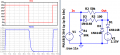
Thanks for the replays. As you say the LT1719 is expensive and I am now trying to find another comparator that fulfils my requirements even if I have to go down a little in speed. The other important thing is that I must interpret both 3 and 30V in as digital high. By changing the comparator reference value in Eric’s circuit I got this to work but I am unsure of how to get your circuit Danko to support both 3 and 30V. When I run the simulation it looks like the leakage current is to big so the voltage drops to far when I apply 3V.
 

ericgibbs

Joined Jan 29, 2010
21,469
hi p1,
Which alternative Comparator have you chosen, I can give it a try.
The problem with the circuit in post #8, is that it requires a low impedance 2.15V source.
Also it assumes a very low input impedance source.

I plan to sim that circuit as a comparison.

E
 
Last edited:

Thread Starter

p1n6

Joined Dec 5, 2018
5
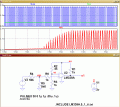
I am not sure... Finding good simulations models are harder than I expected. I wanted to start with and see what kind of response I will get with something as cheap as the LM2901 but I do not get the sim to work properly..
 

Attachments

ebp

Joined Feb 8, 2018
2,332
That "wind up" behavior of the 339 is interesting and not something I would have expected, though I've never really put any thought into the internals of the part.

===

The LM319 is considerably faster than the 339, but still dubious at 10 MHz.

Fast comparators generally are moderately expensive. It might be possible to use an RS-422 line receiver for the application. They are inherently comparators for "digital" signals and will withstand voltages beyond the supply rails (though not 30 V), but they are also less flexible than an analog comparator. The cost saving might not be great - some of the receivers are absurdly expensive, in my opinion.
 

Thread Starter

p1n6

Joined Dec 5, 2018
5
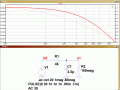
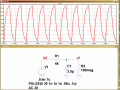
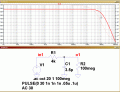
I have now changed tactic and are going to go with the 74LV14 Hex inverting Schmitt-trigger. It has clamping diodes which can withstand 20mA. As long as I limit the current with a resistor I think I will be okay.

Can I calculate the bandwidth on this component as if it’s an RC filter with the series resistance I select and the input capacitance of 3.5pF?

If so, with a 4kOhm resistor I would get 30V/4kOhm = 7,5mA and bandwidth = 1/(2piRC) = 11MHz.
 

Attachments

Top