Facebook
 Google
 GitHub
 Linkedin
I realize that this must be a very basic question, but I'm new to all of this and thus far my instructors have actually been a bit standoffish when it comes to guidance, thus I turn to you.
This is what we have been given -
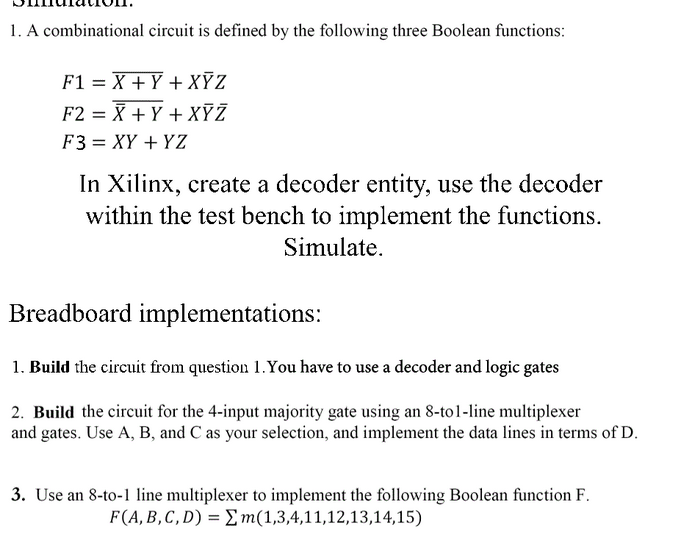
My partner and I are are number 1 under breadboard implementation.
I've read a few resources on decoders, and the main idea expressed was that you can use them in the form of n-to-2^n, or a BCD decoder, where only one of the outputs will be active.
I don't understand how that concept applies to our lab assignment. In what way do we need to use a decoder to build the given functions?
It looks as though we just have three outputs defined in terms of three variables.
Thus far the only thing my partner and I have built is a 3-way majority gate in a previous lab, and the above circuit looks more similar to that.
I just need some help understanding how a decoder fits in with all of this.
This is what we have been given -
My partner and I are are number 1 under breadboard implementation.
I've read a few resources on decoders, and the main idea expressed was that you can use them in the form of n-to-2^n, or a BCD decoder, where only one of the outputs will be active.
I don't understand how that concept applies to our lab assignment. In what way do we need to use a decoder to build the given functions?
It looks as though we just have three outputs defined in terms of three variables.
Thus far the only thing my partner and I have built is a 3-way majority gate in a previous lab, and the above circuit looks more similar to that.
I just need some help understanding how a decoder fits in with all of this.