You need to show YOUR best attempt to solve YOUR homework problem. That will provide the starting point for discussion to let us help steer you along the path to help YOU solve the problem.
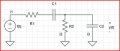
In general, try to make your work easy to follow by defining terms not on your diagram. For instant, in your first equation you use "I" but don't give any indication of what it is and require your readers to figure it out. Instead, make a notation that, "The current 'I' is flowing out of the supply (i.e., flowing left to right in R1)". Finally, the voltage across the capacitor C1 is equal to the definite integral from 0 to t, not the indefinite integral. Arguably, we should use a dummy variable for the integrand, but it isn't too confusing to just keep it as t.
Then, by convention, lower case variables are generally used for time varying signals and upper case variables for constants (and frequency domain variables, which we aren't dealing with here). It's good habit to stick to convention as much as reasonable.
Don't forget about the initial conditions. In this equation, C1 could have a voltage across it (positive on left side) at t=0, which we will call V1. So
Don't just use 'df' and 'dy'. These are infinitesimal quantities. Either use df/dt or use f' since the apostrophe is an accepted notation for the derivative with respect to a single variable, particularly time. So
Carrying the (t) in the notation is often dropped. This is, in part, reasonable because of the convention that lower case variables are understood to be varying functions of time. So
At this point, a good sanity check is to ask if the units work out. The product of resistance times capacitance is time (known as an RC time constant). Each level of derivative results in the factor being divided by the unit of time. Finally, f(t) and y(t) are both voltages. So the left hand side of the equation has units of volts/time. Looking at each term in turn, we see that they also each have units of volts/time, so the units do work out.
So you can see how hard it can be for someone to back out what you are doing. If, instead, you indicate on your drawing I, I2, and I3 and then simply say
I = I2 + I3
I = y/R2 + C2*dy
It becomes very clear and easy to follow.
Remember, your reader doesn't have the mental picture you do and has to build it up based solely on what you provide them. Make it easy for them -- especially if your reader is also the person assigning your grade!

 Facebook
 Google
 GitHub
 Linkedin
 24.2 KB Views: 19