diagnosing op-amp circuit malfunction

Thread Starter

ebeowulf17

Joined Aug 12, 2014
3,307
I would like to volunteer that the act of measuring can cause or quench the oscillation. I have seen both of these in real life, and it was always related to the high gain of the op-amp. A few picofarads from the scope probe can quench oscillation by decreasing the bandwidth of the frequency response at the non-inverting input. I can't remember the schematic, but I had one that would burst into oscillation when measured with a scope probe because it was mis-wired. So, caution be to the trouble shooter. You can't know everything about the circuit until you understand it, and then prove the physical reality matches the schematic.
That's a very interesting point. I'm pretty confident that it's neither creating nor solving the problem of oscillation in this case, because I can also see the LED flicker when it's oscillating, and that behavior is the same with or without test gear connected.

I suspect that the oscillation is simply because there is NO hysteresis near this new, bogus trip point of 1.7VDC. The VREF is way below that, so when it pulls up or down with output changes, it's still nowhere near this bizarre, high trip point.
 
Last edited:

Thread Starter

ebeowulf17

Joined Aug 12, 2014
3,307
I just threw it in without reading the Thread because it's educational. No real intent to be relevant.
It definitely was educational, and appreciated. I didn't mean to sound negative in any way - just clarifying what I know (or think I know) about this particular situation.
 

Thread Starter

ebeowulf17

Joined Aug 12, 2014
3,307
So, I've done a little more reading up on op amp failure modes, and it seems like an input offset voltage (Vos) error would perfectly explain the behavior of this second failed board (the one detailed in post #18, not the original failed board from the top of this thread.) I've found a small number of references to such errors, but not many (here's one, and here's another.)

Is this something anyone here has experienced before? Obviously I don't think it's common, but if we're talking about 1 or 2 failures out of several thousand units, does it seem like a reasonable possibility?

As always, thanks for all the insights and shared knowledge.
 

Thread Starter

ebeowulf17

Joined Aug 12, 2014
3,307
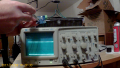
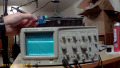
Disregard my last post. I was finally able to get the oscilloscope and this failed board back together again. I had somehow overlooked scoping the output of the Hall Effect sensor on my last go around, and it is not just oscillating near the trip point, it is oscillating 100% of the time. Now that I see what the sensor output is doing, it's a miracle that the comparator output is ever NOT oscillating! The Hall Effect sensor's output switches at ~275kHz at idle, just over 50% duty cycle. As the magnet approaches, the pulse frequency and duty cycle both drop (looks like positive pulse lengths stay the same and zero-voltage time periods are elongated.)

Googling this type of behavior didn't pull up anything specific to Hall Effect sensors or comparators, but it did turn up some references to Class D amplifiers which switch at around this speed and then use LC filters to filter out the high frequencies. Do you think maybe this Hall effect sensor uses a Class D amplifier, or something like it, and that the 275kHz oscillation is a perfectly normal part of the internal workings of the sensor, but that the filter isn't doing its job?

Alternately, do you think I'm mis-attributing the cause of this oscillation? The sensor output is still connected to the comparator input. I suppose it could be the comparator's fault somehow?

2017_0124_Ozo-Hall-Sensor2.MP4_00_00_05_00002.png 2017_0124_Ozo-Hall-Sensor2.MP4_00_00_01_00001.png
 

Thread Starter

ebeowulf17

Joined Aug 12, 2014
3,307
I de-soldered the Hall Effect sensor output from the circuit, isolating it from the comparator, and still found the oscillation on the sensor output. I emailed Honeywell to ask about the failure and whether they use anything like a class d amp in there, and they said it's all strictly linear circuits - no clocks or pulses, nothing that should be oscillating. I think it's safe to say this sensor is toast!

At this point I don't think I have reason to suspect anything else is wrong with the circuit. I'll have the sensor replaced and hopefully that's the end of the story.
 

Thread Starter

ebeowulf17

Joined Aug 12, 2014
3,307
If they are on anything like long leads, maybe they need a decoupling capacitor (100nF?) at the sensor end of the cable?
Good thought, but hopefully not needed here. They're smt mounted on the same pcb as the comparator, less than an inch away. I'm sure a capacitor wouldn't hurt, but I didn't think it would be necessary with such a short path.
 

AlbertHall

Joined Jun 4, 2014
12,626
I meant a capacitor across the supply to the sensors so it wouldn't affect response time, but if they are on the same board then it probably wouldn't make any difference.
 

Thread Starter

ebeowulf17

Joined Aug 12, 2014
3,307
I meant a capacitor across the supply to the sensors so it wouldn't affect response time, but if they are on the same board then it probably wouldn't make any difference.
Yeah, sorry. I realized that almost as soon as I replied and I've edited my response accordingly. Just didn't catch it fast enough!
 
Top