Developing low power watch with USB programming and CR2032 Coin cell power...

Thread Starter

Mark Winney

Joined Mar 3, 2017
7
Hi,
I have attached a circuit diagram of part of my watch circuit around the USB and voltage conversion and battery and needed some guidance on whether this circuit is ok if I want to be able to power the watch via USB whilst the coin cell is still in the watch?
I am not so sure it is.
Do I need a diode in place to prevent the coin cell from being powered by the USB. If this is the case then where would it be and because every uA of wasted power is an issue how would I do it most efficiently.
Of course if it is not possible then perhaps I should require removal of coin-cell during USB programming.
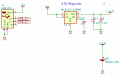
circuit.png

Any help is appreciated.
Mark
 

Infinion

Joined Apr 2, 2016
9
Hey Mark,

A few options come to mind:
The simplest would be simply adding a schottky diode in series with the CR2032, the big downside being that it eliminates 0.2V or more of the coincell's already low voltage. Since CR2032 is already below 3.3V this would be unacceptable (but not sure if your load requirements allow it).

The next option is to add a P-channel MOSFET in series with the CR2032 on the high side, with source pin connected to +3.3V, and its gate tied to VCC. A MOSFET is a great solution because they will act like unidirectional switches with very low resistance, rather than diodes and transistors that have a voltage drop.

With the addition of a pull-down resistor across VCC, the P-channel MOSFET's gate would see -3V with respect to its source while no USB connection is present and conduct in saturation mode, allowing your CR2032 to power the +3.3V line with its 3V. When a 5V USB connection is made, the PFET's gate voltage will be positive with respect to its source and immediately enter the cut-off region of operation where it acts like an open switch, and its body diode will be reverse biased against the MIC5219's generated 3.3V.


This should give you the most efficient reverse-voltage protection for your coincell for the least amount of parts. You could argue a 2-pole single throw switch is the least amount of parts if you used it to simultaneously switch between battery and USB power, but depending on the power draw of your load, you could introduce a bunch of debounce and ripple to your +3.3V line which is less than ideal.

In summary, Add a P-channel Mosfet with a low gate threshold voltage and a 10kΩ-1MΩ pull-down resistor to disable the battery while running off USB power

For more clarity, I would recommend reading these extremely insightful application notes that describe this and a few other methods in greater detail

  1. Reverse Current/Battery Protection Circuits: http://www.ti.com/lit/an/slva139/slva139.pdf
  2. Using MOSFETs in Load Switch Applications: http://www.onsemi.com/pub/Collateral/AND9093-D.PDF
  3. Designing A Li-Ion Battery Charger and Load Sharing System With Microchip’s Stand-Alone Li-Ion Battery Charge Management Controller: http://ww1.microchip.com/downloads/en/AppNotes/01149c.pdf
That last link is more for rechargeable Li-ion batteries (like the LIR2032 coincell btw) but uses the same concepts as above with MOSFETs as load switches and adds further insight on why connecting a rechargeable battery directly to a load isn't the best design practice, and how all drawbacks can be overcome in a novel way by adding some diodes and a P-channel mosfet to route USB power directly to the load, and allow the charger to properly charge a battery without also needing to contend with a load.

Anyways hope this helps! I've works with coincell-powered circuits in the past so figured I'd lend a helping hand. Also if it happens that you needed 3.3V for your circuit instead of the 2.5-3V that a coincell provides over its lifetime, you may want to consider a 3.3V boost converter stage between your battery and load for a true 3.3V rail.
 
Top