Develop a reliable 120 kHz ultrasonic transmitter circuit

Thread Starter

parthmakersmuse

Joined Oct 7, 2026
3
I am trying to develop a reliable 120 kHz ultrasonic transmitter circuit using the KEMET ND18X3N6 piezoelectric transducer.

Problem: Although the Arduino, TC4420, and IRF540N stages generate the required 120 kHz signal correctly, the waveform becomes weak and distorted when the PZT is connected, indicating an impedance/drive mismatch that needs to be resolved.
 

kiroma

Joined Apr 30, 2014
244
I am trying to develop a reliable 120 kHz ultrasonic transmitter circuit using the KEMET ND18X3N6 piezoelectric transducer.

Problem: Although the Arduino, TC4420, and IRF540N stages generate the required 120 kHz signal correctly, the waveform becomes weak and distorted when the PZT is connected, indicating an impedance/drive mismatch that needs to be resolved.
From what I know, the piezo transducer is strongly capacitive. If your drive circuit has some medium output impedance, without load it's perfect, but with load it will distort heavily.
But as others said, post the schematic with PNs.
 
another option
the pizo effisancy is at one particular frequency , with a very high Q.
these circuits often work with the pizo setting the frequency , for max output .
even if it say 120 Khz, it could be say 120.001 Hz ,
 

ronsimpson

Joined Oct 7, 2019
4,832
If this TC4420 can withstand 6 A peak, why do you need another MOSFET to drive it?
The TC4420 was never designed to deliver 6A at 100% duty cycle. Normally they only see current for less than 100nS. Internally it has a Rds_on of 2 ohms. At 6A there will be 12V of drop in the output. Depending on package, don't push the part past 0.5 watts.
 

kiroma

Joined Apr 30, 2014
244
The TC4420 was never designed to deliver 6A at 100% duty cycle. Normally they only see current for less than 100nS. Internally it has a Rds_on of 2 ohms. At 6A there will be 12V of drop in the output. Depending on package, don't push the part past 0.5 watts.
I never said it was designed to handle 6 A at 100% duty. I just said it can deliver this much at peaks, so it's powerful. So, is it enough to drive the piezo or does it need a transistor after it? This TC4420 can handle at most 10 nF of load, which is a lot for 120 kHz.
I'm not seeing the reason it doesn't work.

@parthmakersmuse , what's the 12 V power supply you have? is it regulated or not? Maybe the 12 V is dropping when you plug the transducer because it demands more current.
 

kiroma

Joined Apr 30, 2014
244
I just realized that with a transistor in common-emitter like that, what you do to the piezo is to turn it on, but nothing discharge its capacitance, so you're not sinking current. The TC4420 is capable of sinking current, so plugging it directly might be the solution. It's just 1/10 of the capacitance drive capability. Plug it and let's see.
 
I believe Kiroma's idea has merit.
You do require a push-pull drive, like any good Mosfet driver already has.
If you test it for a few seconds only, you can validate the idea and hopefully the IC will not be damaged.

If the test is successful, then you may then add external P- and N- channel Mosfets.
 

kiroma

Joined Apr 30, 2014
244
If you test it for a few seconds only, you can validate the idea and hopefully the IC will not be damaged.
The piezo is about 1 nF and the IC is capable of driving 10 nF, so you have some margin.
I know, it might not be enough depending on the voltage you apply (the higher the volume, the more current). So to start, don't go past 15 V.
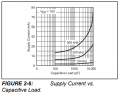
This graph shows it's possible. You'll have about 7 to 10 mA supplied to the piezo. Remember, piezos are very loud, so it's not needed much current.
1791477136883.png
 

kaindub

Joined Oct 28, 2019
187
The piezo is about 1 nF and the IC is capable of driving 10 nF, so you have some margin.
I know, it might not be enough depending on the voltage you apply (the higher the volume, the more current). So to start, don't go past 15 V.
This graph shows it's possible. You'll have about 7 to 10 mA supplied to the piezo. Remember, piezos are very loud, so it's not needed much current.
View attachment 372058
Piezos are loud? I dont know of anyone who can hear 120kHz, which is the resonant frequency of said piezo.
 

Thread Starter

parthmakersmuse

Joined Oct 7, 2026
3
Quick updates:Circuit works now after removing the mosfet.

Work Completed So Far

Developed the transmitter circuit using the TC4420 driver IC.

Generated an approximately 120 kHz signal using the Arduino UNO.

Observed the transmitted signal on the oscilloscope and confirmed that the receiver detects the transmitted wave.

Tested the receiver frequency, which showed readings around 118 kHz with minor fluctuations.

Tested PLA and GFRP samples between the transmitter and receiver, but the received waveform did not show clear or consistent changes.

Current Problem Statement

The main challenge is to obtain and analyse a reliable received waveform when different material samples are placed between the transmitter and receiver. The received waveform does not closely resemble the transmitted waveform, and clear differences between the tested materials are not yet visible.

I need guidance on preparing suitable PLA and GFRP test samples, conducting experiments, identifying expected waveform changes, and selecting an appropriate receiver-side circuit or signal-conditioning device to improve waveform detection and enable future identification of cracks, voids, and delamination. Enclosed video (https://drive.google.com/file/d/1-_w0wH5jKUWyeUTi236-5rEMXvppRjb2/view?usp=sharing) & schematic
 

Attachments

ericgibbs

Joined Jan 29, 2010
21,586
Last edited:
Piezos are loud? I dont know of anyone who can hear 120kHz, which is the resonant frequency of said piezo.
I've seen alarm sirens that go 130 dB with 12 V and idk, about 200 mA. This is what I meant. For 120 kHz, it's obviously ultrasonic (we can't hear it), but it's still loud. The same would apply to light, infrared can be bright, we can't see it, but we would feel on our skin and we would call that strong. You can argue that it's not brightness, it's strongness, but would you call an infrared light strong instead of bright? So the same applies to piezos.
 
I've seen alarm sirens that go 130 dB with 12 V and idk, about 200 mA. This is what I meant. For 120 kHz, it's obviously ultrasonic (we can't hear it), but it's still loud. The same would apply to light, infrared can be bright, we can't see it, but we would feel on our skin and we would call that strong. You can argue that it's not brightness, it's strongness, but would you call an infrared light strong instead of bright? So the same applies to piezos.
What's the signal look like with only air between the tx and Rx pizo
 
Top