Detecting water flow in a pipe

Thread Starter

cmartinez

Joined Jan 17, 2007
8,804
The sensor you are using is a magnetoresistive sensor, it is not a hall effect.
You're quite right, I had forgotten about that detail. But I chose the sensor because of its low power draw, and because my application does not require high switching frequencies. As you might've noticed in the datasheet, the sensor is rather slow compared to a true hall effect. And as Ebe just said, the type of sensor doesn't make a real difference as long as it's low power and sensitive enough for the application.
 

haresfur

Joined Oct 13, 2019
7
Thanks. In fact, I built a circuit exactly like the one you've described a few years ago, except that it worked with two transistors and not a thermistor. And it worked like a charm to measure the flow of air. But this application is battery-powered, so current draw is critical, and therefore this technique is off the table.
This is the principle used in tree heat-pulse sap-flow sensors, which are extremely sensitive to low-flow and are commonly deployed with battery power. Low-power is a question of degree - it depends on how often you need measurements and battery size, and how often you are willing to change them. But in your case, the limit would probably be that you would need a reasonably strong heat pulse to be able to detect it at high flow.
 

Thread Starter

cmartinez

Joined Jan 17, 2007
8,804
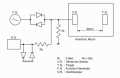
I'm going to start playing with a pair of ultrasonic transducers, and the recommended test circuit looks like this:

1775775843167.png

Question, what role do the pair of anti-parallel diodes in the circuit could possibly have? ... to prevent voltage peaks and/or to cause an intentional voltage drop?, Or are they misrepresented zeners?
 

Danko

Joined Nov 22, 2017
2,201
Question, what role do the pair of anti-parallel diodes in the circuit could possibly have? ... to prevent voltage peaks and/or to cause an intentional voltage drop?, Or are they misrepresented zeners?
Vertically oriented diodes protect receiver from HV signal of transmitter.
Horizontally oriented diodes prevent weak received signal from shunt by transmitter circuit.
 

MisterBill2

Joined Jan 23, 2018
27,876
What has not been mentioned is the system static pressure level. My residential static pressure is about 65 PSI, which would burst some of the suggested sensors. A differential pressure switch across a one PSI opening check valve would not demand an extra sensitive DP switch.

OK, lots of ideas, but not this one, which works for a few industrial applications: A pressure operated check valve in the water path, with a known opening pressure. Then a differential pressure switch across that check valve. When the differential pressure is great enough to open the check valve it indicates that there is flow. For a much more sensitive sensing ability, use a differential pressure transducer. OR you could use a flow sensor as shown in post #23, which could give an output with a very low flow, and the check valve will open with any higher flow.
 
Last edited:

Thread Starter

cmartinez

Joined Jan 17, 2007
8,804
Thanks for the suggestion, Bill. I have already solved the problem mechanically, by designing a very sensitive spring loaded gate that looks pretty much like a plunger with a curved tip that points against the flow, to minimize the chances of small debris being caught when it shuts, At this moment I'm exploring the possibility of a solid state system.
 

wayneh

Joined Sep 9, 2010
18,130
I have already solved the problem mechanically...
Chemical engineer here. We're obsessed with flows and measurements. I haven't chimed in before because your first post lost me in the 2nd paragraph when you mentioned you want to detect a linear flow of just 1mm/min. That eliminates a LOT of options.

I believe what I see is that you ended up "cheating" by essentially sealing the pipe at low flow. I imagine higher flow moves the obstruction out of the way? Clever, as long as the low flow is not altered by the measurement.
 

MisterBill2

Joined Jan 23, 2018
27,876
Thanks for the suggestion, Bill. I have already solved the problem mechanically, by designing a very sensitive spring loaded gate that looks pretty much like a plunger with a curved tip that points against the flow, to minimize the chances of small debris being caught when it shuts, At this moment I'm exploring the possibility of a solid state system.
Amazingly enough, there was a few months back a string of articles about the operation of check valves. That seems like a very good choice for measuring flow if the viscosity is not too great.
And because I am no longer part of that organization that deals with hydraulics and pneumatics I have not stayed current on the subject. I still recall a lot but giving good advice, and knowing when to be quiet is still part of what I do.
 
Top