Designing the Ultimate Continuity Tester

#12

Joined Nov 30, 2010
18,224
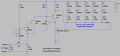
It only took me a short nap to realize the driving impedance is going to change if the voltage target is 3.75 mv.
Now you're going to need 7.5 ma through 0.5 ohms to get to the measurement threshold and you can use up 0.49625 volts to get there.
that's 66.1666 ohms. Hmmm...not much improvement in safety from external voltages.

Good start in post #20. You can get 3V chimes but they max out at 80 db IIRC.
I was looking at a 9V chime for 95 db but you chose a chip that limits at 7 volts Vcc. Not a problem. Add a few volts of zener.
Typo: You need 5mv for the threshold with that chip, and you did the math right on the resistors.
 

Attachments

wayneh

Joined Sep 9, 2010
18,108
My 2¢: You need a microprocessor to run a test routine for an ohmmeter, connected to a noisemaker. The µP would be off most of the time but would be awakened by sensing a small current between the probes. It would then proceed to execute a sweep of increasingly 'harsh' tests to determine the ohms between the leads. The tests would be designed to protect the device, and would only advance when the safe conditions were confirmed. This could all happen in the blink of an eye.
 

ian field

Joined Oct 27, 2012
6,536
A continuity tester is a pretty mundane piece of gear, but very useful.

I have several, but I started thinking about designing and building one that meets my obsessive fantasy specifications.

I am often working on some prototype and just want to quickly validate connectivity, with minimum effort.
My fancy Fluke multimeter has a good continuity function, but it's a pain to turn it on and switch the mode, I have to twiddle the dial and push buttons, I need a dedicated tool that suits my workflow - just pick up the leads and test, always ready, nothing to think about.

1) It's just a box with 2 banana jacks and a beeper. Super simple.

2) No ON/OFF switch.
I want it to always be ready, just grab the leads and test.

3) Long battery life.
Standby current of a few uA.

4) Only beeps when it sees less than 5 ohms on the test probes.
Ignores bad connections and most components in the circuit.

5) Ignores diode and transistor junctions- it's a CONTINUITY tester!

6) Outputs a limited, safe current.
Less than 10 mA? Will not damage delicate parts.

7) Robust- withstands my absent-minded probing of live circuits without blowing up.
50 V AC/DC without damage.

8) It should respond really quickly.
This allows me find intermittent connections in connectors and cables, etc.
Some multimeters suck at this! drives me nuts, have the designers not ever used the thing??

Anyone have any circuit concepts?

I will share my design as the project unfolds.
Horses for courses - I have various continuity testers, but often have to pick the right one for the job.

When I serviced monitors for a living, there were no shortage of fatigued VGA cables. Most continuity testers would read OK but I end up with a call back. My solution was a H4 headlamp bulb and a motorcycle battery. It only takes 1 intact strand to give a false OK - the current I put through it made sure. It also works for setting the timing on energy transfer ignition - the points short the coil so a regular timing light won't tell you anything. The DC resistance of the coil is enough to dim the headlamp bulb when the points open.

You do have to watch it though - the lighter cables warm up a bit with headlamp current.
 

wayneh

Joined Sep 9, 2010
18,108
My solution was a H4 headlamp bulb and a motorcycle battery.
That's exactly what I was thinking of when I offered my strategy above. If you don't test with a significant load current, where justified, you can be fooled. But you can't just set your meter to drive 1A through everything you test.
 

#12

Joined Nov 30, 2010
18,224
If you don't test with a significant load current, where justified, you can be fooled. But you can't just set your meter to drive 1A through everything you test.
Today, I like a uP on this job. Low currents being measured by high impedances is inviting mistakes.:(
 

RichardO

Joined May 4, 2013
2,270
I have posted this before. I does not quit meet all of your spec's but I think it is close enough. The threshold is more like 100 ohms and it might not withstand 15 volts. If surface mount parts are used it can all sit on the end of a 9-volt battery.

Surprisingly, the 100 ohms seems about right. A lower threshold is a problem when there is oxidation on solder joints. I have been using variations of this circuit for decades and I've seldom permanently damaged one.

The biggest problem I have been having lately is that it is not loud enough for my failing hearing.

upload_2017-6-10_10-26-57.png
 

Attachments

Thread Starter

Sensacell

Joined Jun 19, 2012
3,785
A final follow-up on my project:

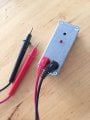
After a few obsessive-compulsive hours of soldering and fiddling, the project is completed.

The main change I made to make it bullet-proof was adding the Bournes TBU to protect the input from negative over voltage.
This part is perfect for those situations when you cannot figure out how to protect an input from damage, when all conventional ideas fail.

The TBU acts as an ultra- fast (1 us) mini circuit breaker, when the TBU sees 50-75 mA, it snaps open and stays open until the voltage drops to a low level, then it resets to look like a low value resistor again.
Since it's a chip, not a thermistor, it's really fast, both breaking and resetting.
It's rather expensive, I might add.

With this part in the circuit, I believe I could plug the tester into 220 mains and it would not die.

I added an LED to the switch output, this turns on at a few mA, giving you a visual that some current is flowing, but it won't beep until it sees 3 ohms or less on the test leads. This allows me to poke around and even test diode and transistor junctions with it, the LED lights, but the beeper stays quiet.

Very happy with the results.

IMG_6064.JPG
Coninuity_tester.png
 

Attachments

Last edited:

RichardO

Joined May 4, 2013
2,270
A final follow-up on my project:

After a few obsessive-compulsive hours of soldering and fiddling, the project is completed.

The main change I made to make it bullet-proof was adding the Bournes TBU to protect the input from negative over voltage.
This part is perfect for those situations when you cannot figure out how to protect an input from damage, when all conventional ideas fail.

The TBU acts as an ultra- fast (1 us) mini circuit breaker, when the TBU sees 50-75 mA, it snaps open and stays open until the voltage drops to a low level, then it resets to look like a low value resistor again.
Since it's a chip, not a thermistor, it's really fast, both breaking and resetting.
It's rather expensive, I might add.

With this part in the circuit, I believe I could plug the tester into 220 mains and it would not die.

I added an LED to the switch output, this turns on at a few mA, giving you a visual that some current is flowing, but it won't beep until it sees 3 ohms or less on the test leads. This allows me to poke around and even test diode and transistor junctions with it, the LED lights, but the beeper stays quiet.

Very happy with the results.

View attachment 129201
View attachment 129202
Excellent. Can you post the .asc file for me to play with?
 

MisterBill2

Joined Jan 23, 2018
27,571
I designed and built one about 20 years ago. It has a low open circuit voltage and a quite low test current. The good news is that it should withstand an accidental 120 volt mains input, although I only tested it to +/- 65 volts DC. The bad news is it does have an on/off switch.
It uses an LM311 comparator and several other parts, including a couple diodes. I can try and trace out the circuit and post it here. But that may be a couple of days. My recollection is that it had some sort of bridge scheme along with a very high input resistance to limit current during an "excess voltage incident."

Probably similar to the one in post #20, but without the automatic turn on circuit, and using ab LM311 comparator, not an opamp. And some sort of input over voltage protection scheme. So it CERTAINLY IS POSSIBLE to produce.
ADD a pushbutton power switch and a power-on LED and almost as good as an automatic continuity tester, but AAC mains proof!
 
Last edited:

panic mode

Joined Oct 10, 2011
5,002
nice video.... and circuit... thanks for that.

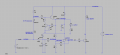
but... i see no reference so response will change with aging batteries. so i tried the simulation file...

I set supply to 3.3V (new batteries) and circuit appear to stop working - which of course is not true.
simulation does work with 3.1V. as the supply is dropped further, window opens up since threshold is changing.
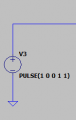
this is only issue with simulation and used current source to simulate input. changing it to voltage source fixes this part of simulation (one can try other supply voltages like 3.6V if using Li battery).
1727806364921.png

also... changes due battery aging should be rather small since they get canceled out to a degree. reason is that R3/R4 as well as (R1+R11)/Rx form voltage dividers and both are tied to battery voltage. to compensate it one could try added in series with R3 and matching voltage drop across D4(some 550mV) with voltage drop across this new diode and Vce of the Q1. oh well...
 
Last edited:

Thread Starter

Sensacell

Joined Jun 19, 2012
3,785
The one I built is a steadfast companion on my test bench, I use it almost everyday.
I love the brain-deadness of using it! just grab the leads and prod away.

A few things that annoy:

1) The test leads always tangle into a mess.
2) Having the LED on the box means I need to place the tester within my peripheral vision to see when the LED blinks
(when testing diodes, LED's etc.- no beeping)

So I am working on a new design that attempts to be more better!
The probe tip is a light pipe that will illuminate right where you are looking.
A single GND lead out the back should be less tangle-prone.
Vers_3.png
 

MisterBill2

Joined Jan 23, 2018
27,571
The tester I built uses 5-way terminals spaced to match the common double-pin plugs,, for connections, so no leads to tangle. The LED is a pilot light showing power on, although it does get brighter during a beep. I can plug in probes or clip leads or wire to the terminals to check a device with wire leads. And it has no tendency to roll away on a bench top. So there are benefits to each of the different form factors.
 

Ya’akov

Joined Jan 27, 2019
10,240
The one I built is a steadfast companion on my test bench, I use it almost everyday.
I love the brain-deadness of using it! just grab the leads and prod away.

A few things that annoy:

1) The test leads always tangle into a mess.
2) Having the LED on the box means I need to place the tester within my peripheral vision to see when the LED blinks
(when testing diodes, LED's etc.- no beeping)

So I am working on a new design that attempts to be more better!
The probe tip is a light pipe that will illuminate right where you are looking.
A single GND lead out the back should be less tangle-prone.
View attachment 332856
Very nice. I wonder if a small MCU and an RGB LED would help make the UI even more friendly. One piece of scope creep that strikes me is a voltmeter. A lot of LED flashlights can read out the battery voltage as a series of blinks. Since they are generally powered but a single Li cell, it’s up to 4 blinks, a pause, then up to 9 blinks. But with an RGB led you could extend that range and the speed of read out considerably, e.g.:

R: 10V per blink
G: 1V per blink
B: .1V per blink

So, 12.6V would read out as R, G, G, B, B, B, B, B, B. At a rate of 225ms per blink and 25ms per space, that would take about 2.25s—you might even be able to go faster. Hey, since we are expanding your project beyond all reason, you might even be able to make something that can show the difference between two probes. Say, R for higher and G for lower—so I press the difference button (or whatever) and probe one, it blinks to say “got it” then probe again, and it shows me R or G.

I’m going to stop now before I end up on your secret enemies list. Looks like a nice project, I look forward to buying one. You will sell me one, won’t youi?
 

Thread Starter

Sensacell

Joined Jun 19, 2012
3,785
Very nice. I wonder if a small MCU and an RGB LED would help make the UI even more friendly. One piece of scope creep that strikes me is a voltmeter. A lot of LED flashlights can read out the battery voltage as a series of blinks. Since they are generally powered but a single Li cell, it’s up to 4 blinks, a pause, then up to 9 blinks. But with an RGB led you could extend that range and the speed of read out considerably, e.g.:

R: 10V per blink
G: 1V per blink
B: .1V per blink

So, 12.6V would read out as R, G, G, B, B, B, B, B, B. At a rate of 225ms per blink and 25ms per space, that would take about 2.25s—you might even be able to go faster. Hey, since we are expanding your project beyond all reason, you might even be able to make something that can show the difference between two probes. Say, R for higher and G for lower—so I press the difference button (or whatever) and probe one, it blinks to say “got it” then probe again, and it shows me R or G.

I’m going to stop now before I end up on your secret enemies list. Looks like a nice project, I look forward to buying one. You will sell me one, won’t you?
I started thinking about that idea a bit too.

A super cheap tiny microcontroller opens up a world of possibilities, the micro in sleep mode is awakened by current flow, an opamp, with a gain around 30, feeds the ADC.
The micro then can determine the resistance seen at the probes, (not very accurately, but hey...) now we can consider beeps, RGB lighting effects, etc.?

Now I am confronted by a range of things that might be amazing- or just dumb feature creep.
I think the key is to build a mockup and jut TRY out some of these ideas, see what feels good and makes sense.
I had to physically experience a haptic vibration motor on a probe to realize that was a bad idea.

Some contenders:

a) One-shot pulse catcher mode- edge trigger extends the beep to a minimum length, to help find those intermittent connections.
b) All-manner of beep signals- pitch corresponding to resistance? Beep length/sequences indicating resistance?
c) Color signals- this could be cool, grade the resistance values into different colors.
 

MrChips

Joined Oct 2, 2009
34,828
Now you’ve got me thinking. I do continuity testing often. How about an MCU and a tiny seven segment LCD module?
 

MisterBill2

Joined Jan 23, 2018
27,571
Now you’ve got me thinking. I do continuity testing often. How about an MCU and a tiny seven segment LCD module?
If you are doing testing that needs to know actual resistance, that is a whole lot different from continuity checking. I have several ohm meters that do that very well, and need no counting beeps to interpret. I even have a tiny probe style DMM that includes a continuity beep function. It also uses about$5 worth of tiny batteries. It is about 20 years old.
 

MisterBill2

Joined Jan 23, 2018
27,571
How about a resistance meter and you can set the threshold for beeps?
Would that be so that you could tell how bad a connection was??? The whole thing is beginning to sound a lot like "feature bloat", that syndrome where a useful, easy to use product gets changed into a piece of junk by adding so many marginally useful functions that it is tedious to use. When would anybody ever need a tester like that???
Besides, the very simple battery and bulb continuity checker already does that: A bit of resistance and the bulb is not as bright. Those testers have been available in hardware stores for at least 60years..
And long ago I met a farm kid who made a tester that used a six volt tractor battery and a horn. It was good for finding opens in electric fence wires, with the shock power off. HE had just added connections to the horn button on the old tractor. A weak beep indicated a rusty splice.
 
Last edited:
Top