Designing series resonant bandpass filter. Need advice on component test freq.

Thread Starter

ballsystemlord

Joined Nov 19, 2018
249
Hello,
I'm working a bit ahead of where I am in my education. I wanted to design a bandpass filter that would pass 108Khz with a bandwidth of ~6Khz. I've done all the calculations based on this fine article by eepower -- including part tolerances (5%).

I'm confused about one thing. The test frequency of parts. I think it would matter, but it's unmentioned in the aforesaid article. The datasheets are not too useful, because the graphs they give are normally for the lower inductance parts. I find that most inductors I look at are tested at 10Khz. I have been careful to select parts with a higher SRF than my filter's pass frequency band of 108Khz.

How will this affect the filter?
Is there any advice you have regarding trying to create such a filter given that many inductors are tested at 10Khz?

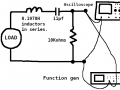
My current circuit consists of:
10K resistor
100mH + 47mH*2 + 4.7mH inductors == 0.1987H of inductance.
11pF capacitor (C0G).

Thanks
 

Ian0

Joined Aug 7, 2020
13,097
Most passive filter designs are matched to 50Ω or 75Ω loads.
If you redo your calculations for a lower impedance system, you will get component values that are more sensible.
11pF is probably less than the stray capacitance in the system so it will be difficult to make it work, and the intrawinding capacitance will be more than that. Check the inductors' datasheet and you will see that the inductance reaches a peak then reduces again - that is caused by intrawinding capacitance.
Smaller value inductors will more likely to be designed to work at 100kHz.
 

Papabravo

Joined Feb 24, 2006
22,058
Hello,
I'm working a bit ahead of where I am in my education. I wanted to design a bandpass filter that would pass 108Khz with a bandwidth of ~6Khz. I've done all the calculations based on this fine article by eepower -- including part tolerances (5%).

I'm confused about one thing. The test frequency of parts. I think it would matter, but it's unmentioned in the aforesaid article. The datasheets are not too useful, because the graphs they give are normally for the lower inductance parts. I find that most inductors I look at are tested at 10Khz. I have been careful to select parts with a higher SRF than my filter's pass frequency band of 108Khz.

How will this affect the filter?
Is there any advice you have regarding trying to create such a filter given that many inductors are tested at 10Khz?

My current circuit consists of:
10K resistor
100mH + 47mH*2 + 4.7mH inductors == 0.1987H of inductance.
11pF capacitor (C0G).

Thanks
You are mixing units in an expression, which is ALWAYS a bad and misleading thing to do. You have:
  1. 100mH - units of millihenries
  2. 47mH^2 - units of millihenries SQUARED
  3. 4.7 millihenries - units of millihenries
You cannot add millihenries to millihenries squared. The result is nonsense.

We're just a bit nuts on this point with homework problems where the manta is "ALWAYS CHECK THE UNITS"

Where is your schematic?? You should also have an expanded specification for the filter including the roll-off in the transition bands and the desired attenuation in the stopbands.

In addition, you should also check the Okawa-Denshi online filter design program when sketching out a design. If we had a schematic I could do it for you and even run some simulations.

Filter Design and Analysis
 

Ian0

Joined Aug 7, 2020
13,097
You are mixing units in an expression, which is ALWAYS a bad and misleading thing to do. You have:
  1. 100mH - units of millihenries
  2. 47mH^2 - units of millihenries SQUARED
  3. 4.7 millihenries - units of millihenries
You cannot add millihenries to millihenries squared. The result is nonsense.

We're just a bit nuts on this point with homework problems where the manta is "ALWAYS CHECK THE UNITS"

Where is your schematic?? You should also have an expanded specification for the filter including the roll-off in the transition bands and the desired attenuation in the stopbands.

In addition, you should also check the Okawa-Denshi online filter design program when sketching out a design. If we had a schematic I could do it for you and even run some simulations.

Filter Design and Analysis
He has TWO 47mH inductors he put *2 not ^2.
100mH+2*47mH+4.7mH = 198.7mH
 

Papabravo

Joined Feb 24, 2006
22,058
Two observations:
  1. Who puts the quantity after the units?
  2. ^ is not the only way to indicate exponentiation.
If the TS is going to be obscure, he should at least try to be obscure clearly.
 

Thread Starter

ballsystemlord

Joined Nov 19, 2018
249
Most passive filter designs are matched to 50Ω or 75Ω loads.
If you redo your calculations for a lower impedance system, you will get component values that are more sensible.
The resistance needs to be high in order to suppress the high voltage on the other side of the filter (I'll explain more below).

11pF is probably less than the stray capacitance in the system so it will be difficult to make it work, and the intrawinding capacitance will be more than that. Check the inductors' datasheet and you will see that the inductance reaches a peak then reduces again - that is caused by intrawinding capacitance.
Smaller value inductors will more likely to be designed to work at 100kHz.
I understood that.
Also, thanks for pointing out that it was 47mH TIMES 2 not raised to the second power (Now it's very clear).

At that frequency a Sallen-Key active-filter might be a better approach.
I don't think that's an option if I want to feed in a signal (I'll explain more below).


<snip>
Where is your schematic?? You should also have an expanded specification for the filter including the roll-off in the transition bands and the desired attenuation in the stopbands.
As I said, I'm working ahead of where I'm at in my books. I did all the calculations with a calculator using the aforementioned article's math equations. It was rather straightforwards, but I was a bit concerned that it was oversimplified, hence this post. I'll have to test the circuit and find out.

In addition, you should also check the Okawa-Denshi online filter design program when sketching out a design. If we had a schematic I could do it for you and even run some simulations.
Thanks for the link. I entered the filter values and found out that it's not quite as sharp a roll off as I'd like. I wanted something more in the line of 48db or more outside of the frequency band.

bandpass-filter.png
This is purely for educational purposes (and it would be very educational, I assure you). I wanted to measure the inductive value of a motor under load. This would mean the filter would be exposed to 250vAC on the incoming side (Yes, that is the known actual value). I intend to feed in a signal from my function gen of a sine wave of 108Khz, possibly through a 20db amplifier (not pictured). This would give me 5 readings per pole, 6 poles total (3-phases, only one pictured above with it's star ground). I would then receive the waveform using my oscilloscope and, based on the XL value of the motor, I could calculate the relative inductance.

Thanks again!

PS: The motor is being driven from a pump drive. Thus the need for bandpass instead of highpass.
 

Thread Starter

ballsystemlord

Joined Nov 19, 2018
249
There is some evidence in the TS's response that he was not exactly clear what he meant when he put "*2" after the units.
I was trying to be accommodating. I was hoping to get back to the question and avoid any additional misunderstanding. If you thought I meant something else, correctly or by mistake, that's okay. It's straightened out now.
 

Ian0

Joined Aug 7, 2020
13,097
This is purely for educational purposes (and it would be very educational, I assure you). I wanted to measure the inductive value of a motor under load. This would mean the filter would be exposed to 250vAC on the incoming side
Divide the voltage using resistors, that would mean that the impedance driving the filter would be much lower. And it would also mean you could use an active filter.
But - the usual way to measure the inductance of a motor under load is with a power factor analyser. If you measure the current and voltage at mains frequency you can calculate the power factor, and a little bit of vector calculations gives you the resistive and inductive parts.
 

Thread Starter

ballsystemlord

Joined Nov 19, 2018
249
Divide the voltage using resistors, that would mean that the impedance driving the filter would be much lower. And it would also mean you could use an active filter.
Using a voltage divider of 10 to 1 (so only 25v on the filter side), would mean 90% of the power I would try and feed into the circuit would go through the lower impedance path. Although I might try it, I'm concerned I'd be measuring too close to the noise floor.

But - the usual way to measure the inductance of a motor under load is with a power factor analyzer. If you measure the current and voltage at mains frequency you can calculate the power factor, and a little bit of vector calculations gives you the resistive and inductive parts.
My oscilloscope can do power factor analysis (IDK at what rate it updates the analysis). But it's only a 4 channel scope and I'm trying to analyze 3-phase power, therefore... I MUST buy a new scope!!! Yay!!!
 

Ian0

Joined Aug 7, 2020
13,097
Using a voltage divider of 10 to 1 (so only 25v on the filter side), would mean 90% of the power I would try and feed into the circuit would go through the lower impedance path. Although I might try it, I'm concerned I'd be measuring too close to the noise floor.
Thermal noise floor for 50kHz bandwidth and 1k resistance = -121dBV
Signal @ 25V = +28dBV
So you have 149dB SNR to go at. If there are any harmonics at 150dB below the fundamental, I wouldn't worry about them.
Noise floor is the least of your worries. With inductors that size, inductive pickup is going to be a real problem, and without mu-metal screening you won't get anywhere near the noise floor.
 

Thread Starter

ballsystemlord

Joined Nov 19, 2018
249
Thermal noise floor for 50kHz bandwidth and 1k resistance = -121dBV
Signal @ 25V = +28dBV
So you have 149dB SNR to go at. If there are any harmonics at 150dB below the fundamental, I wouldn't worry about them.
Noise floor is the least of your worries. With inductors that size, inductive pickup is going to be a real problem, and without mu-metal screening you won't get anywhere near the noise floor.
It appears that I confused you.

The 25v figure was for the incoming power from the pump drive (post voltage divider), going into the filter and then the remainder of that would be going into the oscilloscope, not the signal I was planning to feed into the system, which would be about 12v (unless I had much bigger amplifiers). 90% of the wattage of that 12v signal at 108Khz would, in a 10 to 1 voltage divider, go through the 1k resistor (the other resistor being 10k). But that's without considering the pump and the star ground config I'd need to use.

The noise floor I was referring to wasn't the resistor's, so much as it was the fact that I'd be measuring the resistors' impedance, not the pump's. To get to the pump, the power would need to go through the 10k resistor in a voltage divider, through the pump, and through the other two 10K resistors and their associated 1K resistors for a star ground configuration.

The noise of the 10K resistor at 108Khz would be -105.98dbV or ~5uV and the 1K would be -115.98dbV or ~1.6uV (at 150C). Using a star ground would mean that my input would have to flow through the other 10K resistors and 1K resistors, bringing the thermal noise floor up to 13.2uV or about -97.59dbV. My input signal to the system would be ~12v, which would be about -8.42dbW through the 1K resistor. But the signal that goes through the pump would be limited to about -20.32 dbW. That's not a whole lot of power. I'd be trying to measure a 9mW signal superimposed on top of a 144mW signal plus whatever the filter couldn't filter out plus the thermal noise of the resistors. I'm concerned that the 144mW signal alone will create too much noise to measure the 9mW signal.

It's that -20.32dbW signal feedback level which concerns me. I'd need to feed enough power into the system to measure the inductance. That means being able to interact with the magnetic fields. I'm uncertain what the minimum input power to the motor should be to be able to interface with the magnetic fields inside of the motor. If I am to take measurements like this, another goal must be to keep the power low enough so as not to disturb the internal workings of the motor to a significant effect. I can't just blast power at it.

With my own idea of using a series RLC filter, I'd be looking at about -6.2dbW (240mW) of signal going into the pump. As you might imagine, this is a huge step up. I'm going from under 1mA, with the voltage divider, to 20mA of current with the RLC filter. Again, IDK what power level I should be aiming for.

Thanks!
 
Last edited:
Top